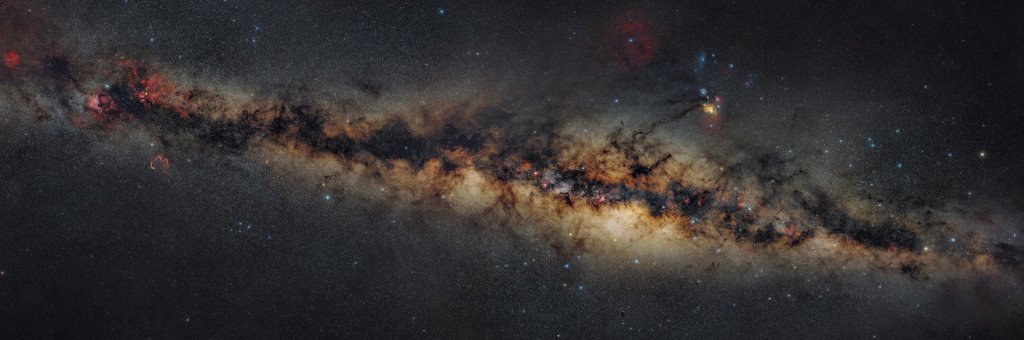
The Milky Way – Courtesy Andrew McCarthy, on X @AJamesMcCarthy
Summer can be a frustrating time for Arizona astronomers. Afternoon thunderstorms roll across the high desert with little warning, and many evenings that begin with promise end beneath a blanket of clouds. Yet every so often, the storms move on, the air settles, and the night sky opens above us. When it does, one of the finest sights in astronomy stretches from horizon to horizon.
The Milky Way.
People have looked up at this hazy ribbon of light for thousands of years. The ancient Greeks imagined it as milk spilled across the heavens, giving our galaxy the name we still use today. Other cultures saw it as a river, a road, or a bridge connecting Earth with the spirit world. Long before telescopes, it inspired people to wonder what lay beyond the stars.
Today we know the answer is even more remarkable than the legends.
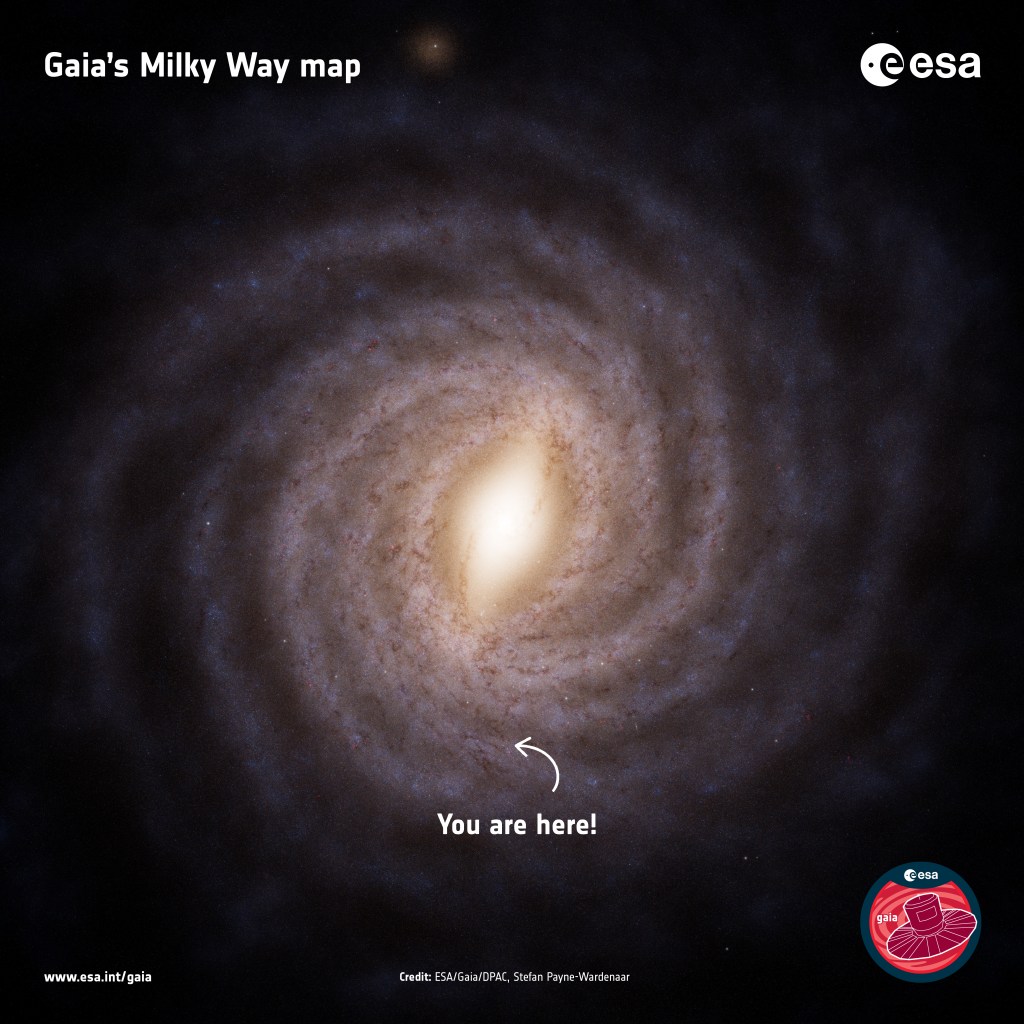
Gaia’s Milky Way Map – Courtesy ESA.
The Milky Way is our home galaxy, containing hundreds of billions of stars along with vast clouds of gas and dust. Unlike the beautiful spiral galaxies we see in photographs, we don’t have the luxury of viewing our own from the outside. Instead, our Solar System sits within one of its spiral arms, about 26,000 light-years from the galactic center. When we look toward the Milky Way, we’re looking across the disk of our own galaxy rather than at it from afar.
That soft glow isn’t a cloud. It is the combined light of countless distant stars, so numerous and so far away that our eyes blend them into a single band crossing the sky.
Running through that river of starlight are dark gaps that seem almost empty. In reality, they are enormous clouds of dust drifting between us and the stars beyond. Hidden inside many of those clouds are stellar nurseries where gravity is quietly shaping new generations of stars and, perhaps, future planetary systems.
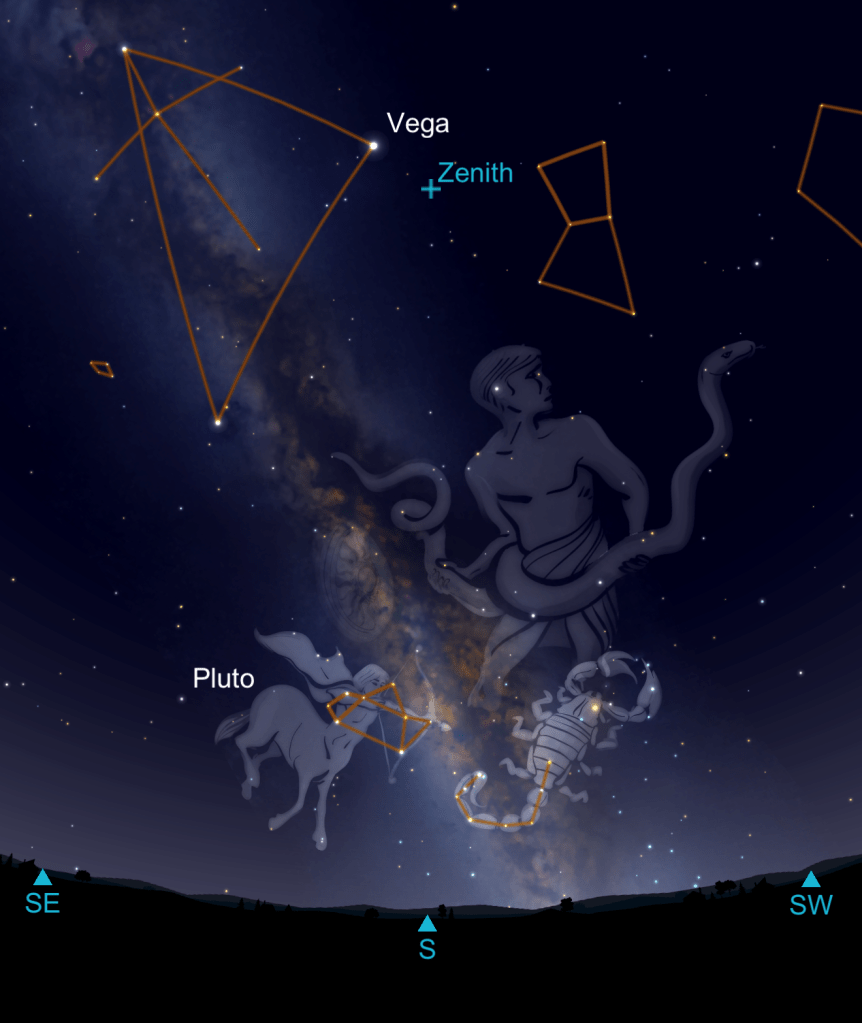
August 15th sky over Yavapai County – SkySafari Pro.
August offers some of the year’s finest views of this celestial landscape. Shortly after darkness falls, look low to the south for the constellation Sagittarius. Its brightest stars outline the familiar shape of a teapot. Follow the “steam” rising from its spout, and you’ll be looking toward the center of the Milky Way, some 26,000 light-years away.
From there, let your eyes wander north through Aquila and into Cygnus, the Swan. A pair of binoculars will reveal rich star fields, sparkling open clusters, and bright patches of nebulae that are easy to overlook with the naked eye. You don’t need expensive equipment to appreciate the view. Sometimes the best instrument is simply a comfortable chair and a dark sky.
Shot from a cinder hill near the San Francisco Peaks, in the Flagstaff Ranger District, Coconino National Forest. We went out around sunset to view Comet NEOWISE. Photo by Deborah Lee Soltesz, July 14, 2020.
One of my favorite moments is sharing that view with someone seeing the Milky Way under truly dark skies for the first time. There is usually a quiet pause as they realize they aren’t looking at some distant galaxy. They’re looking out across the one we call home.
If the monsoon clouds give you a break this month, spend a few minutes under the stars before setting up the telescope. Some of the most memorable nights in astronomy begin with nothing more than looking up.
Arc To Arcturus, Spike To Spica: Tracing A Line Through The Stars And American History This Independence Day– A Backyard Astronomer Special
The Declaration of Independence, John Trumbull.
The Big Dipper is one of those patterns that seems almost permanent once you learn it. Tonight, it is easy to pick out from a backyard in Arizona. It was just as easy to find from the deck of a wooden ship crossing the Atlantic in the 18th century, where a clear northern sky and a steady horizon were often all a navigator had to work with.
It does not take much imagination to picture that same shape hanging over tall ships, guiding long crossings when coastal lights did not exist and shorelines were still uncertain. Polaris would have carried the weight of navigation, but the Dipper was the pointer, the familiar signpost rotating quietly around the pole night after night.
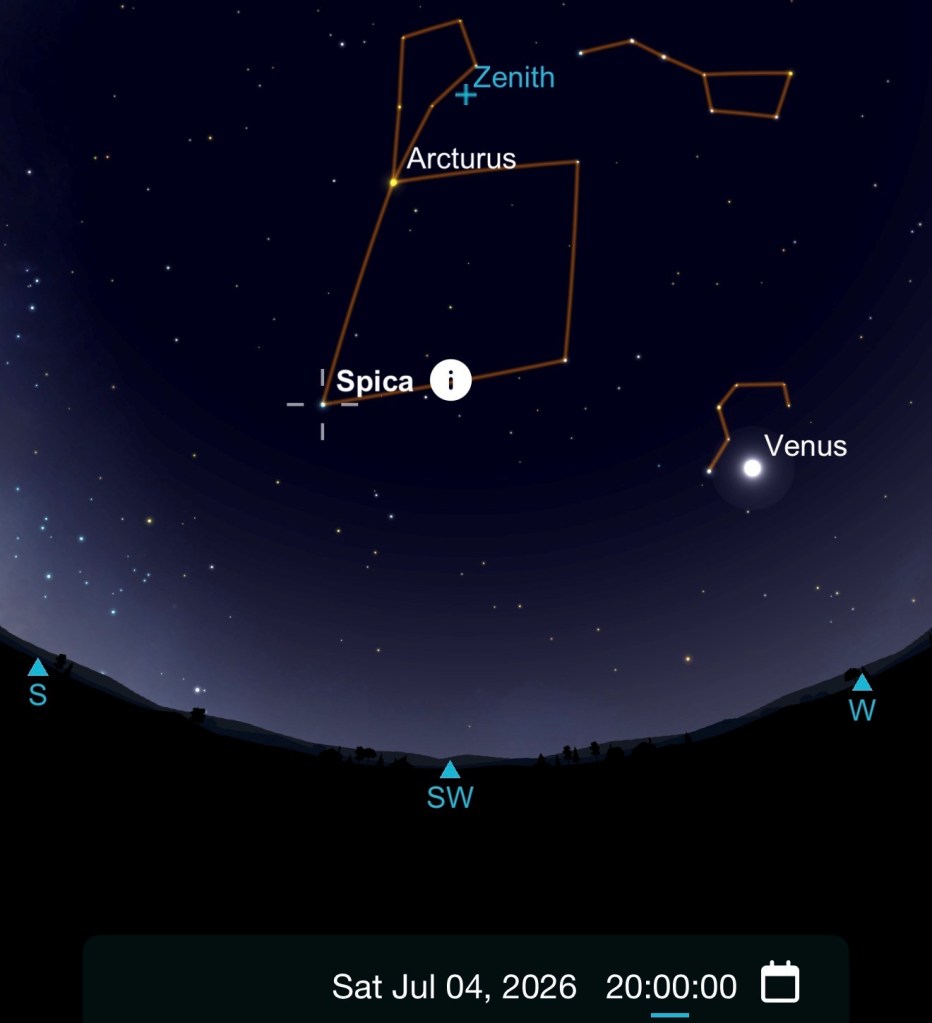
From that same pattern, the first step is simple. Follow the arc of the Dipper’s handle outward and it lands on Arcturus.
Arcturus is one of the brighter stars in the northern sky, and once you’ve identified it a few times, it becomes almost impossible to miss again. It sits about 37 light-years away, which means the light reaching us now left that star in the around 1989. That is recent enough to overlap with a world that already feels familiar—satellites, early personal computers, the modern shape of global communication beginning to settle into place.
A lot has shifted since then, but not in ways the photons themselves could have witnessed. The light arriving at your eye is unchanged; the context around it is not.
Extend that same arc a bit farther, and the line continues toward Spica.
Arc to Arcturus, Spike to Spica. Sky oriented to Northern Arizona, 07/04/2026 at 8PM. SkySafari Pro.
Spica is farther still, sitting roughly 250 light-years away. That distance places its light near the same point in time when the light of American independence first began its journey.
When that light began its journey, the United States did not exist. The idea of it was still forming, debated, and untested. Since then, the country has expanded, fractured, reformed, industrialized, digitized, and extended its reach far beyond anything imagined at the time. Through all of that, the photons from Spica have been in transit, moving steadily outward with no awareness of the changes unfolding beneath them.
So on a clear July night, there is something quietly fitting about that line across the sky. A simple hop from the Big Dipper leads to Arcturus, a relatively nearby star with light that has been traveling since late 20th-century Earth. Extend it again and you reach Spica, whose light has been en route across the entire span of American history.
Arc to Arcturus. Spike to Spica. A navigational trick, yes, but also a reminder that when we look up, we are never really looking at “now.” We are looking at layered history, arriving one photon at a time.
On Independence Day, the contrast feels sharper—an old sky overhead, and a relatively young nation still writing its own light into history.
Adam England is the owner of a local financial services firm and moonlights (pun intended) as an amateur astronomer, writer, and interplanetary conquest consultant. Follow him on Instagram @TheBackyardAstronomerAZ and at http://www.Manzanita-Insurance.comhttp://www.ManzanitaAccounting.com
Most everyone on Earth can pick out a few basic star clusters, constellations, or asterisms, despite their respective language, culture, or even level of education. Orion’s belt is probably the most common of these, with the three bright stars Alnitak, Alnilam and Mintaka forming a near perfect line in our Northern Hemisphere winter, but visible from latitudes spanning most of our planet. Similarly recognizable at the same time of the year is the Pleiades star cluster. Rising in the East about an hour before Orion, we know the Pleiades as the “Seven Sisters” of Greek mythology, and the tight grouping of six bright blue stars has been an easy waypoint for seafarers, farmers, fisherman, calendar makers and sages for thousands of years.
Orion chasing the Seven Sisters, Courtesy WikiHow.
Let’s back up to that last sentence – “Seven Sisters” and yet only six bright stars? Didn’t the Ancient Greeks discover all sorts of advanced mathematics? Certainly, they knew the difference between 6 and 7.
Turns out, the Greeks weren’t the only ones in this conundrum.
Danish folklore tells of six brothers who rescue a kidnapped princess, and torn between which brother she likes best, God offers for all seven to live forever together in the heavens.
In Ukraine, the legend includes seven maids who so beautifully danced and sang to honor their gods that upon their deaths, they were brought to the stars to continue dancing for eternity.
The Nebra Sky Disc was found by metal detectorists in Germany in 1999, dated to around 1600 BC, and is recognized as the oldest depiction of astronomical phenomena, including a grouping of seven stars believed to represent the Pleiades.
Jumping continents, the Cherokee warn rambunctious children to behave with the story of the Seven Boys, six of whom flew off to heaven, with one being pulled back down to Earth by his mother, becoming the first pine tree.
Stretching even further across vast oceans and time, the Aboriginal peoples of Australia have various regional stories of the Pleiades, including seven sister who first learned to make fire, and separately, seven sisters who fled from the unwanted attention of a man chasing them. This is strikingly similar to the Greek story of Orion the Hunter chasing the daughters of Pleione.
It wasn’t until Galileo first gazed at the cluster though his rudimentary telescope in 1610 that he observed 36 stars in this grouping, and we now count more than 1,000 stars in this stellar nursery.
So how did all of these ancient cultures, separated by thousands of miles and thousands of years, all include seven stars in their stories, while only able to see six with the naked eye?
Computer modeling of this volatile region of space shows that while some stars have moved further apart in the relatively young 100 million years since their cosmic birth, others have been pulled closer together by gravity. Nearly 100,000 years ago, as viewed from prehistoric Earth, the star Pleione would have been discernible as a separate, seventh star from its current position close to Atlas, which we see today as a double star through our binoculars and telescopes. As such, archeoastronomers have posited the theory that the origins of these stories may well predate any object, culture or language we know of, and that the genesis of the seven stars may have traveled across the globe with our earliest ancestors 100 millennia ago.
Adam England is the owner of Manzanita Insurance and Accounting and moonlights as an amateur astronomer, writer, and interplanetary conquest consultant. Follow him @ Facebook.com/BackyardAstronomerAZ and Instagram.com/TheBackyardAstronomerAZ
The ancients clearly had two things going for them: wonderfully dark skies and fantastic imaginations. It can often be difficult for the modern backyard astronomer to pick out constellations and imagine a Great Bear, a Hunter, or a horse with wings, just by connecting the twinkling dots in the sky. Light pollution certainly has an impact on our ability to decipher some of these celestial images, with brighter lights preventing us from seeing many of the dimmer stars in the sky. Some online tools can help one find relatively dark areas for astronomical viewing, such as lightpollutionmap.info, where one can see the major metropolitan areas of the Southwestern United States pockmarked against the more desolate (and DARK!) regions that may be just a short drive away. Even with our good fortune to live in a fairly dark area, some of those constellations can still be a challenge.
For this astronomer, Pegasus is one of these constellations. Usually depicted upside down between the neighboring Aquarius to the south and Andromeda to the North, and bordered by the two fish of Pisces to the East, I still have a difficult time coming to the same conclusion of a winged horse when I look to the South during the Fall. Alternatively, I can quickly pick out the four bright stars that form a near perfect square – the asterism oft referred to as the Great Square of Pegasus. Roughly outlining the body and wings of a sensational stallion, two white and one each red and blue stars denote the corners of this heavenly box, residing just above the ecliptic. You can follow the stars off the southern and western corners to envisage the head and front legs of this airborne equine. As you explore around the Great Square, there are a may dark sky objects you can find.
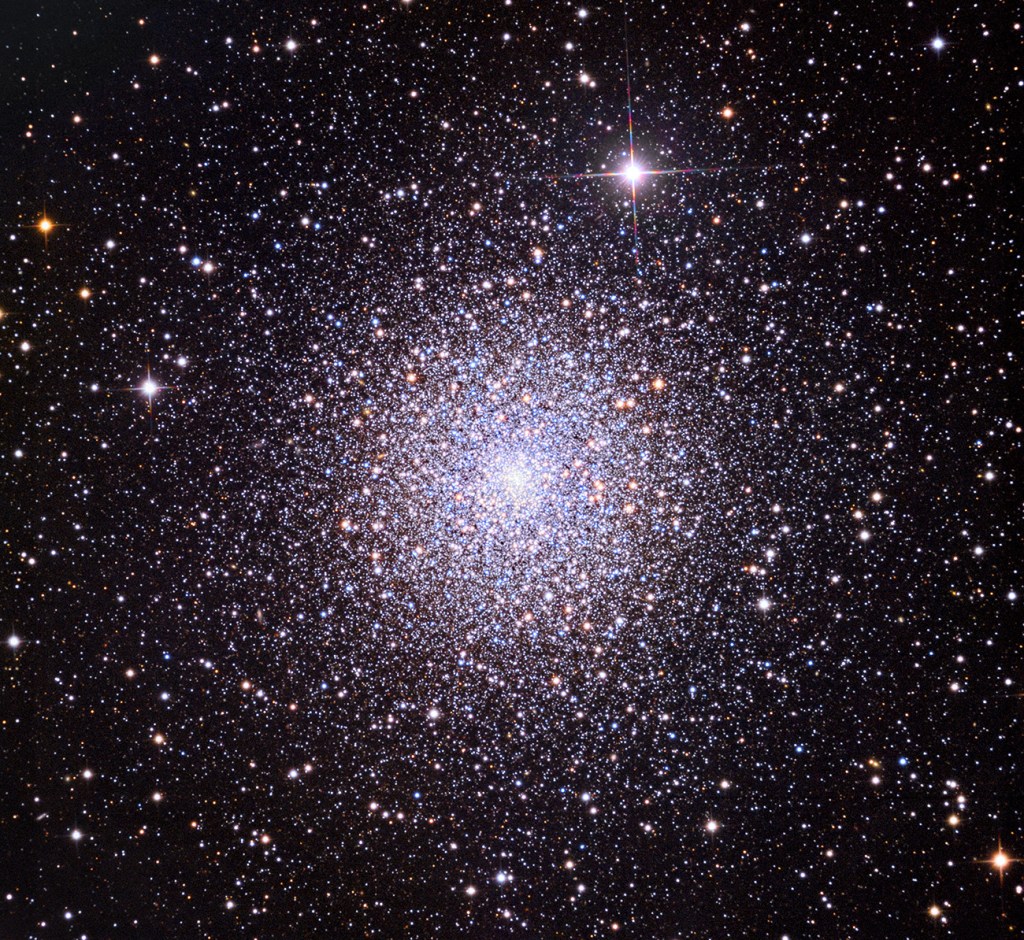
M15, Courtesy Adam Block, Mount Lemmon.
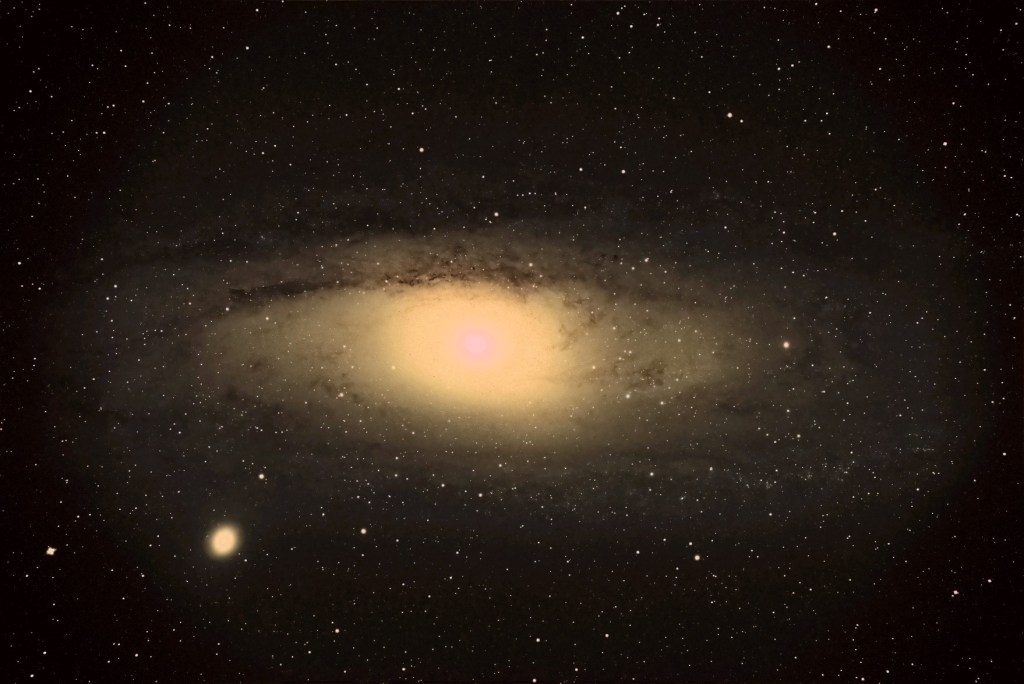
Moving to the Southwest of the Great Square is the red star Enif, marking the horse’s muzzle. Just to the west of this star is M15, a prime target for fans of globular clusters. Do you prefer galaxies? Look to the North of the bright white star Alpheratz, the top corner of the square, and you can find M31, the Andromeda Galaxy, the closest galaxy to our own Milky Way. You can also use the square to guide you to other objects, such as the Triangulum Galaxy. Draw a line between the top two stars in the sky, look approximately the same distance east, and you will find one of the only deep sky objects which – with dark skies and good vision – humans have been able to see with the naked eye for thousands of years, even if they did not yet know what it was.
M33, courtesy Joel Cohen, Prescott Valley, AZAndromeda Galaxy, courtesy Joel Cohen, Prescott Valley, AZ.
The Ancients observed many of the same “naked eye” phenomena that we also see today, and although their understanding of these astronomical events was limited, they knew something unique was occurring. Episodes such as a lunar or solar eclipse or the passing of a comet could be seen as messages from the heavens, heralding great events or omens of destruction. We know now that these astronomical events have no impact on the sociopolitical landscape, nor do the stars you are born under determine specific personality traits, however it was by tracking these happenings that patterns began to emerge.
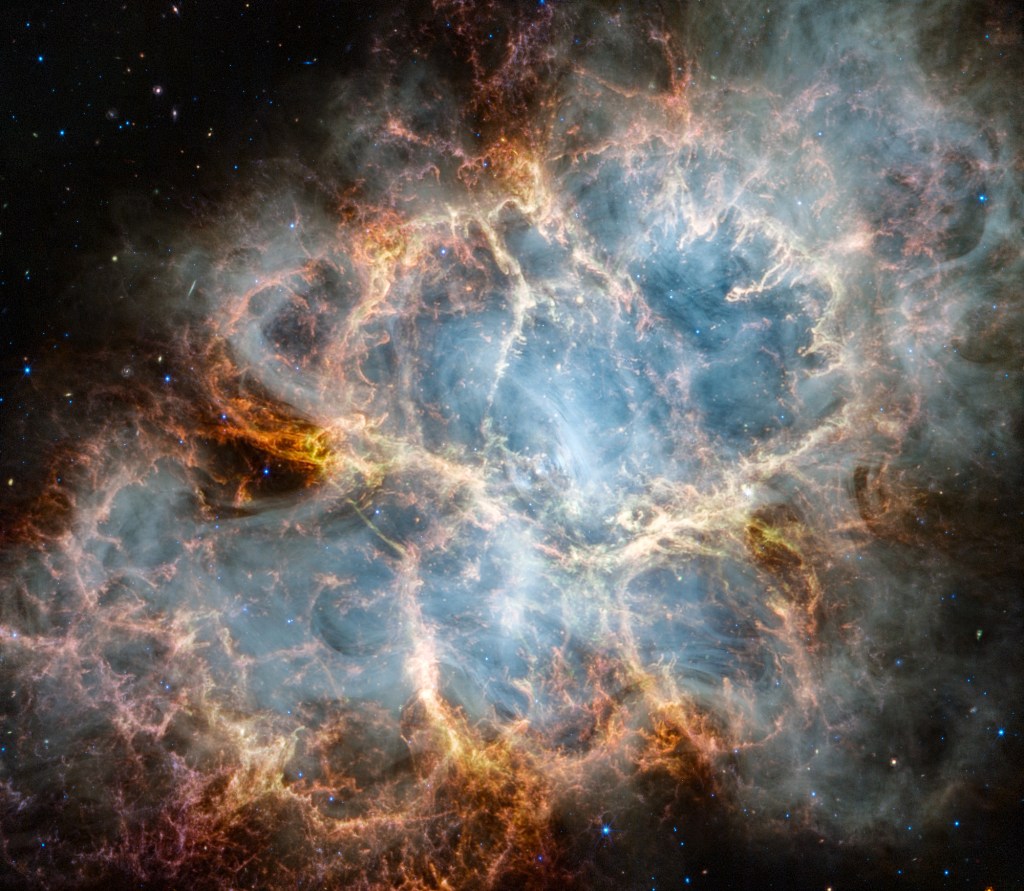
Crab Nebula, courtesy NASA James Webb Space Telescope.
Meteor showers were one of the first sights to be known as regularly occurring. As humans worldwide saw these recurring fireballs seasonally and in specific parts of the sky, we refer to most meteor showers based on the constellation they appear to stem from. Likewise, astronomers from many cultures documented a “guest star” that appeared on 10 July 1054 and continued to shine bright through April 1056. Compiling astronomical records from Chinese, Islamic, European, and Native American cultures lead us to the Crab Nebula, giving us nearly 1000 years of recorded history of this distinctive event.
Artist rendering of nova, courtesy of NASA
Other novae have been registered in the same location many times over the centuries. Where a supernova registers the end of a star’s life as it bursts into a nebula, a recurrent nova continues to feed off a neighboring star again and again, establishing a pattern of brightening and dimming. Enter T Coronae Borealis stage left.
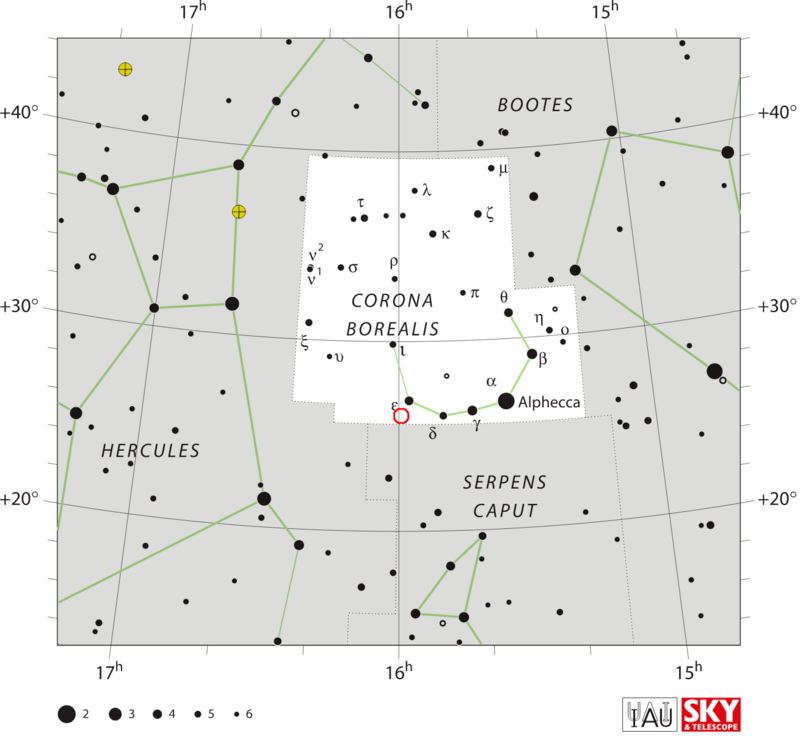
Location of T Coronae Borealis, courtesy of IAU.
The small constellation Coronae Borealis – The Northern Crown – is essentially 7 stars in a semicircular arc, filling the space between Hercules and Boötes. This void contains just a few faint galaxies that are difficult for even seasoned backyard astronomers to view, but one of the stars holds a secret. Every 78 years, T Coronae Borealis or the Blaze Star suddenly brightens from a dim magnitude 10 to a peak of near magnitude 2. The smaller, hotter white dwarf continuously sucks the outer layers off the larger, cooler red giant, separated by only have the distance from the Earth to the Sun, forming a large accretion disk surrounding the white dwarf, and all hidden away inside a thick cloud of gas and dust. After slowly devouring its larger neighbor for three quarters of a century, the white dwarf gets stellar indigestion and ejects huge volumes of material into the cosmos, brightening tremendously as it does. This recurrent brightening has been documented by astronomers in 1866 and 1946, with historical records dating as far back as 1217 recording a similar event in the same part of the sky likely to be the Blaze Star. We can’t predict exactly when this will happen, so keep your eyes to the Northern Crown and Blaze Star this summer for an extra special surprise.
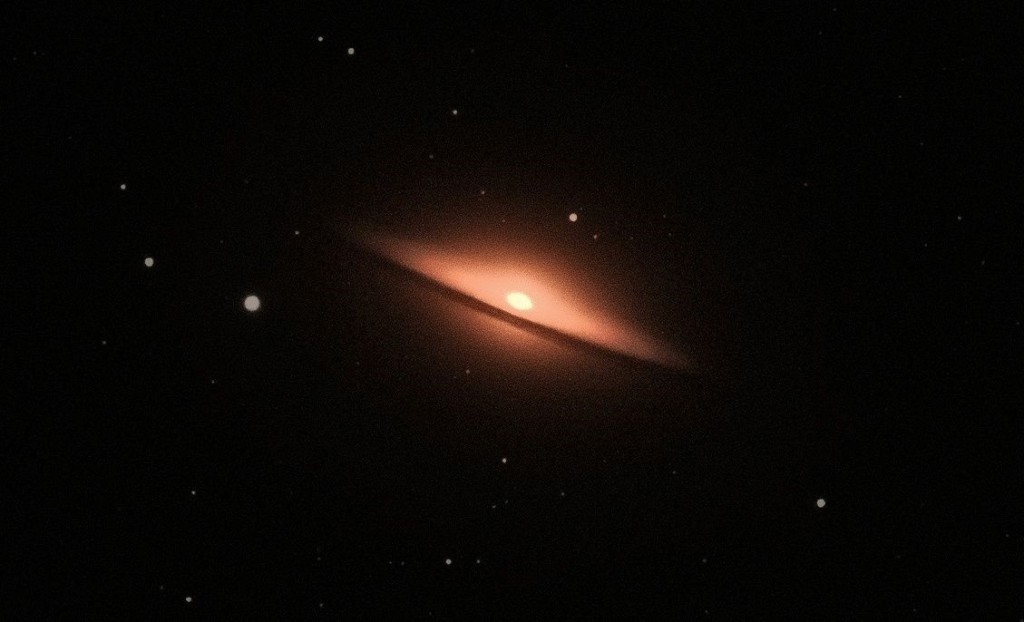
M104 Sombrero Galaxy, courtesy Joel Cohen, Prescott Astronomy Club. Taken from Prescott Valley, AZ with Astro-Physics Starfire 178 7-inch f/9 APO.
The late 18th Century was a golden age of astronomical discoveries. After Galileo famously pointed his early invention at the heavens in 1609, Dutch glassmakers spent decades perfecting the lens technology that allowed for larger telescopes and more precise visual observations. Every reigning monarch in Europe just had to have the latest and greatest telescopes, observatories, and professional astronomers at their personal disposal, and all of these eyes on the sky began to record diverse celestial phenomena. Astronomers the world over spent night after night gazing at the heavens and journalizing their observations in both the written word and sketches. With no “astronomy buds” group texts, mass peer emails, or posts of their findings on social media, the spread of these discoveries often took years for a publication to disseminate throughout the powerful capitals which fostered the Age of Enlightenment. As such, it was quite common for multiple observers to happen upon the same fuzzy patch of sky and note their unique, personal discovery. Essentially an informal and independent peer review, many of the nebulae, galaxies, comets, and even planets that we are so familiar with today were found in this manner. The Sombrero Galaxy is one such amazing find that you can also discover as a modern backyard astronomer.
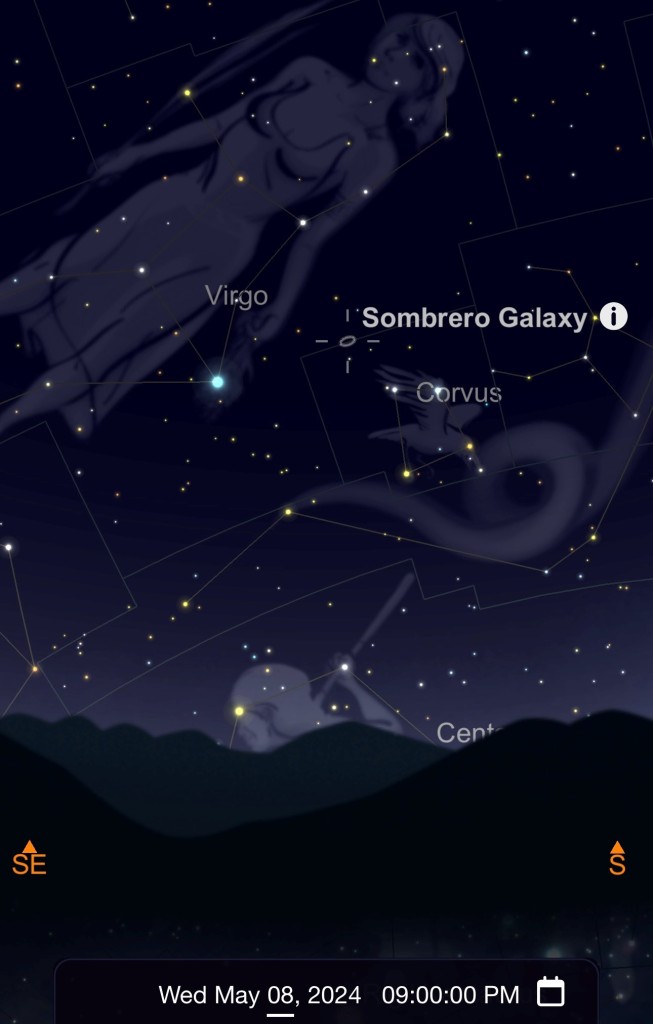
M104 Sombrero Galaxy location on the night of 8 May 2024, SkySafari.
Scientifically catalogued as Messier Object 104 (M104), it was independently discovered by no less than three separate astronomers between 1781 and 1784. Charles Messier himself noted and dismissed the Sombrero Galaxy, as he quickly discerned it was not a comet like those he was actively searching for. Viewed from Earth, this galaxy is seen edge-on, and its full breadth of approximately 100,000 light years is observed as a thin strip of light. Compared to a face-on galaxy, where the stars are spread across a much larger swath of space, edge-on galaxies appear brighter and are often easier for the amateur astronomer to locate. With a 100mm/4inch telescope, one can pick out this illuminated belt separate from the surrounding stars. 11.5° west of the bright blue-giant star Spica and 5.5° north-east of Eta Corvi, it is situated in the space between the hand of Virgo and wing of Corvus. Take advantage of the May 8th New Moon for extra dark skies and look to the SSE in the 9 o’clock hour. If you have a telescope in the 8” range, you will begin to discern the galactic center bulging around the supermassive blackhole that gravitationally binds the galaxy. It is this dense, bright nucleus resembling the crown of a hat from which the name is derived. 10” and larger scopes with optimal viewing conditions will also discern the dust lane, a dark swath of dispersed material that encircles the galaxy. This strip of darkness is mostly composed of molecular hydrogen and primordial dust, and infrared astronomy has revealed it is the primary nursery for the birth of new stars around the circumference of the Sombrero Galaxy. It is by studying these stellar generating regions that we can begin to understand the process by which our own Sun and solar system were formed, and our place within the Milky Way Galaxy and the Universe.
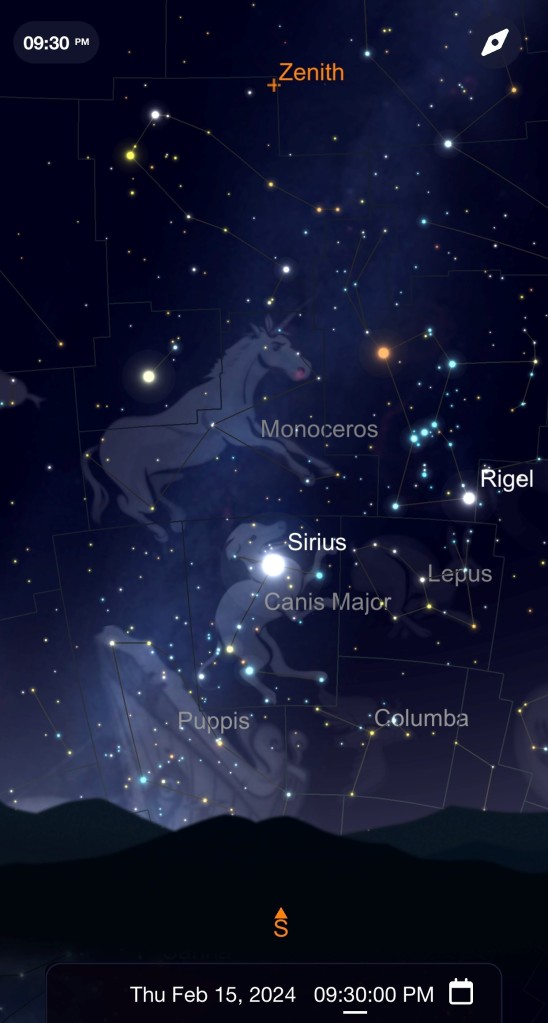
A lesser-known and relatively modern constellation occupies the void between Orion, Canis Major, Hydra and Gemini, though the stars are difficult to see with the naked eye due to modern light pollution. Monoceros – mono meaning “one” and ceros meaning “horn” – the Unicorn is a simple 7-point constellation, though only two of the stars are usually discernible without the aid of binoculars or a telescope. Coined by Dutch cartographer Petrus Plancius in the 17th century, Monoceros contains many intriguing objects for the amateur observer.
The nose of the unicorn is quite easy to locate. Start with the bright orange shoulder of Orion, the easily identifiable star Betelgeuse and the dimmer blue star Meissa that marks the Hunter’s head. Draw a line from Meissa to Betelgeuse, continuing nearly that same distance again to the Southeast of Betelgeuse to find the binary system ε Monocerotis, denoting the nose of the unicorn. Just a slight look continuing to the east will place the Rosette Nebula in your view.
Orion and Monoceros, SkySafari, 2/15/2024.
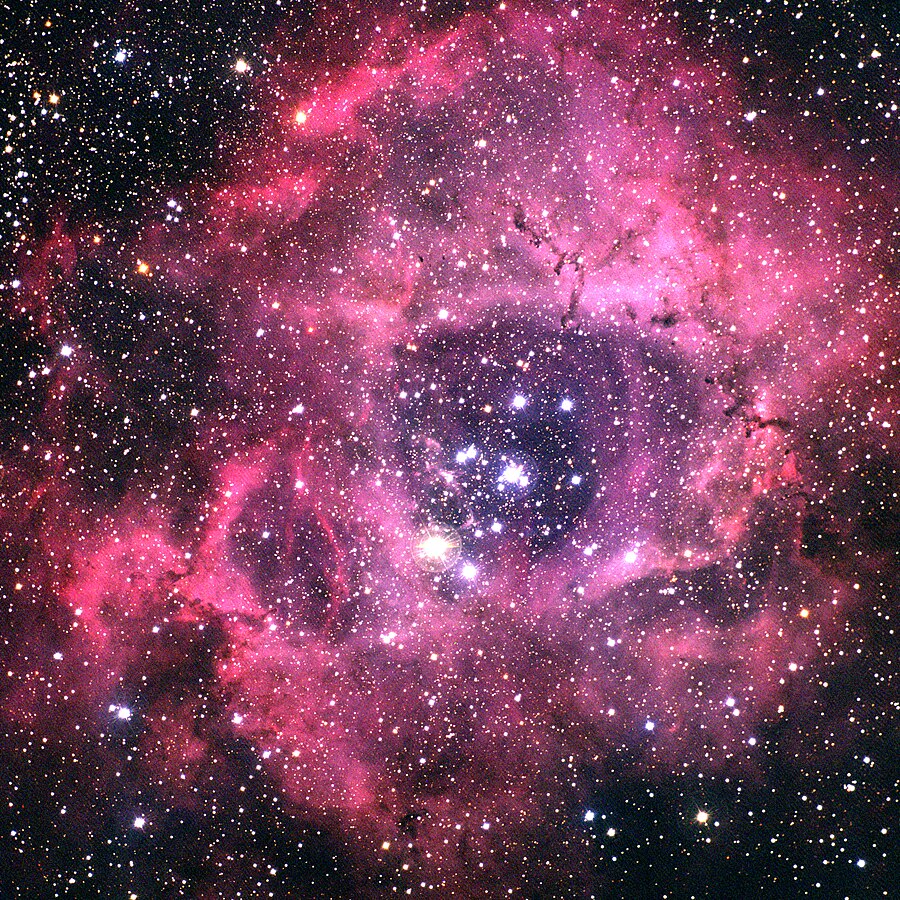
About 5,200 lightyears distant, the Rosette Nebula takes its name from the stylized floral design, often seen as a textile rose awarded for competitions. English astronomer John Flamsteed first noted the nebula in 1690, noting its circular shape and dark center, reminiscent of a rose. Approximately 130 lightyears across, this emission nebula is a star nursery, estimated at a mass of more than 10,000 solar masses, or the equivalent of 10,000 of our suns. The intense radiation of the juvenile stars in this densely packed space excites the molecules in the clouds of gas and dust around them, off putting more and more radiation in a chain of events that continuously sends ever increasing quantities of ultraviolet and x-ray radiation in all directions. For us, this equates to a beautiful nebula, perfect for our viewing pleasure. At apparent magnitude of 9.0, even small telescopes can resolve this stellar breeding ground.
Enjoy the Rosette Nebula, Monoceros, and the Orion constellation in the Southern sky in the early hours of the evening throughout the month of February. Wishing you clear skies!
From double full super moons to ringed giants at opposition, August was full of local events in our Solar System, whereas September takes us back to some amazing deep sky objects. Many of the best clusters and nebulae lie along the galactic plane, easily identifiable in the sky as the Milky Way. While one can technically define the Milky Way as everything around us, the vast swath painted across the night sky represents the edge-on view of much of our galaxy, given Earth’s position somewhat centrally located on what we call the Orion Arm of our barred spiral galaxy. Being in the middle of all the action, looking toward this denser region of stars offers the casual viewer opportunities to pick out many more “faint fuzzies”.
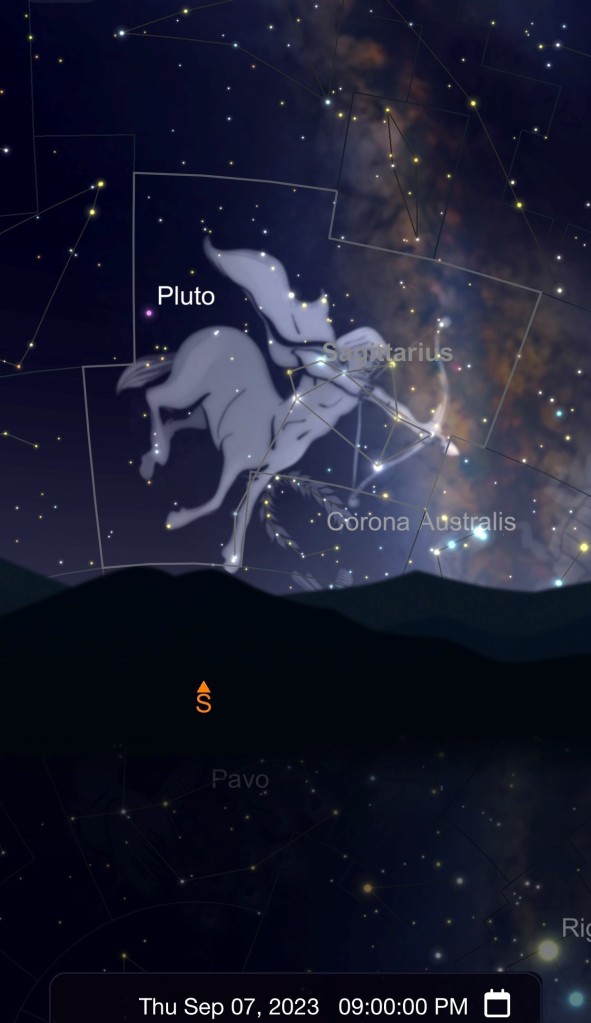
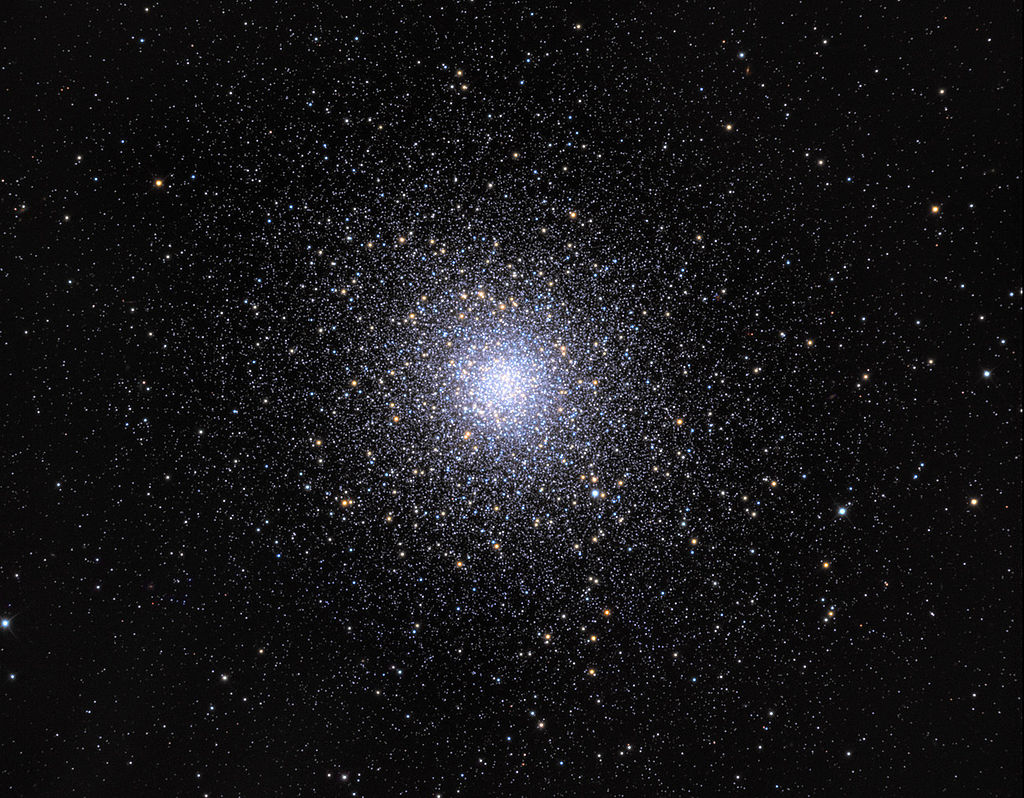
The constellation Sagittarius borders the Western edge of the Milky Way, pointing his bow and arrow into this hotbed of stellar activity. Hundreds of stars inhabit this constellation, with 17 making up the primary outline of the centaur archer. More easily identifiable are the 8 primary stars that make up the “Teapot” asterism, which defines the torso and bow of the Archer. Within or abutting the Teapot are five Globular clusters, catalogued by Charles Messier as M22, M28, M54, M69 and M70. The clusters of stars are only a few light years across yet are packed with thousands or even millions of stars orbiting the galactic center together. To the naked eye, these may seem like a single star, then binoculars will show the observer a fuzzy cotton-ball like image, and larger telescopes will begin to resolve many of the individual members of these heavenly neighborhoods. Use your binoculars or a wide-angle eyepiece on your telescope to scan the Teapot and see how many star clusters you can find.
Globular Cluster, Courtesy Mount Lemmon Steward Observatory.
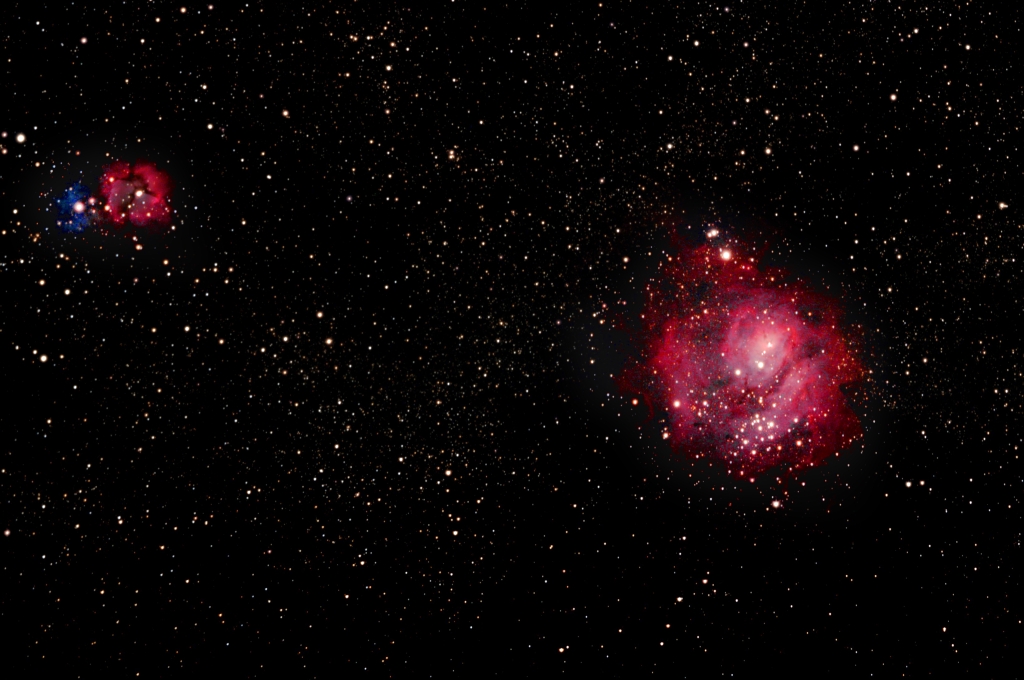
The stellar life cycle may begin or end with a large cloud of gas and dust, either coalescing over millions of years into stars and planets, or inversely created when a star runs out of fuel and collapses in on itself, exploding in one of the universe’s greatest displays of light and energy. These clouds are known as nebulae, Latin for “mist” or “fog”. As you peruse the Teapot and Milky Way, areas of light and dark gas will highlight against the dark backdrop of space. The Lagoon Nebula is visible to the naked eye in the darkest skies and is a perfect starting point for the amateur astronomer. As an emission nebula, it has a pinkish hue created by the ionized particles coming off nearby stars. Separately, the Trifid Nebula is a combination emission and reflection nebula, appearing both pink and blue as you scan the region. Also containing an open star cluster, the Trifid Nebula is a late summer favorite among many astronomers.
Trifid Nebula and Lagoon Nebula, Gary Jones, Wikimedia Commons.
So, remember to look to the South, for the teapot pouring out the milk, and you will be locked on to some of the greatest views in the Northern Hemisphere summer.
The Greeks coined the term planetes – meaning “wanderer” – to describe the objects they saw in the sky that regularly moved against the background of the other, fixed stars. Over time, this included many bodies that wander across the night sky, including the moon, Mercury, Venus, Mars, Jupiter, and Saturn, as well as smaller bodies like Sedna, Eris, Ceres, and Pluto. The strict definition of a planet has caused heated debates between individual astronomers, professional observatories, and universities, which have pockmarked history like the craters of our Moon. The International Astronomical Union, or IAU was founded in 1919 as a consortium of astronomers from all over the world, with the mission of cooperative astronomical “research, communication, education and development”. As such, the IAU has become the definitive organization for the uniform classification and naming of our continued discoveries across space.
Since the first telescopes appeared around 1608, we have been able to observe much more than the easily visible stars that have graced our skies and mythologies for thousands of years. Commonly known stars such as Polaris, Betelgeuse, Rigel, and Vega were soon joined by many hundreds of others, which were often assigned designations, usually relative to the name of the discoverer, and the chronology of which it was discovered. For example, German astronomer Wilhelm Gliese (pronounced GLEE-zə) published a 1957 catalogue of 915 stars that were within 20 light years of Earth, essentially our closest stellar neighbors. The majority of these continue to carry designations like Gliese 436, being the 436th star listed in the catalogue. Not nearly as fun to say as Betelgeuse, the IAU has developed periodic naming competitions for some of the more interesting and commonly studied of these many thousands of additional stars sans moniker. Astronomers, educators, students, and laypeople alike contribute to these competitions, with the winning epithets from around the world are now represented in the heavens.
In 1992, the first exoplanet was confirmed. Exo being the Greek for “outside”, the IAU has defined an exoplanet similar to that of a planet, being a body which regularly orbits its host star, with a gravitational pull great enough to have cleared its orbit of other smaller bodies, and with the caveat of existing outside of our own solar system. Finding these exoplanets is difficult, and only a handful have been directly imaged. Most are discovered through various methods including how their gravity tugs on a star as it orbits and making the host star “wobble”, or by measuring the dip in light observed when the exoplanet passes in front of its star as measured from our view. Since that first discovery in 1992 by researchers at Puerto Rico’s now defunct Arecibo Observatory, we have added more than 5000 confirmed exoplanets to the list of rocky, liquid, or gas bodies orbiting other stars. Commonly, they follow the naming designation of the host star itself, such as the hot-Neptune icy body Gliese 436b orbiting its red dwarf star approximately 32 light years distant.
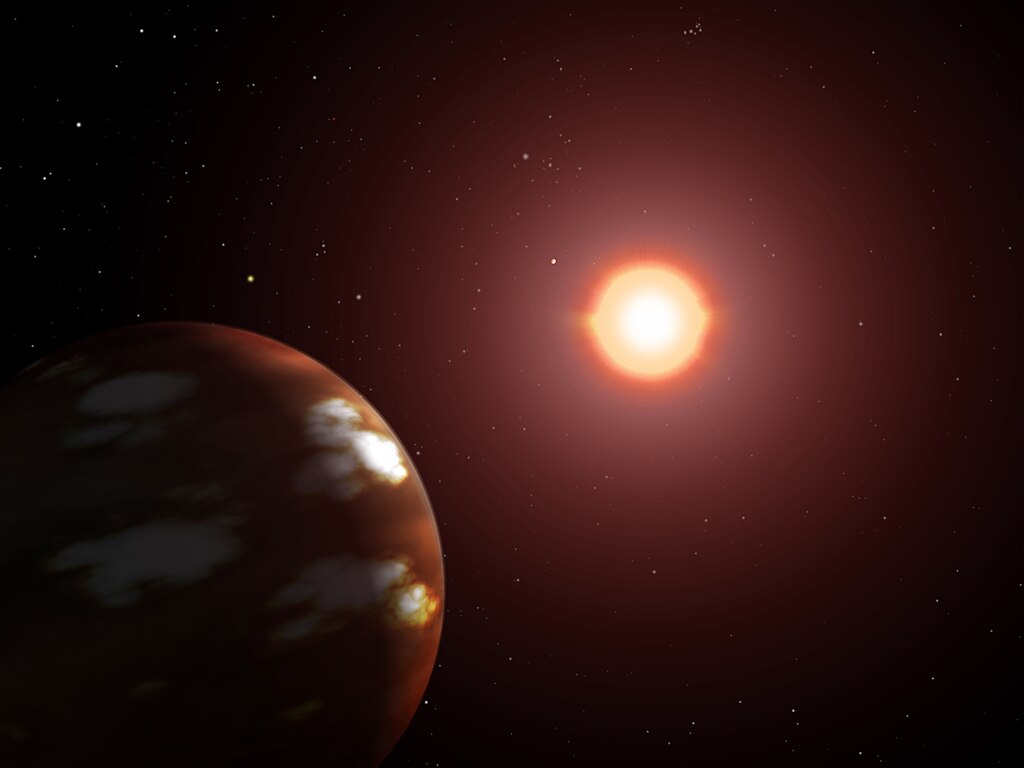
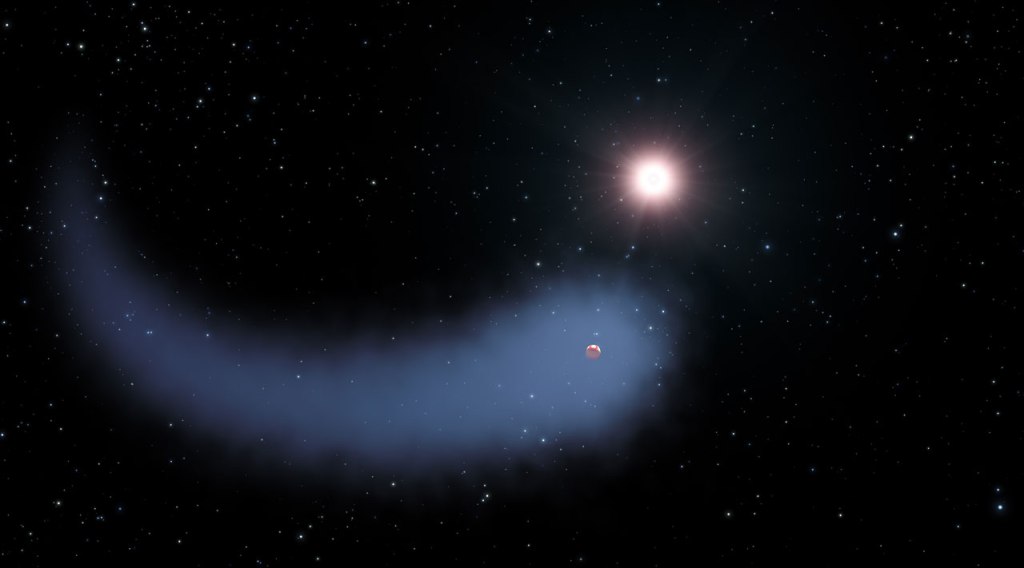
This artist’s concept shows the enormous comet-like cloud of hydrogen bleeding off of the warm, Neptune-sized planet Gliese 436b just 30 light-years from Earth. Also depicted is the parent star, which is a faint red dwarf named Gliese 436. The hydrogen is evaporating from the planet due to extreme radiation from the star. A phenomenon this large has never before been seen around any exoplanet.
To learn more about these exoplanets astronomers have created ground-based observatories such as the Very Large Telescope in Chile’s Atacama desert, and space-based equipment like the James Webb Space Telescope orbiting with the Earth at 4 times the distance of the moon. The sensitivity of these telescopes, and ability to observe outside the visible light spectrum of optical telescopes, has provided information that allows us to measure the volume, mass, and atmospheric compositions of some of these exoplanets. For example, Gliese 436b was chosen as one of the first exoplanets to be studied by the JWST, after the smaller Spitzer Space Telescope previously suggested a composition like that of a giant ice world, albeit with extremely high pressures and temperatures in excess of 800F. The heat, pressure, and proximity to the radiation of its star at just 2.6 million miles suggested that a giant cloud of gas observed around the exoplanet was actually a comet-like tail stretching 9 million miles.
Credit to @Trolligi and @Planetkid32 for Celestia footage of Noquisi and Awohali
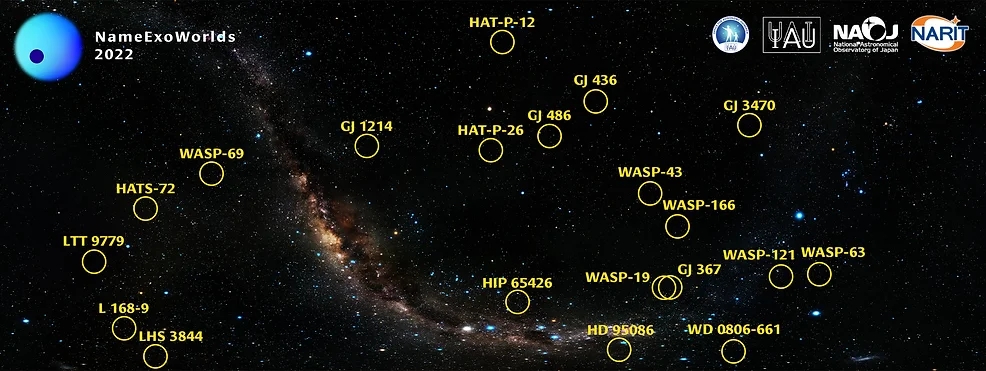
An exotic exoplanet, 21 times the mass of Earth, soaring around its star every 62 hours, with a surface of solid ice that exists at temperatures hotter than a household oven – and carrying the monotonous designation Gliese 436b. Something had to be done, and to this end, the IAU introduced NameExoWorld2022, an international competition to propose names for the more fascinating exoplanets that the James Webb Space Telescope will be dedicating time to observing. The theme for the NameExoWorlds2022 competition was “indigenous languages”, and so I assembled a team including representatives from Prescott’s Museum of Indigenous People, Embry Riddle Aeronautical University, The Northern Arizona Astronomical Consortium, and students from ERAU, Bradshaw Mountain High School, Northpoint Expeditionary Academy, and Liberty Traditional School. Together, we came up with submission for Gliese 436b and its host star Gliese 436, and have spent the last 8 months promoting this through in-person outreach events around the Quad City area, articles, videos, and podcasts available online.
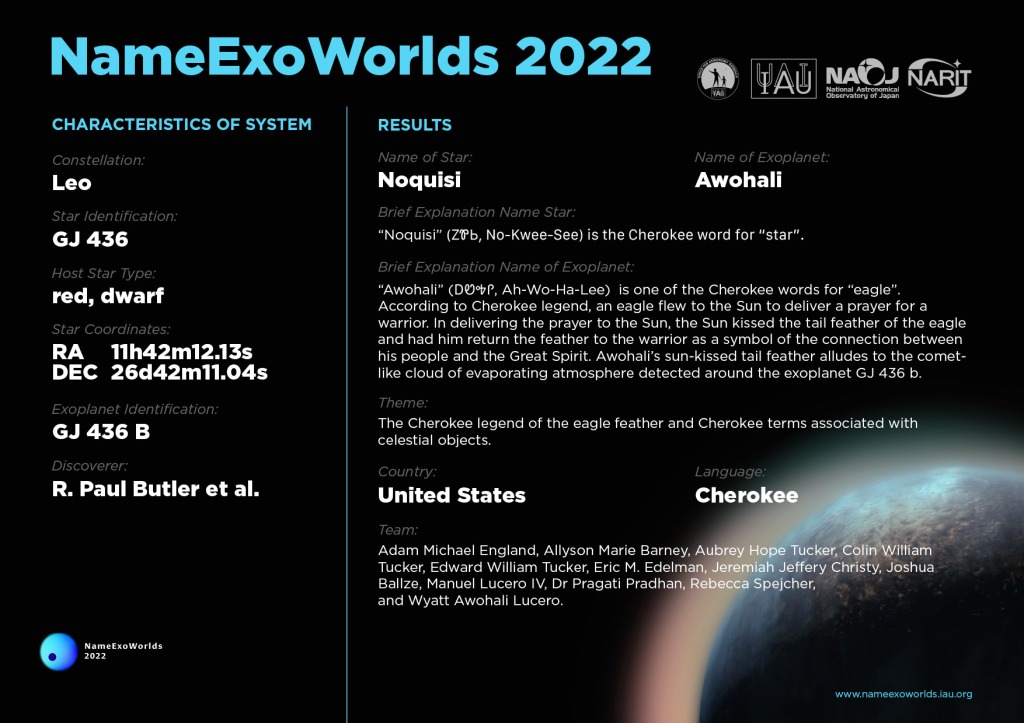
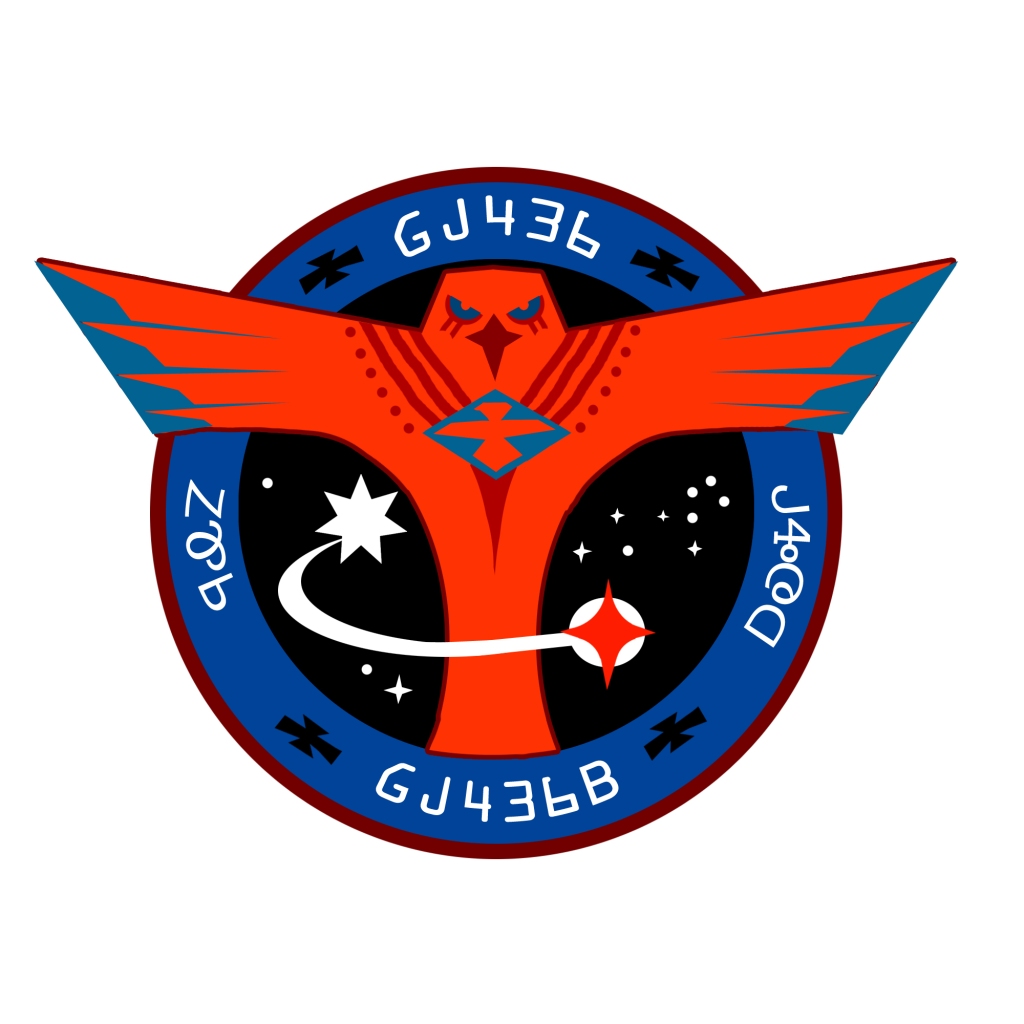
On Wednesday, June 7th, the IAU announced that Gliese 436/b will now formally carry the approved names Noquisi and Awohali for the star and exoplanet, coming from the Cherokee language meaning “Star” and “Eagle” respectively. These names represent so much more than just two words picked at random from an indigenous language. They represent an oral history handed down for hundreds of generations telling of a connection between humanity, nature, and the stars, as well as the first time that a star or exoplanet have officially carried a name in the indigenous language of a North American people. As told by Manuel Lucero IV, Director of Prescott’s Museum of Indigenous People, and a member of the Cherokee Nation, the oral history of Awohali goes:
Long ago when animals chose to speak with us, there was a warrior who had a prayer for his people that he wanted to deliver to the Great Spirit. This warrior climbed a mountain as high as he could go, and he came across Yona, the Bear. Yona said, “Two-legged, what are you doing here? You don’t belong here!” The warrior said, “I want to deliver this prayer to the Great Spirit.” Yona was very taken aback by this story and says, “I will take that prayer for you.” He took the prayer and climbed as high up the mountain as he could. When he reached the top of the mountain and there were no more trees except for one, he saw Awohali the Eagle nested up at the top of it. Awohali looked down and said, “Yona, what are you doing here? You don’t belong here.” Yona told Awohali about the prayer, and equally touched, offers take the prayer. Awohali in Cherokee means “He who flies the highest,” and Awohali flew as high as he could, higher than he ever had before, all the way to the Sun – our star Noquisi. The Sun looked at the eagle and said, “Awohali, what are you doing here? You don’t belong here.” Awohali told the Sun about the prayer, who replied, “I speak with the Great Spirit all the time, give me the prayer and I will deliver it. But first, give me one of your tail feathers.” Awohali reached back and plucked one, handing it to the Sun, who kissed it. This is why the golden eagle tail feather has a black mark on the tip. The Sun told Awohali, “Give this feather to the people so they will know they have a direct connection to the Great Spirit.” For this reason, the eagle feather is coveted by most native people.
We are honored to share this story with you, as a small piece of the valued history of one of our country’s many diverse cultures, and as the members of the Prescott Area team who worked so diligently to share it with the world, for now and for generations to come. I urge you to take an afternoon and visit the Museum of Indigenous People at 147 N. Arizona Avenue to learn more about the Noquisi/Awohali system, the NameExoWorlds2022 competition, and indigenous astronomy at the Ani Noquisi exhibit running now through December 2023, and follow the Jim and Linda Lee Planetarium at Embry-Riddle for more upcoming shows on this and other astronomical wonders. Additionally, a video of the project is available at https://youtu.be/nl893hO6v5w
Members of Team Ani Noquisi:
-Manuel Lucero – Director, Museum of Indigenous People; Representative of the Cherokee Nation
-Joshua Ballze – Trustee, Museum of Indigenous People; Jurassic Paleoart Expo; Representative of the Hia-Ced O’odham Nation
-Dr. Pragati Pradhan – Assistant Professor of Physics and Astronomy, Embry Riddle Aeronautical University; Association for Women in Science
-Eric Edelman – Director, Jim and Linda Lee Planetarium, Embry Riddle Aeronautical University; AAS Astronomy Ambassador, Equity, Diversity, and Inclusion Committee of the International Planetarium Society
-Adam M. England, E.A, “The Backyard Astronomer” – Founding secretary, Northern Arizona Astronomical Consortium; Former Vice-President, Prescott Astronomy Club; Astronomical League member
-Rebecca Spejcher – Undergraduate Student of Astronomy, ERAU; Society of Physics Students
-Colin Tucker -Student, Bradshaw Mountain High School
-Wyatt Lucero – Student, Northpoint Expeditionary Learning Academy
-Allyson Barney – Student, Liberty Traditional School
-Jeremiah Christy – Student, Liberty Traditional School
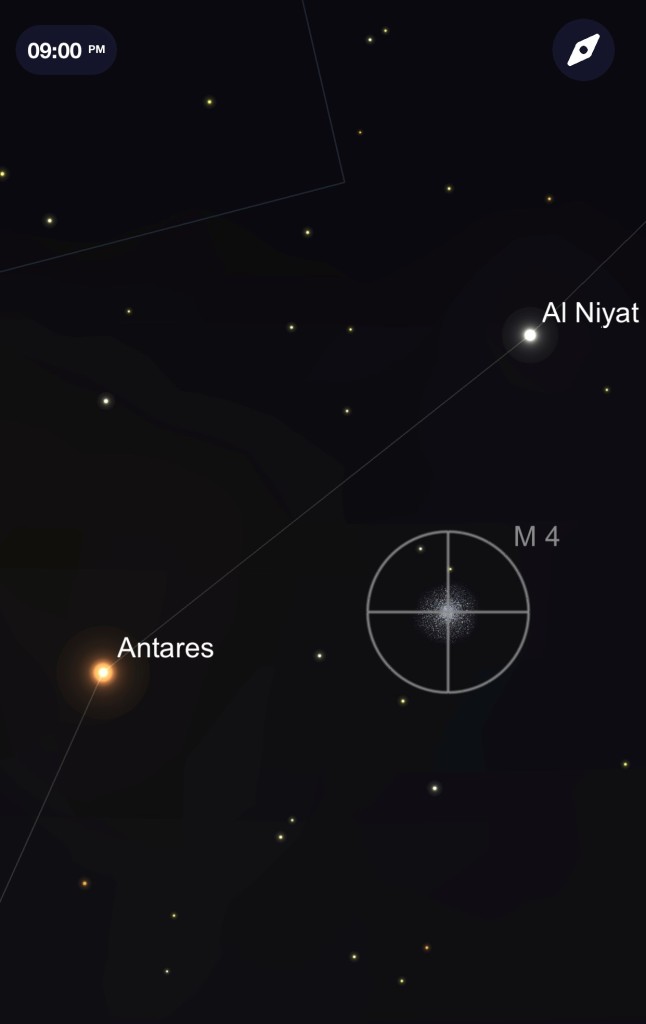
One of my personal favorite constellations is Scorpius. It is very easy to identify in the summer months when it rises in the Southeast and sways above the Bradshaw Mountains like the traditional scorpion promenade à deux pairing dance. The red supergiant Antares defines the head of the Scorpion and is often confused with Mars for its brightness and somewhat ochre coloration. Just one degree westward of Antares is the globular cluster Messier 4 (M4), the first cluster to have individual stars resolved by astronomers in the mid 1700s. Today, Backyard astronomers can easily locate this cluster with a decent pair of binoculars or a small telescope.
Antares and Messier 4 – SkySafari
While the head of the scorpion is dominated by Antares and the five stars making up its head and claws, the tail of the scorpion rises above the mountain tops a litter later in the evening and is defined by its large hook at the tip. The Hawaiian culture saw these stars as the fishhook of the demigod Maui, calling it Ka Makau Nui o Māui or “The Big Fishhook of Maui”.
Scorpius – Till Credner, Wikimedia Commons
Here in Northern Arizona, we certainly have scorpions and will use a fishhook for landing a trout, however the Navajo culture some something different in these stars. The last four stars in the tail are strikingly similar to the tracks left by a running rabbit, and as such, was known as Gah Haat’e’ii – Rabbit Tracks. It was the return of the rabbit tracks each year that signified to Navajo hunters that hunting season was over. During the time this constellation is visible in the night sky is when deer, elk, and other large game have given birth to your young, and these newborns are still reliant on their mothers for sustenance. When Rabbit Tracks move to the East and is no longer upright in the sky, the young are then old enough to care for themselves, and the hunting season returns.
Gah Haat-e’ii – Rabbit Tracks – Judy Volker, judy-volker.com
Due to its placement along the main swath of the Milky Way, Scorpius contains many other deep sky objects, including double stars, nebulae, and both open and globular clusters. Enjoy the beautiful summer nights of Northern Arizona and get your telescope out to look at this amazing patch of sky.