Category: Stars & Deep Sky

  • Spring Serpents and Clusters

    Spring has sprung in Northern Arizona, and with it comes the return of budding flora and emerging fauna.  In like fashion, the sky also graces us with clusters in bloom, and the slithering serpents that herald their homecoming.

    Messier 5 through the eyes of the Hubble Space Telescope.

    The constellation Serpens is often depicted as two halves of a snake, as held by Asclepius, the Greek god of medicine.  The snake was observed to shed its skin, an act seen by the ancients as a sort of rebirth and resurrection, and the return of the constellation Serpens brings the rebirth of the plant and animal life that laid dormant throughout the winter.  The serpent begins to rise in the Eastern skies during the month of May and brings with it a host of deep sky objects for your viewing pleasure.

    M5 as seen from the 32″ scope on Arizona’s Mount Lemmon (Schulman).

    Messier 5 (M5) is a globular cluster near the head of the Serpent, with more than 100,000 stars densely packed into a ball of space about 165 light years in diameter.  Despite having so many individual stars, its distance from Earth at around 25,000 light years makes it appear to the naked eye as a single, faint star.  Through your binoculars you will be able to discern that it is not a single object, however larger telescopes can resolve many of the brighter individuals, which includes one hundred five variable stars, 2 millisecond pulsars, and a dwarf nova. 

    Messier 5 through the eyes of the Hubble Space Telescope.

    The entirety of M5 is speeding away from our solar system at more than 50km/s, so by the time you finish reading this article, it will have moved a full Earth diameter further away from your backyard telescope.  The most daring Backyard Astronomers can also hunt galaxies off the head of The Serpent.  Hoag’s Object is an extremely rare ring galaxy, and Seyfert’s Sextet is a group of six galaxies which are gravitationally bound like a globular cluster, albeit over a much grander scale.

    Hoag’s Object taken by astronomer Konig Von Murmeltiere.

    For early-bird astronomers, Jupiter and the Moon will be dancing together on the morning of May 17th.  Jupiter will be hidden behind the Moon as it rises from the Eastern Horizon, in what is known as a Lunar Occultation.  Jupiter will re-emerge from behind Luna at 5:17 AM MST, with sunrise just a few minutes later at 5:26 AM, potentially obscuring the view from all but the most dedicated observers.

    Seyfert’s Sextet by Don Goldman.
  • Bullish About Astronomy

    Crab Nebula. Hubble Space Telescope.

    The Red Planet shines bright this month, transiting between the horns of Taurus, the bull, and up towards Gemini, the twins, at just over one AU from Earth.  One Astronomical Unit is the average distance from the Earth to the Sun, or about 93 million miles/150 million kilometers.

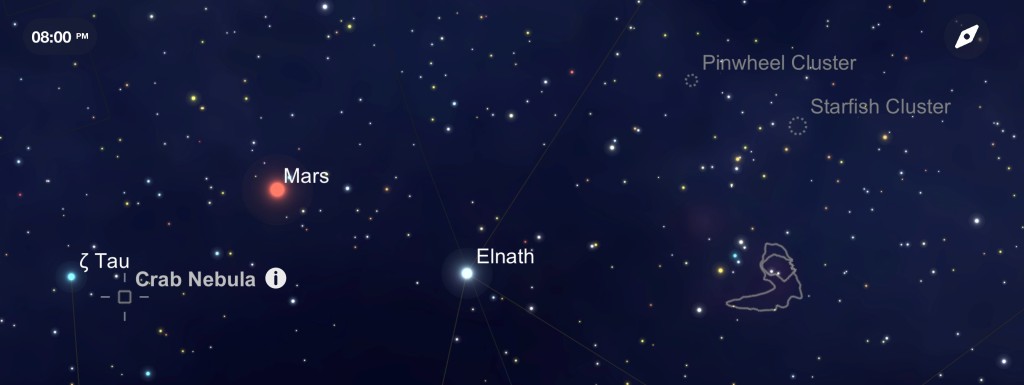
    The horns of Taurus are peaked by the bright stars Zeta Tauri and Elnath.  At apparent magnitudes 3.0 and 1.67, respectively, they should be quite easy to find by looking to the Southwestern sky after sunset.  Zeta Tauri is a binary star system, with the brighter  Zeta Tauri A 11 times more massive than our sun, and separated from its partner Zeta Tauri B by only 1.17 AU.  Being nearly as close to each other as we are to the Sun or Mars right now, we cannot see them as separate objects with backyard telescopes, though scientists have been able to measure the Doppler shift – or change in the frequency of their light spectrum – calculating an orbital period of just 133 days. 

    Mars in Taurus, 3/15/2023 at 8PM MST.

    About 1 degree west of Zeta Tauri is the popular Crab Nebula.  You can approximate 1 degree in the sky by the width of your finger at arm’s length.  The Crab Nebula bears the designation M1 or Messier 1, as it was the first object recorded by Charles Messier in 1758 during his attempts to locate the predicted return of a comet, as previously calculated by its modern namesake, Edmund Halley.  This same nebula was independently discovered by multiple astronomers over the 18th century, and has since become one of the most studied and beloved objects in the night sky.  Modern observations by the Hubble Space Telescope, Chandra X Ray Observatory, and the Spitzer Infrared Telescope have continued to provide extraordinary detail into this magnitude 8.4 remnant of an ancient supernova which was recorded by Chinese astronomers in 1054.

    Defining the bull’s other horn, Elnath come from the Arabic meaning “the butting one”.  Relatively close at 130 ly distant, this giant star is 5 times the mass of our Sun, while putting out approximately 700 times more light.

    Mars, Courtesy Joel Cohen, taken 10/02/2020.

    While the Pleiades is the most familiar open cluster in the constellation Taurus, it is host to many other star clusters and nebulae.  The Hyades cluster is nearer the bright star Aldebaran in the face of the bull, with approximately 100 total stars filling a spherical void in space with the same age and chemical composition.

    Moving counterclockwise from the West around Elnath, backyard astronomers can find the Flaming Star Nebula (magnitude 6.0), Messier 38 or the Starfish Cluster (magnitude 7.4), and Messier 36 or the Pinwheel Cluster (magnitude 6.3).

  • Fusion – The Lifeblood of Stars and Science Fiction

    The first and most basic element on the periodic table is hydrogen. A single atom of hydrogen consists of one positively charged proton in the center or nucleus, and one negatively charged electron orbiting it. This simple element was the first thing in the universe after the Big Bang, and there was a lot of it. Every one of these hydrogen atoms had an infinitely small amount of gravity, and each of those tiny atoms immediately began to pull on and towards one another. As more and more atoms found gravitational friends, they coalesced into large clouds of hydrogen. The more dense a cloud became, the larger its gravitational force, and subsequently it was able to pull in more hydrogen, and over and over the cycle repeated.

    No alt text provided for this image
    The Cycle of Star Formation.

    Now let’s compare this with a material we are all familiar with – water. If you dip your hand in a small bowl of water, you will feel its temperature and the unique, wet texture, but if you dive to the bottom of a deep pool or body of water, you will also feel the pressure of the water push in on your body. The larger the body of water, and the deeper one dives, the more pressure that will be exerted on the diver. The same process occurs with any element or compound, and these clouds of hydrogen were no exception. Clouds of hydrogen gas larger than our solar system pushed inward as they grew, and the individual atoms were packed tighter and tighter into the center, generating heat under the intense pressure. Somewhere around 25,000,000 degrees Fahrenheit, these hydrogen atoms ran out of space and began to merge, fusing four hydrogen nuclei into a heavier Helium atom, and releasing electrons, gamma rays, neutrinos, and heat and energy in the process. This process is known as nuclear fusion and is how stars are born.

    No alt text provided for this image

    The James Webb Space Telescope has been hard at work this past year, looking deep into nebulous clouds of gas around our galaxy that act as stellar nurseries. Comparing against the Hubble Space Telescopes famous images of the Carina Nebula, Tarantula Nebula, and the Eagle Nebula’s Pillars of Creation, we can see that the additional data available through observation in the near and mid-infrared allows astronomers to better understand this process of star formation and stellar nucleosynthesis.

    No alt text provided for this image
    The Pillars of Creation – Hubble on the left, James Webb on the right.

    Looking to our own star, we are constantly observing in many different wavelengths. With filters like Hydrogen Alpha that are readily available to backyard astronomers, we can begin to resolve the product of the fusion process taking place deep within the sun’s core, and using satellites and observatories we can trace the radiation, heat, and energy produced as it travels the 93 million miles to Earth, and beyond.

    No alt text provided for this image
    The sun is Hydrogen Alpha (left) and visible light (right).

    Understanding this process has been a key focus of physicists since 1920. After calculating that the mass of 4 hydrogen atoms was slightly more than that of one helium atom, British chemist Francis William Aston laid the groundwork of a science to understand how stars produce energy, and how we may be able to replicate it. On December 5th, 2022, scientists at the Lawerence Livermore National Laboratory in California successfully produced a fusion reaction in which the energy output was, for the first time, greater than the input, using lasers targeted at a gold canister containing deuterium and tritium. As we continue to develop technology, systems, and materials that can withstand such extreme temperatures and environments, we stand at the junction of a future right out of science fiction.

  • The Many Wonders of Boötes

    In the early summer months, the constellation Boötes moves to the western sky.  Adjacent the Big Dipper, some Ancient Greek Mythology tells of how Boötes invented the plough and was rewarded with a place in the heavens for this history-altering advancement.  Keeping in line with feeding the masses, the Yup’ik language – second most widely spoken Native American language after Navajo – of the Eskimo-Aleut people refers to this same grouping of stars as Taluyaq, literally translated as “fish-trap” for the funnel shape of the stars.  Many different Chinese constellations have focused around Arcturus, the brightest star in Boötes and in the Northern hemisphere, which was so important in their mythology that it’s position in the sky marked the beginning of the lunar calendar.

    Boötes is home to a plethora of deep sky objects, many of which represent the earliest discoveries after the invention of the telescope.  The easiest star to locate first is the bright orange-giant Arcturus.  Just under 37 light years distant, 25 times larger than our sun and 170 times as luminous, it should be a quick task.  The next brightest star is Izar, which viewed with a scope of diameter 3” or larger reveals a beautiful multi-colored double star.  Approximately the same distance but in the opposite direction of Izar is magnitude 11 galaxy Caldwell 45.  Six degrees to the Southeast of Arcturus is Pi Bootis, another double star visible to the naked eye.  Remember, you can easily approximate degrees in the sky with your hand at arm’s length – a fingertip is about 1 degree, three fingers about 5 degrees, and a clenched fist is about 10 degrees.

  • The James Webb Space Telescope

    As early as 1923, space telescopes were proposed to peer deeper into the universe, without the obstruction of the Earth’s tenuous atmosphere.  By the 1970s congress had funded the first of these great space telescopes, with the 2.4 meter primary mirror completed in 1981 for a Ritchey-Chreitien Cassegrain type telescope which finally launched in 1990 in the cargo bay of the Space Shuttle Discovery, carrying the name Hubble. A few servicing missions later, the Hubble Space Telescope has been gracing our computer screensavers with images of the cosmos for over 31 years.

    courtesy http://www.NASA.gov

    Before it’s launch, however, NASA knew that the narrow visible spectrum that Hubble was designed to observe in was not the end-all goal of space telescopes.  A series of additional orbiting laboratories able to capture light from all ends of the spectrum were developed, including the Chandra X-Ray Telescope, the Spitzer Space Telescope in the infrared, and the Kepler planet hunter telescope, but NASA engineers and astronomers dreamed of something bigger and better.  In 1989, the concept was floated for a much, MUCH larger space telescope that could open like an umbrella, with multiple mirrors converging to create a 4-meter aperture telescope that could image across a much larger swath of the visible to near infrared spectrum.  The next three decades of scientific advancements, engineering marvels, as well as numerous delays and drastic budget overruns have led up to this moment. 

    On December 25th the James Webb Space Telescope will launch aboard an Ariane 5 rocket from the European Space Agency spaceport in French Guyana, South America at 5:20 AM MST.  Whereas Hubble orbits at about 330 miles above the Earth, making it a previously accessible target for repair and upgrade mission with the now retired fleet of Space Shuttles, The JWST will orbit the Sun at what is known as the L2 Lagrange point.  This is a unique point in space where the gravitation forces of the Sun and Earth balance each other and create a stable point in space for an object to remain in relative equilibrium.  There are 5 such Lagarange points created by the Sun/Earth gravity wells, with the benefit of the L2 point being that it will always be in a line with the Earth directly between it and the Sun, helping to block the Sun’s light – and astronomers like it dark!  The JWST will take approximately a month to reach this point 1.5M km from earth, about 3 times further than the moon.  During this time, the observatory will open its mirrors, solar panels, and a unique solar shield that will add additional protection from the light and heat of the sun, allowing for more detailed observations in the near and mid-infrared.

    20 countries, more than 30 years, 9.7 billion dollars, and human capital that could never be accurately calculated, will all culminate in a Christmas gift to the world early this Saturday morning.  God speed James Webb!

  • The Subaru Cluster

    The dormant volcano Mauna Kea is the highest point in the Central Pacific and of the Hawaiian Islands. At such a height, the benefits of dry air above the clouds with little to no light pollution make it the preeminent site in the world for astronomical observing. As such, many large telescopes operate at its summit. One of these is the Subaru telescope of the National Astronomical Observatory of Japan.

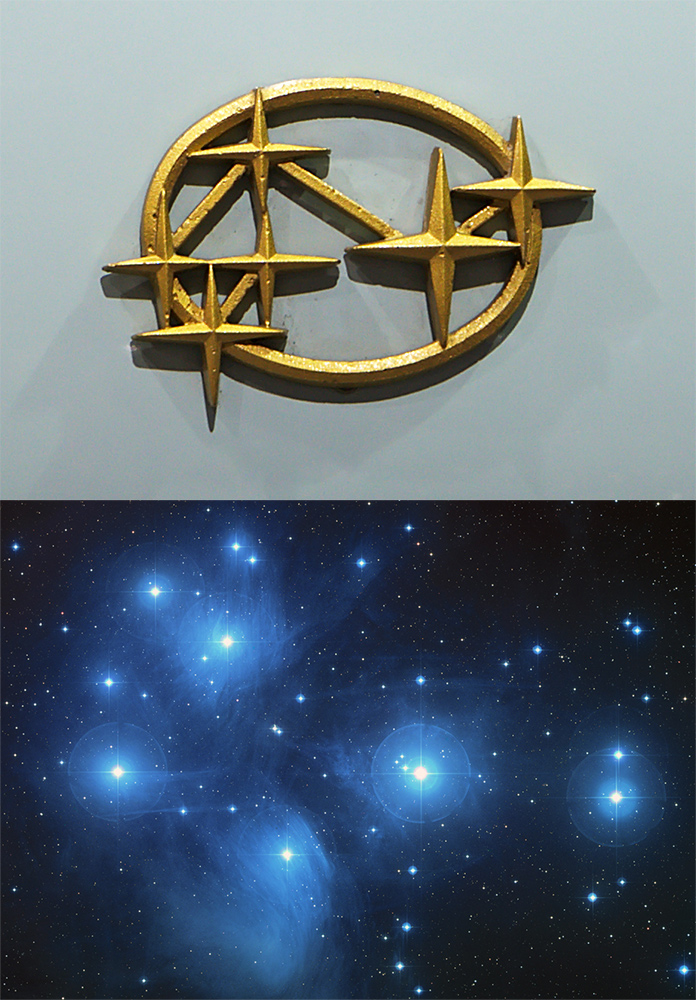
    Subaru, you say? They sold naming rights of a telescope to a car company? Well, no. The car company and the telescope were both named for the open star cluster Subaru which graces the fall and winter skies of the Northern Hemisphere. The closest naked eye star cluster to Earth, the six bright stars of Subaru glow hot blue and are surrounded by beautiful nebulosity that can be seen with even the smallest binoculars or telescopes. This cluster has been clearly recorded in dozens of ancient cultures and even referenced in the bible. The oldest known depiction of the night sky is a bronze disc found in Germany that dates to around 1600 BCE and is believed to include the sun, moon, and the stars of the Subaru cluster.

    Fast forward to 1953, when the Japanese businessman Kenji Kita combined six smaller companies across the manufacturing sector to create Fuji Heavy Industries, producing everything from scooters to cars to busses. Drawing from his love of the sky to constitute the combined six businesses he brought together, he named his first car the “Subaru 1500” with the logo a clear representation of the star cluster. Whoa, whoa, whoa. The brightest and best star cluster, most visible to the naked eye, with visible nebulosity, and you’ve never heard of it? That may be because Western culture traditionally uses ancient Greek and Roman names for the primary constellations, and we know “Subaru” as “The Pleiades”.

  • The Backyard Astronomer – Andromeda! 

    We live on Earth, which orbits the sun every 365.256 days as part of our Solar System.  Our Solar system is one of hundreds of millions of stars and similar systems that orbits the center of our Milky Way galaxy about every 225 million years.  We are familiar with the cloudy or “milky” swath above our heads that is visible on moonless nights throughout much of the year.  With advancements in radio astronomy in recent decades, we have been able to peer deeper into the sky and analyze the structure of our galaxy to learn we are on the outskirts of an arm in a giant spiral galaxy, held together by the gravitational pull of dark matter and a massive black hole in the center which we call Sagittarius A* – pronounced “Sagittarius A Star”.

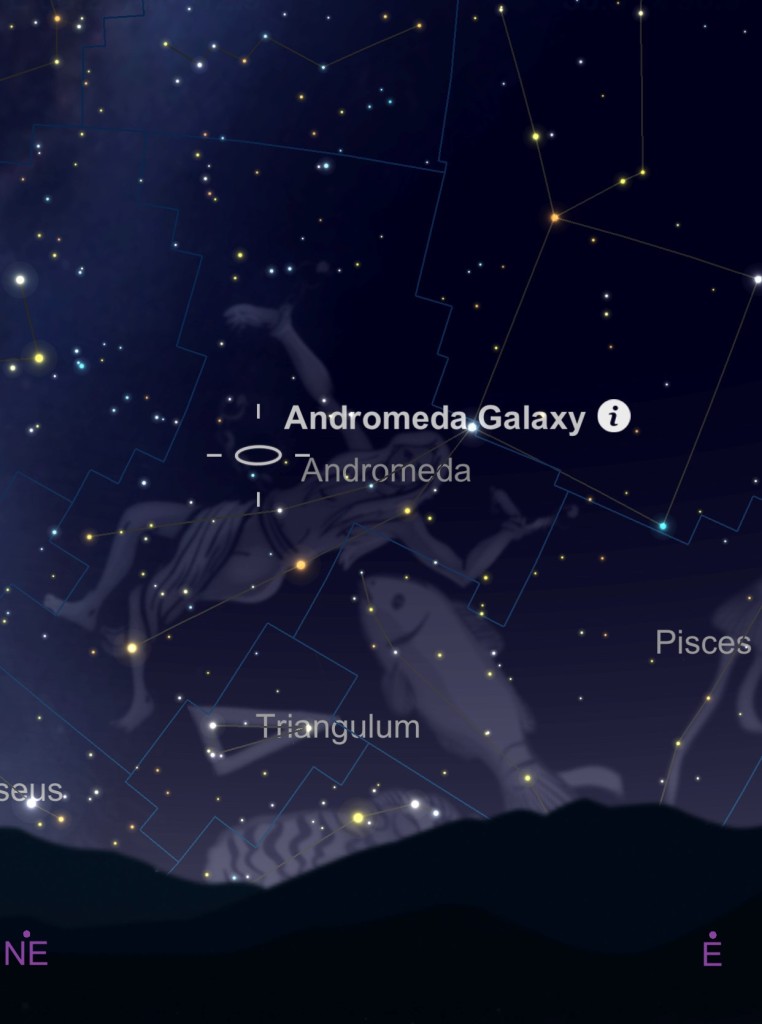
    Great Square of Pegasus and Andromeda, Screenshot, Sky Safari 2021

    For hundreds of years, we had to guess what the structure of our galaxy was, as we are inside of it and cannot see it from an outside perspective.  Our best approximation came from looking at our neighboring galaxies, some of which are visible to the naked eye.  Our nearest partner in space is the Andromeda galaxy.  Although it hangs out about 2.5 million light years distant, it is large enough and bright enough to have been documented over a thousand years ago – long before the advent of the telescope.  In the tenth century Persian astronomer Abd al-Rahman al-Sufi described Andromeda as a “nebulous smear”, with later astronomers using rudimentary telescopes to define the blurry spot in the sky as an “island universe”.  With a diameter more than 6 times that of the full moon, Andromeda is one of the largest objects that astronomers can see with either the naked eye or simple ground-based equipment, and many astronomers have spent their lives dedicated to researching it.  However, it was not until Edwin Hubble studied Andromeda in 1925 that we truly understood it was a separate galaxy at such as distance from our own.  This realization expanded our understanding of the universe from essentially believing in one galaxy to now knowing there are upwards of two trillion separate galaxies in the observable universe.

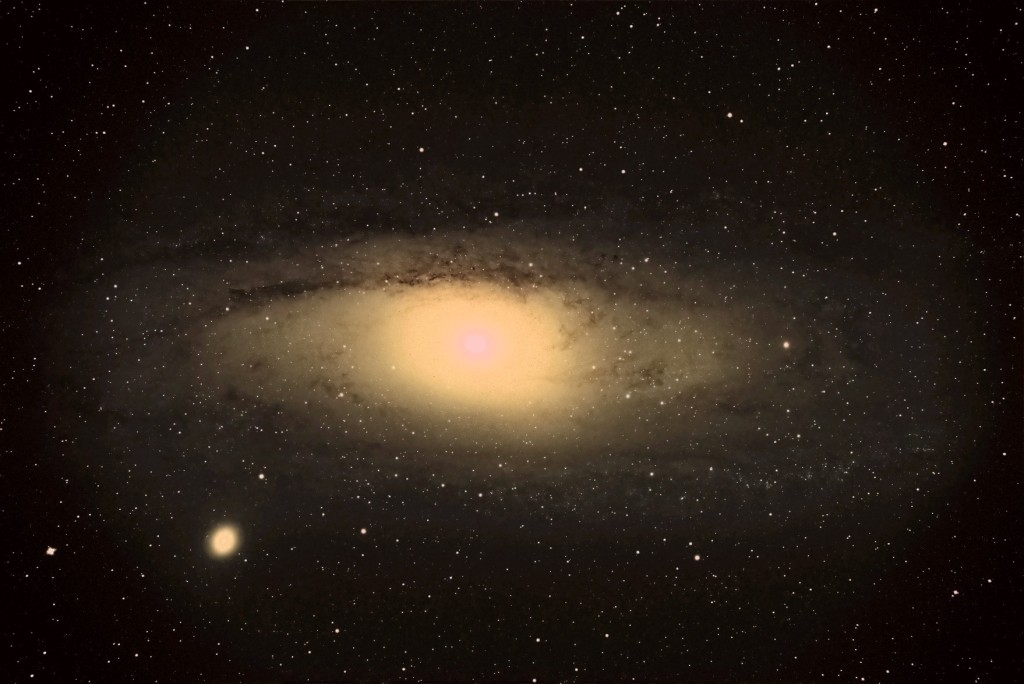
    Image courtesy Joel Cohen, Andromeda, 12-21-2020

    October is arguably the best month to view Andromeda in the evening sky, reaching the zenith (directly above you) around midnight.  October 6th is the new moon, and about an hour after sunset that evening Andromeda will be approximately 30° above the Northeast horizon.  You can find it by looking for the Great Square of Pegasus – an easily identifiable asterism – with the bright double star Alpheratz forming the northern corner.  Two streams of stars seem to pour left from this point, and about 12° from Alpheratz (slightly more than the size of your fist held at arm’s length) and just above the top line of stars will have you looking at a cloudy patch of sky.  Bust out the binoculars and you will see this is Andromeda, and then with the telescope you will begin to resolve the bright galactic center and swirls of stars around it.  You will see Andromeda just slightly off from edge on, so it should look like a long oval getting brighter and denser towards the center.

  • The Backyard Astronomer – The Summer Triangle and The Dumbbell Nebula

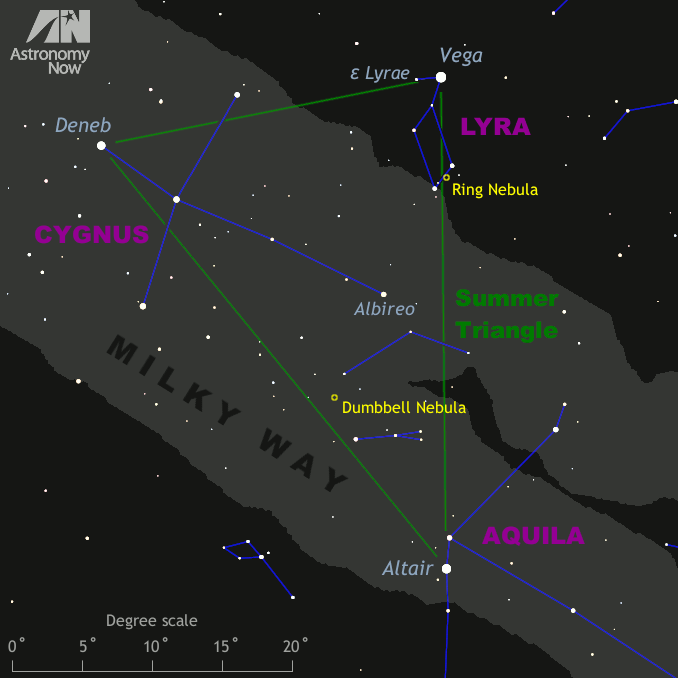
    In July we talked about using the Summer Triangle asterism to locate Messier 57, the Ring Nebula.  If you were able to make it to our August Star Party at Pronghorn Park in Prescott Valley, you most likely were able to view it and the planets Saturn and Jupiter shining bright at opposition.  M57 however is just one of the heavenly surprises hiding within the Summer Triangle.

    Image courtesy Ade Ashford, www.astronomynow.com

    One of the three points of the Summer Triangle is Deneb, the brightest star in the constellation Cygnus, the Swan.  The main stars of the Swan make up the Northern Cross, making it easily identifiable to the naked eye just after sunset.  Move down from Deneb to about midway between Vega and Altair, and the main body of the Northern Cross is formed with Deneb at the top and Albireo at the bottom.  Inversely, the Swan is viewed as diving down, with Deneb at the Tail and Albireo as the head.  Albireo appears as one bright star until a look through your binoculars or telescope reveal it to be a fun double star, with Albireo A being the brighter yellow star and Albireo B a smaller blue star.  It is believed that these two stars are not actually a binary system and orbiting each other, as Albireo B is most likely 300 light years further past Albireo B, and just appears to be a neighbor as viewed from Earth.

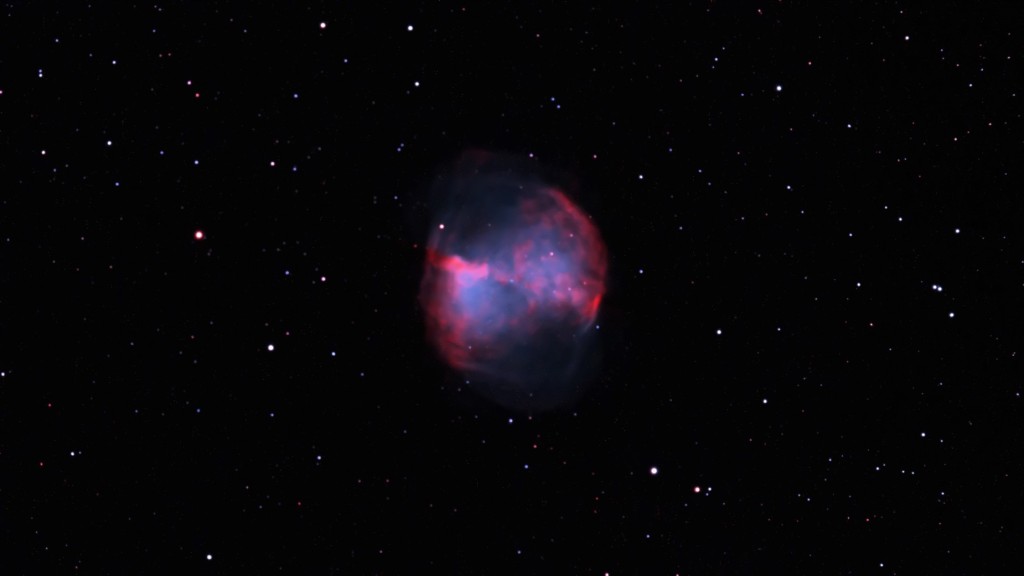
    The Dumbbell Nebula (M27) by Joel Cohen

    Another fun object to view in the Summer Triangle is M27 – The Dumbbell Nebula.  The first planetary nebula to be discovered during Messier’s charting of non-comets, The Dumbbell nebula is much larger and closer than the Ring Nebula and has a higher reflectivity.  This makes it much easier to find with binoculars, and higher magnification with a telescope reveals a beautiful shape and some color.

  • Summer Constellations, Asterisms, and the Ring Nebula

    By Adam England, The Backyard Astronomer

    The beginning of Summer in the Northern Hemisphere brings warmer nights to the backyard astronomer, a stark contrast from the oft freezing viewing sessions of the Winter constellations.  July offers longer days, but also some great stargazing for the moderate sized telescope.  The constellations Aquila the Eagle, Cygnus the Swan, and Lyra the Lyre converge directly overhead at solar midnight, with their three brightest stars forming the Summer Triangle.  Easily identifiable asterisms such as the Big Dipper, the Southern Cross, and the Summer Triangle have long been a way for the layperson to identify patterns of stars.

    Lyra and M57 – Courtesy Stellarium, http://www.skyandtelescope.org.

    The Big Dipper is probably the first asterism kids in North America become familiar with.  Popularized as the “Drinking Gourd” from an African American folk song in the 1920’s, the end stars of the bowl form a line to the bright star Polaris, the star closest to Earth’s Celestial Northern Pole, which helped lead escaped slaves North to freedom.

    The Southern Cross is a series of 4 (sometimes 5) bright stars that is visible in the Southern Hemisphere nearly any time of year.  Used in a similar fashion to find Earth’s Southern Celestial Pole, everyone from ancient Pacific navigators to Argentine gauchos have used this grouping of stars to navigate vast tracts of land and desolate expanses of ocean.  Used in no less than 10 national, regional, or organizational flags, Crosby, Stills, Nash and Young spoke of it in their aptly named 1982 hit “Southern Cross”, positing, “When you see the Southern Cross for the first time, you understand now why you came this way.”

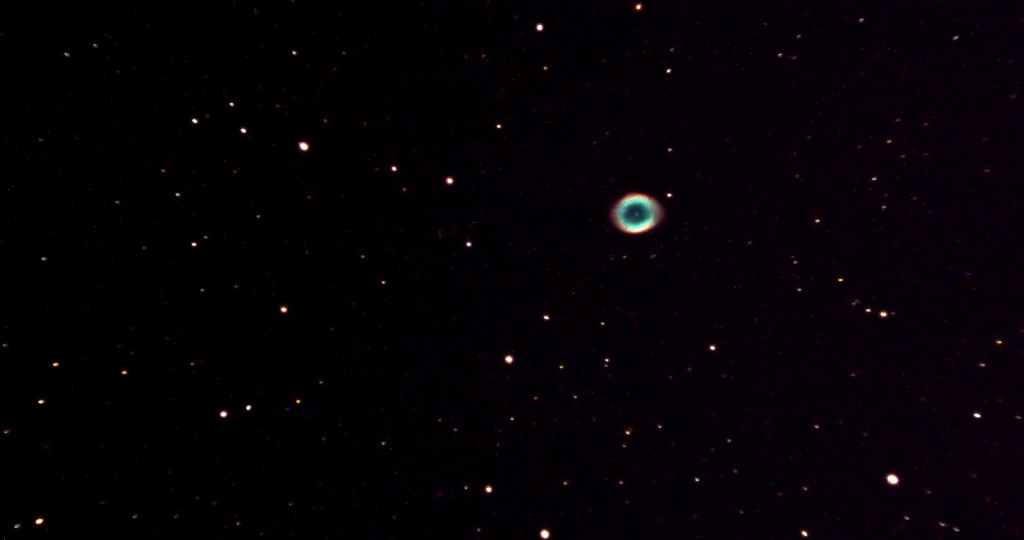
    M57 – Courtesy Joel Cohen.

    The Summer Triangle is formed by the three bright stars Altair, Deneb, and Vega, with Vega being the brightest of the three.  The second star (after our Sun) to be photographed and the first to have its spectrum recorded, Vega is relatively close at just 25 light years distant and is the second brightest star visible in the Northern Hemisphere.  Just below Vega, and directly on the leg of the Triangle formed with Altair, is The Ring Nebula, a small planetary nebula formed when a dying star ejects gas in all directions as it runs out of fuel required to maintain nuclear fusion.  Becoming visible with 3–4-inch telescopes, you can begin to resolve the rings of gas and eventually the central remaining white dwarf star with 8-inch scopes and higher magnification.

  • Mars, Cancer, and the Beehive Cluster

    The scientific community has been intently focused on Mars for the past couple months.  Every 26 months, our planets align in a way that shortens the time from Earth to Mars down to about 9 months, and as more countries develop space programs, more robotic explorers are sent to the red planet during this window.  In 2021, the UAE orbiter Hope arrived on February 9th, China’s Tianwen-1 entered orbit on February 10th, and the NASA Perseverance rover touched down February 18th.  Perseverance carried with it the Ingenuity helicopter, which has spent the last month proving the first powered flight on another world, and on May 14th, Tianwen-1 released the Zhurong rover which became only the second country to successfully land a rover on the Martian surface.

    Mars, Courtesy Joel Cohen, Prescott Valley, AZ, 10/2020.

    Mars is easily identifiable with the naked eye, having a deep red hue due to high levels of oxidized iron in its crust – basically the whole planet has rusted over the last couple billion years.  The arrivals of the orbiters and landers in February signaled a (relatively) close approach of our two planets, as they have spent most of 2021 pulling further distant from one another, and lower and dimmer in our night sky.  Sinking closer to the setting sun, Mars enters the constellation Cancer on June 8th.  As the moth wanes, you may be able to catch one last conjunction with Mars passing just 0.5 arcminutes from the Beehive Cluster M44 on June 23rd, just minutes after sunset, low in the western sky.

    M44 Beehive Cluster, Courtesy Joel Cohen, Prescott Valley, AZ.

    The Beehive Cluster – or Messier 44 – is one of the nearest open clusters to Earth.  Ptolemy referred to it as the “nebulous mass in the breast of Cancer”, proving how easily identifiable it is with the naked eye.  Galileo resolved 40 stars within the cluster, though we now count at least 1000 stars across 39 light years, which are close enough to be gravitationally bound to each other.  At least 3 exoplanets are known to orbit stars within the Beehive Cluster.  If you are lucky enough to catch the conjunction of this open cluster and our neighboring planet, both should easily fit within the field of view of your telescope or binoculars.  With the right magnification, one can resolve some nebulosity from the Beehive Cluster and the polar ice cap of Mars.