Category: Observing & Night Sky

  • October 2026 – The October Dark Sky Challenge

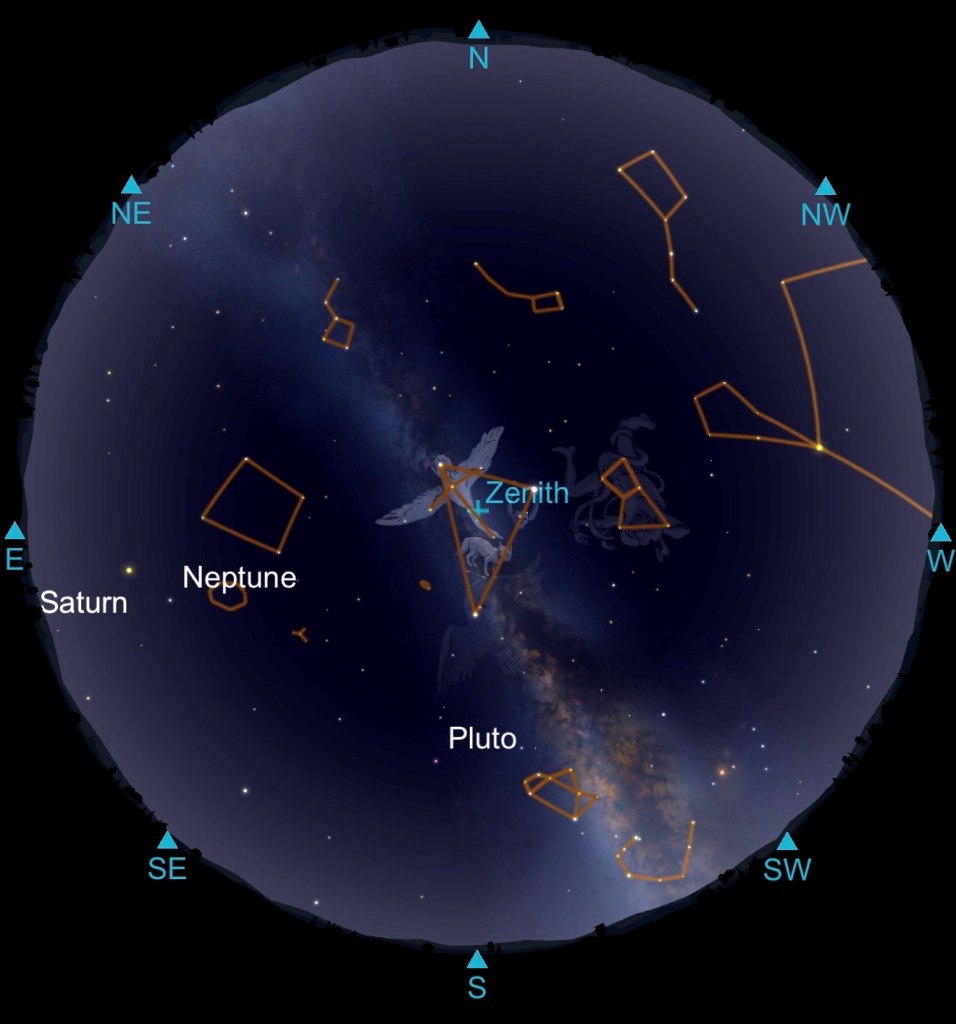
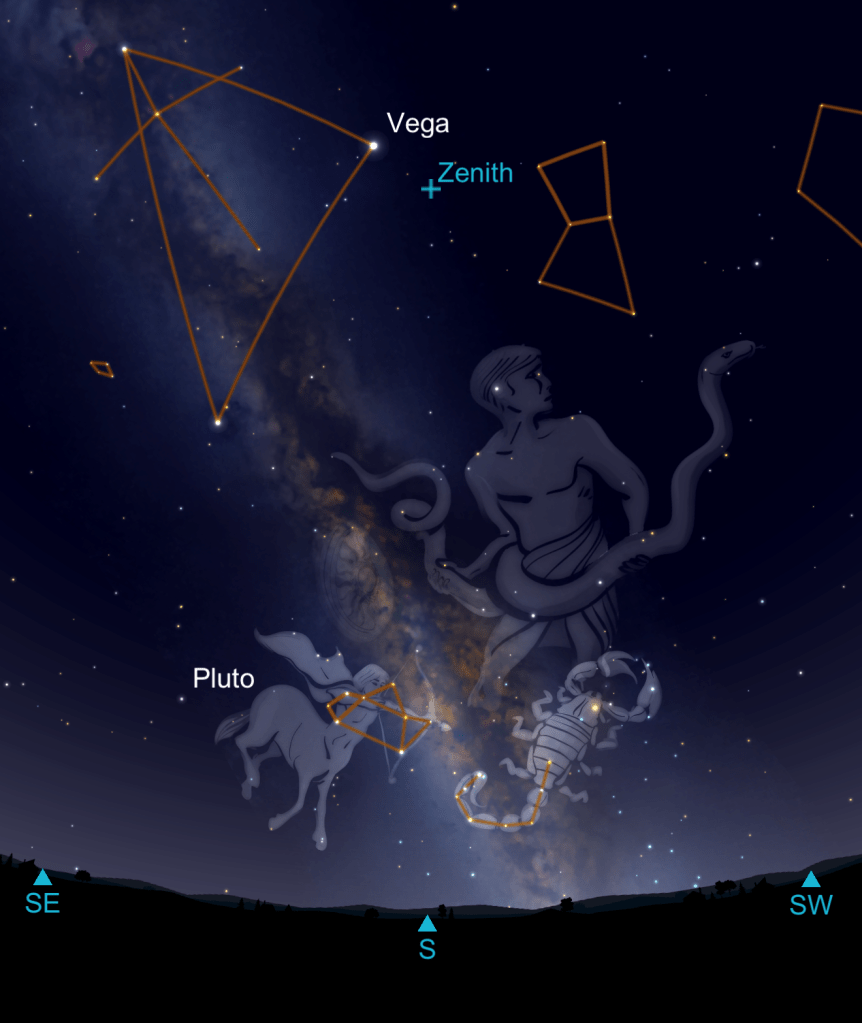
    10 October 2026 night sky – Courtesy SkySafari.

    How many can you find?

    October 10 brings us a New Moon, giving us one of the darkest evenings of the month. In central Yavapai County, sunset will be around 6:00 PM. Get outside shortly afterward, turn off the porch lights, and give your eyes time to adjust. Over the next few hours, more and more of the night sky will reveal itself.

    A comfortable chair will make the evening more enjoyable, and a pair of binoculars or a small telescope will open up even more to see. A good free sky app, such as SkySafari, can also make finding some of these objects much easier.

    ☐ The Summer Triangle

    As twilight fades, look overhead for three bright stars forming a huge triangle: Vega, Deneb and Altair. That’s the Summer Triangle. Despite its name, it remains easy to spot in October and makes a great first landmark.

    ☐ The Great Square of Pegasus

    Look toward the east for four bright stars forming a large square. The Great Square of Pegasus is another easy pattern to recognize once the sky gets dark. Learn these big, simple shapes and the night sky starts to feel a lot less intimidating.

    ☐ The Teapot of Sagittarius

    Now look toward the southwest for the Teapot. It really does look like one, with a handle on one side and a spout on the other.

    The Teapot, Summer Triangle, and Great Square of Pegasus are asterisms, recognizable patterns of stars that aren’t an official constellation by themselves. Asterisms are useful because they give us landmarks in the sky. Once you learn a few, you can use them to find other objects with your eyes, binoculars or a telescope.

    ☐ The Milky Way

    Look toward the Teapot’s spout and you’ll find the Milky Way stretching across the sky. That hazy band isn’t a cloud. You’re looking through the disk of our own galaxy, seeing the combined light of countless stars.

    The Teapot points toward the crowded center of the Milky Way, which is why this part of the sky can be so spectacular under a dark sky. Follow that river of starlight across the sky and you’ll eventually encounter another familiar pattern.

    ☐ The Big Dipper

    The Big Dipper is one of the easiest asterisms to recognize. On this October evening, it will be in the northern sky, looking almost as if it is swinging toward the Milky Way, ready to scoop some of it back up.

    ☐ The Andromeda Galaxy

    Now that its getting a little darker, go back to the Great Square of Pegasus. Find the star at its northeastern corner, then follow the line of stars extending northeast from it. These stars lead you into Andromeda. Under a dark sky, look just beyond them for a faint, elongated smudge of light.

    That’s the Andromeda Galaxy, our nearest large galactic neighbor, about 2.5 million light-years away. If you can see it with your naked eyes, you’re looking at an entire galaxy without a telescope.
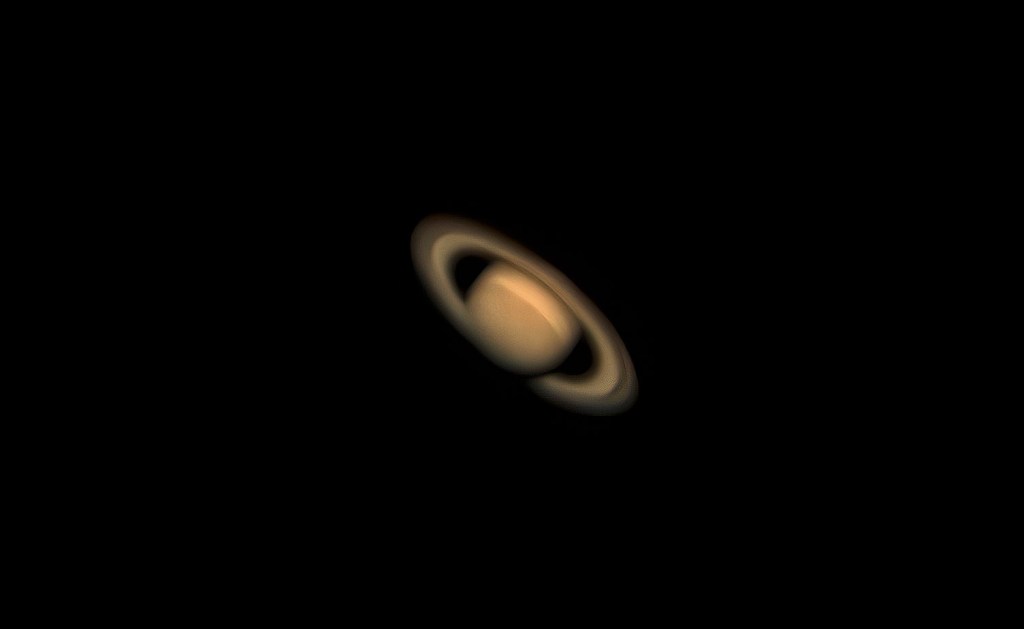
    Saturn – Courtesy PAC member Joel Cohen, Prescott Valley, 09/2020.

    ☐ Saturn

    Now look toward the southeast for Saturn. It will be one of the brightest objects in the sky tonight. Saturn is at opposition this month, when Earth passes between it and the Sun, making Saturn especially bright and well placed for observing.

    With binoculars or a small telescope, you can clearly see Saturn’s rings.

    ☐ Titan

    Have a 4-inch or larger telescope? Take the challenge a step further and see if you can spot Titan, Saturn’s largest moon. Look for a tiny point of light near Saturn and its rings. Titan is constantly moving around Saturn, so its position will change as it orbits the planet.

    ☐ Neptune

    Did you find Titan? Are you up for an even fainter object? Let’s see if you can spot Neptune!

    Neptune is much fainter than Saturn, but on this night it will be only about 10 degrees away (about the width of your closed fist held at arm’s length), making Saturn a useful starting point for finding it. Through a telescope, Neptune appears as a tiny blue-green disk. The color is subtle, but if you can make it out, you’ve found a world nearly 2.7 billion miles from Earth.
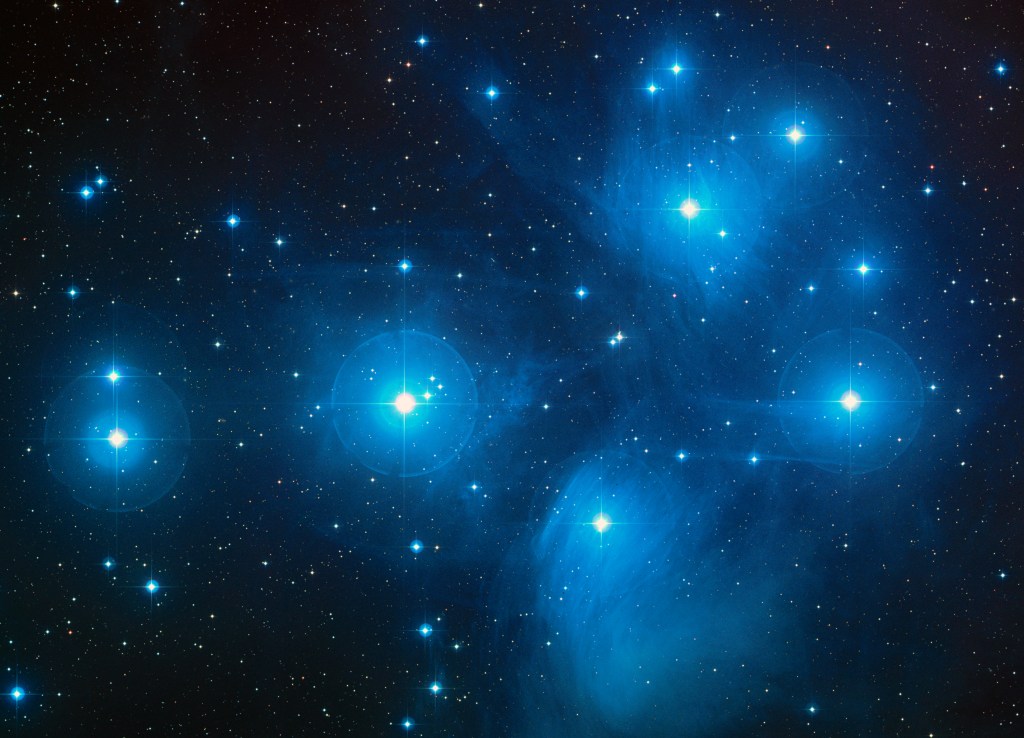
    The Pleiades – Courtesy NASA, Wikimedia Commons.

    ☐ The Pleiades

    By around 10 PM, turn your attention toward the east and look for the Pleiades. To the naked eye, this young star cluster looks like a tiny handful of stars. Through binoculars, the view changes completely, revealing many more stars packed together.

    How many did you find?

    You don’t need an expensive telescope or an astronomy degree to explore the night sky. Start with the patterns you can recognize, use them as landmarks, and let your eyes do the rest.

    Clear skies and happy viewing.

    10 October 2026 night sky – Courtesy SkySafari.

    Saturn – Courtesy PAC member Joel Cohen, Prescott Valley, 09/2020.

    The Pleiades – Courtesy NASA, Wikimedia Commons.

    Adam England is the owner of a local financial services firm and moonlights as an amateur astronomer, writer, and interplanetary conquest consultant.  Follow him on Instagram @TheBackyardAstronomerAZ and at http://www.ManzanitaInsuranceAndAccounting.com
  • August 2026 – The River of Light

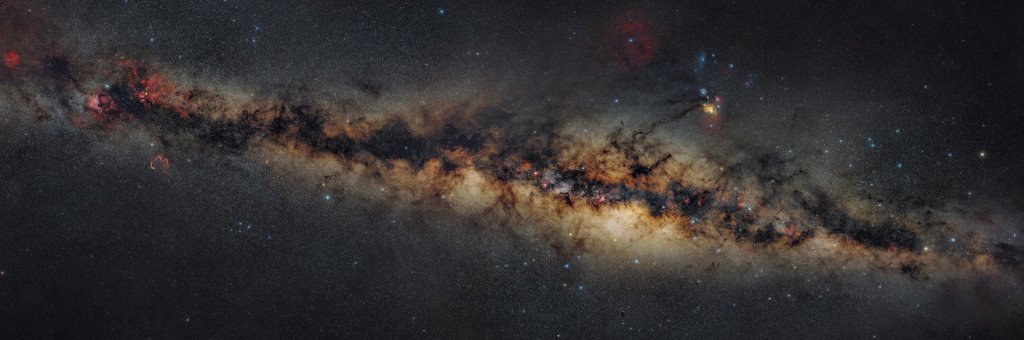
    The Milky Way – Courtesy Andrew McCarthy, on X @AJamesMcCarthy

    Summer can be a frustrating time for Arizona astronomers. Afternoon thunderstorms roll across the high desert with little warning, and many evenings that begin with promise end beneath a blanket of clouds. Yet every so often, the storms move on, the air settles, and the night sky opens above us. When it does, one of the finest sights in astronomy stretches from horizon to horizon.

    The Milky Way.

    People have looked up at this hazy ribbon of light for thousands of years. The ancient Greeks imagined it as milk spilled across the heavens, giving our galaxy the name we still use today. Other cultures saw it as a river, a road, or a bridge connecting Earth with the spirit world. Long before telescopes, it inspired people to wonder what lay beyond the stars.

    Today we know the answer is even more remarkable than the legends.

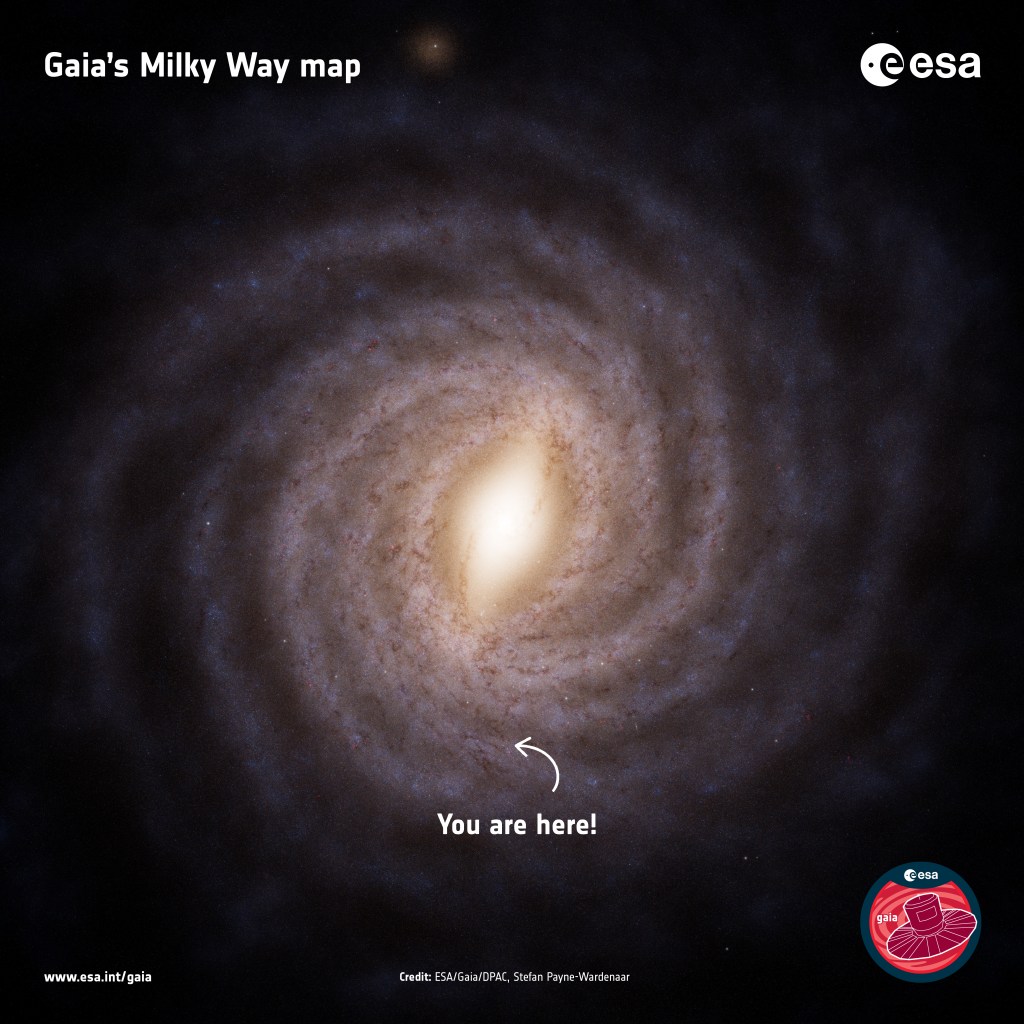
    Gaia’s Milky Way Map – Courtesy ESA.

    The Milky Way is our home galaxy, containing hundreds of billions of stars along with vast clouds of gas and dust. Unlike the beautiful spiral galaxies we see in photographs, we don’t have the luxury of viewing our own from the outside. Instead, our Solar System sits within one of its spiral arms, about 26,000 light-years from the galactic center. When we look toward the Milky Way, we’re looking across the disk of our own galaxy rather than at it from afar.

    That soft glow isn’t a cloud. It is the combined light of countless distant stars, so numerous and so far away that our eyes blend them into a single band crossing the sky.

    Running through that river of starlight are dark gaps that seem almost empty. In reality, they are enormous clouds of dust drifting between us and the stars beyond. Hidden inside many of those clouds are stellar nurseries where gravity is quietly shaping new generations of stars and, perhaps, future planetary systems.

    August 15th sky over Yavapai County – SkySafari Pro.

    August offers some of the year’s finest views of this celestial landscape. Shortly after darkness falls, look low to the south for the constellation Sagittarius. Its brightest stars outline the familiar shape of a teapot. Follow the “steam” rising from its spout, and you’ll be looking toward the center of the Milky Way, some 26,000 light-years away.

    From there, let your eyes wander north through Aquila and into Cygnus, the Swan. A pair of binoculars will reveal rich star fields, sparkling open clusters, and bright patches of nebulae that are easy to overlook with the naked eye. You don’t need expensive equipment to appreciate the view. Sometimes the best instrument is simply a comfortable chair and a dark sky.

    Shot from a cinder hill near the San Francisco Peaks, in the Flagstaff Ranger District, Coconino National Forest. We went out around sunset to view Comet NEOWISE. Photo by Deborah Lee Soltesz, July 14, 2020.

    One of my favorite moments is sharing that view with someone seeing the Milky Way under truly dark skies for the first time. There is usually a quiet pause as they realize they aren’t looking at some distant galaxy. They’re looking out across the one we call home.

    If the monsoon clouds give you a break this month, spend a few minutes under the stars before setting up the telescope. Some of the most memorable nights in astronomy begin with nothing more than looking up.

    Clear skies and happy viewing.

    Adam England is the owner of a local financial services firm and moonlights as an amateur astronomer, writer, and interplanetary conquest consultant.  Follow him on Instagram @TheBackyardAstronomerAZ and at http://www.ManzanitaInsuranceAndAccounting.com http://www.Manzanita-Insurance.com http://www.ManzanitaAccounting.com
  • June 2026 – Keeping An Eye On Jupiter

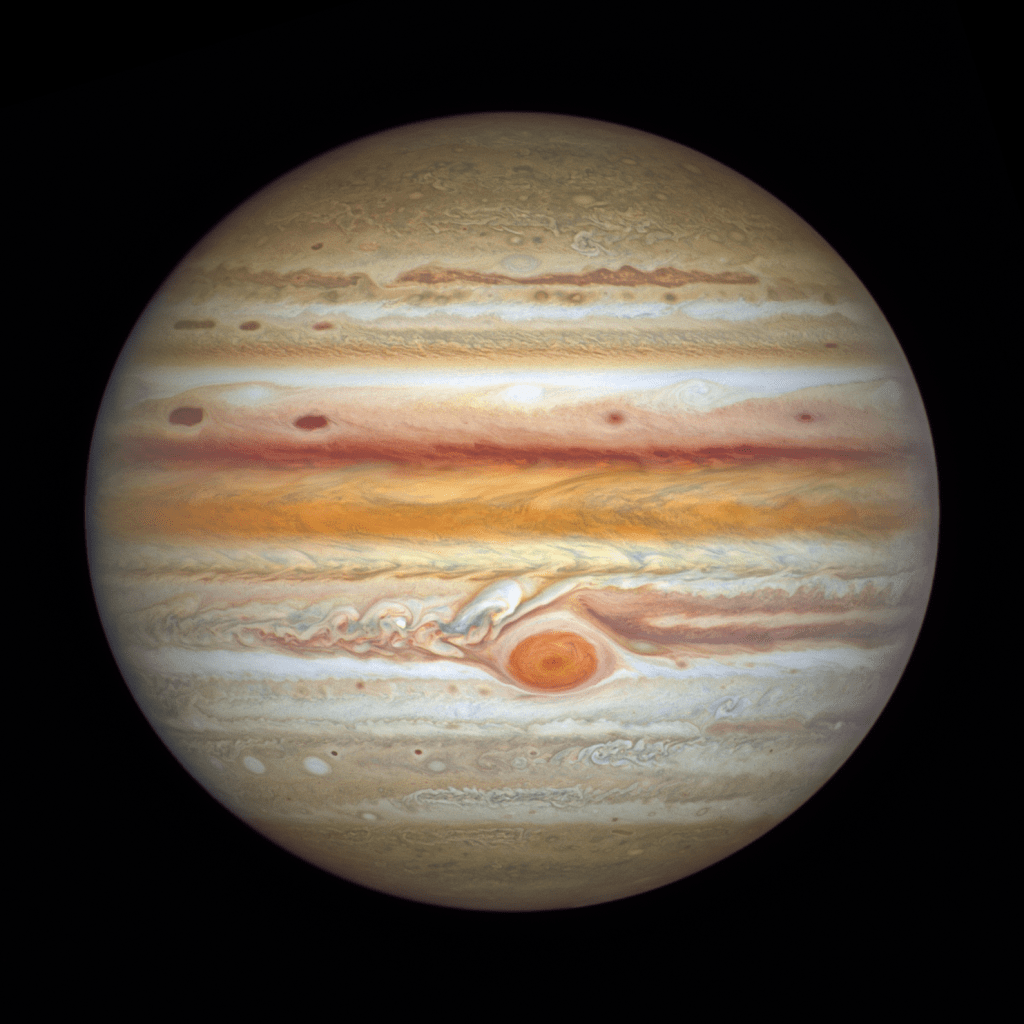
    Jupiter – Imaged by Hubble Space Telescope; Courtesy NASA.

    In Roman mythology, Jupiter was king of the gods, ruler of the heavens, and notorious for his wandering eye. His wife Juno knew this all too well. Often depicted beside a peacock whose feathers bore the “eyes” of the hundred-eyed giant Argus, Juno became a symbol of vigilance and watchfulness. For thousands of years, humanity has kept an eye on Jupiter as well—from ancient storytellers to modern spacecraft exploring the giant planet today.

    “Juno and Jupiter” by Gavin Hamilton, 1770; Courtesy Wikimedia Commons. Note the peacock keeping a watchful eye.

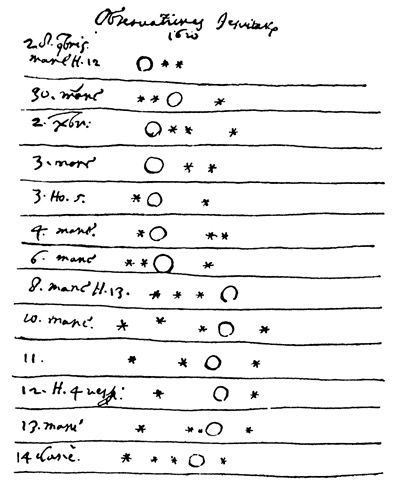
    That mythology found its way into astronomy centuries later. When Galileo first observed the four largest moons of Jupiter in 1610, they were eventually named Io, Europa, Ganymede, and Callisto—figures tied to Jupiter’s many romances and exploits in Roman mythology. As additional moons were discovered over the centuries, astronomers largely continued the tradition, naming many of Jupiter’s satellites after mythological companions, lovers, and descendants of the king of the gods.

    Galileo’s notes on Jupiter and location of 4 Galilean moons, c. 1610; courtesy Wikimedia Commons.

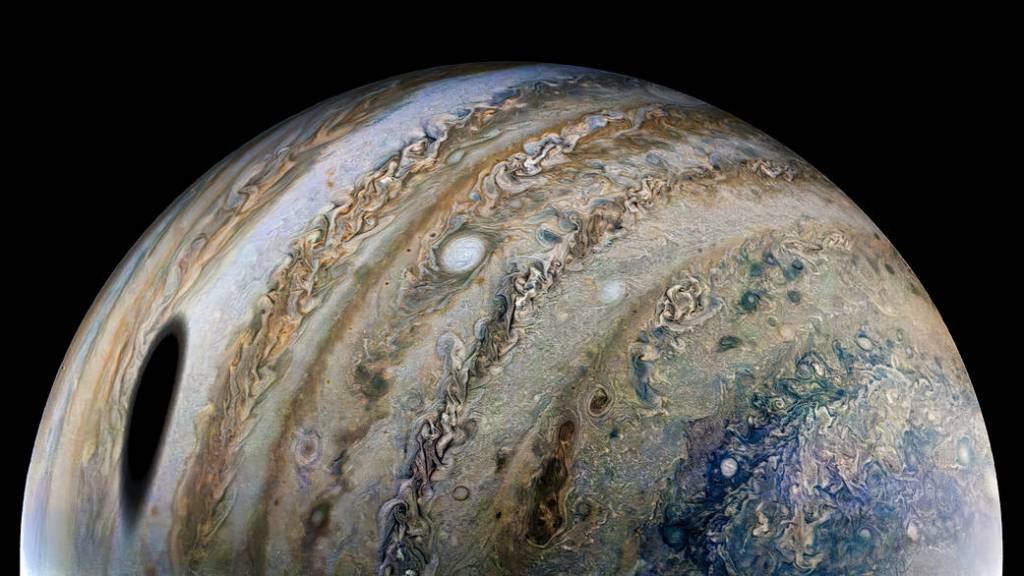
    More than four hundred years after Galileo’s discovery, NASA revived the theme with the Juno spacecraft. Launched in 2011 and arriving at Jupiter in 2016, Juno was designed to peer beneath the planet’s swirling cloud tops and study its atmosphere, magnetic field, auroras, and interior structure. Orbiting through one of the harshest radiation environments in the Solar System, the spacecraft continues to send back breathtaking images and scientific discoveries. Even today, Juno still keeps a close eye on Jupiter.

    Jupiter – Imaged by Juno spacecraft; Courtesy NASA.

    Fortunately, backyard astronomers can do the same this month.

    Throughout the month of June, Jupiter will glow low in the western sky shortly after sunset, offering several beautiful conjunctions for evening observers. The most striking occurs on the evenings of June 8th and 9th, when Jupiter and brilliant Venus appear less than one degree apart in the twilight sky. The two brightest planets will create a spectacular pairing visible even before the sky fully darkens. Binoculars should frame both planets comfortably together, while small telescopes may reveal Jupiter’s four Galilean moons alongside the dazzling crescent phase of Venus.

    The show continues on June 16th, when a thin crescent Moon joins the scene low in the western sky. The pairing should make for an excellent photo opportunity shortly after sunset, especially with foreground scenery or desert landscapes silhouetted beneath the planets.

    By June 24th, elusive Mercury joins the gathering as it approaches Jupiter near the horizon. Observers with a clear western view and steady skies may be able to spot all three planets during evening twilight.

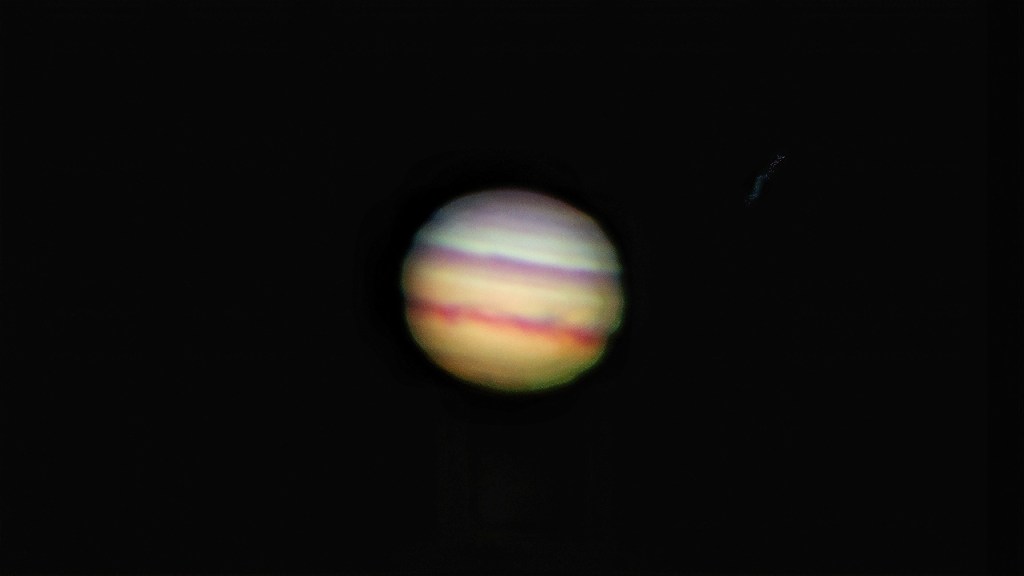
    Jupiter as imaged by Prescott Astronomy Club member Joel Cohen. Prescott Valley, AZ, 2020.

    While Jupiter will sit relatively low for Northern Hemisphere observers this month, even modest backyard telescopes can still reveal its cloud bands and ever-changing family of moons. One of the great joys of observing Jupiter is watching those moons shift position from night to night. Sometimes they line up neatly beside the planet. Other evenings one or more may disappear behind Jupiter or pass in front of its disk, casting tiny shadows onto the giant world below.

    For centuries, humans have watched Jupiter wander across the heavens, weaving mythology, science, and exploration together in its wake. This June, as Venus, Mercury, the Moon, and Jupiter gather in the twilight, take a moment to keep an eye on the king of planets yourself.

    Clear skies and happy viewing.

    Adam England is the owner of a local financial services firm and moonlights as an amateur astronomer, writer, and interplanetary conquest consultant.  Follow him on Instagram @TheBackyardAstronomerAZ and at www.ManzanitaInsuranceAndAccounting.com

    www.Manzanita-Insurance.com

    www.ManzanitaAccounting.com

  • May 2026 – A Fire in the Asteroid Belt

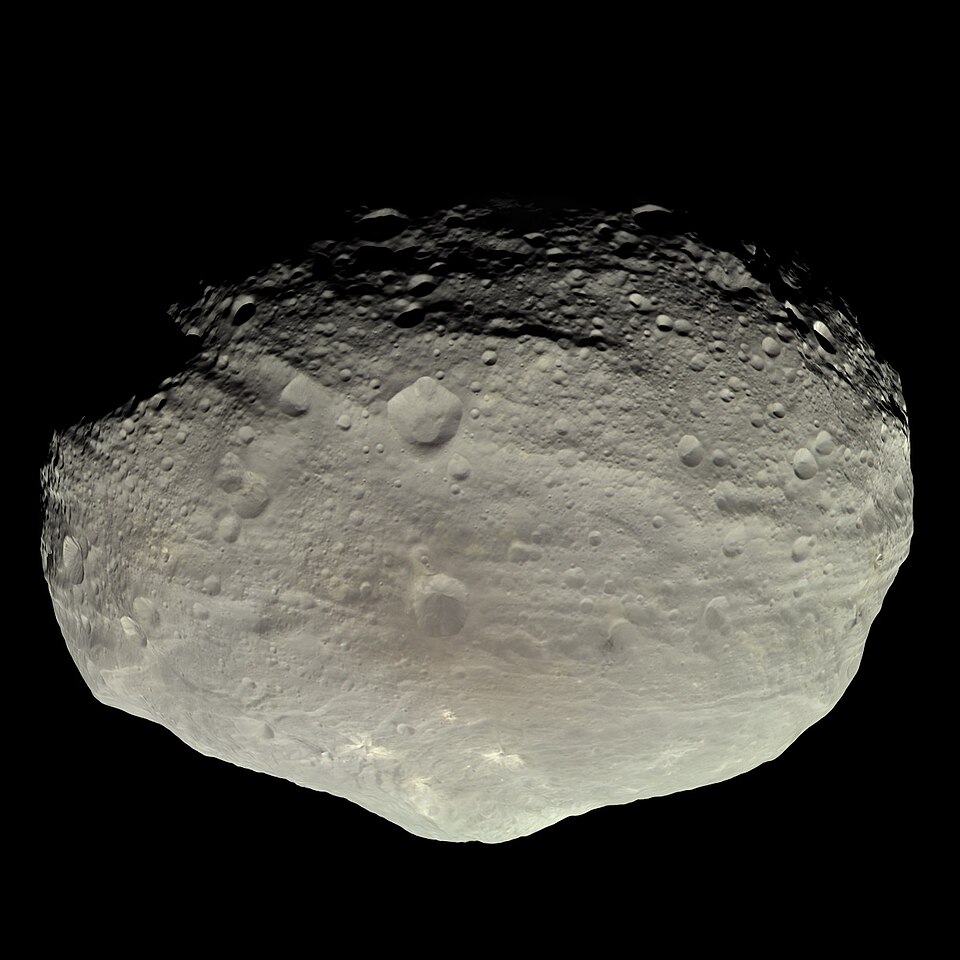
    Vesta – Imaged by Dawn spacecraft 2011, Courtesy NASA.

    The dawn of the 19th century marked a boom in astronomical discovery. Telescope technology improved rapidly, revealing a new class of objects orbiting between Mars and Jupiter.

    In 1801, Italian astronomer Giuseppe Piazzi discovered Ceres, the first and largest of these bodies. A year later, Heinrich Olbers identified Pallas. These objects didn’t behave like planets, yet they weren’t comets either. They occupied a region that seemed curiously empty.

    Olbers proposed a bold idea. He suggested to William Herschel that these bodies might be remnants of a destroyed planet. If so, additional fragments should lie along similar orbital paths. Searching near where the orbits of Ceres and Pallas intersected, Olbers made another discovery in 1807.

    He had found Vesta.

    Named after the Roman goddess of home and hearth, Vesta became the fourth asteroid discovered—designated 4 Vesta. While Olbers’ hypothesis captured imaginations for years, modern science tells a different story. These asteroids are not fragments of a single world, but leftover building blocks from the early Solar System. That Olbers found Vesta where he did was more coincidence than confirmation.

    Even so, Vesta stands apart.

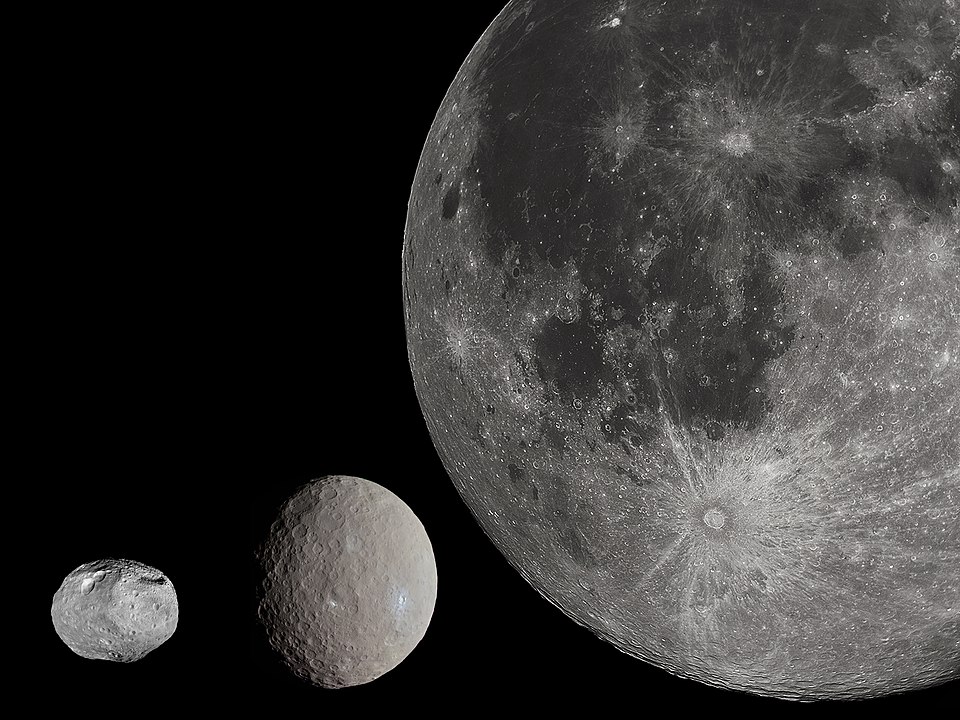
    Vesta Size Comparison – Courtesy NASA.

    With a diameter of about 330 miles, it is the second most massive object in the asteroid belt, behind Ceres. Unlike many smaller asteroids, Vesta is differentiated, with a core, mantle, and crust—more like a small planet than a typical space rock. In many ways, it is a world that nearly became one.

    Its surface tells a violent story. Massive impacts have carved enormous basins into its southern hemisphere, ejecting debris that has reached Earth as meteorites. These fragments give scientists a rare chance to study a protoplanet without leaving our planet.

    In 2011, NASA’s Dawn spacecraft arrived at Vesta, becoming the first mission to orbit a main-belt asteroid. Over a year, it mapped the surface in remarkable detail, revealing bright and dark regions, ridges, and deep craters.

    For backyard astronomers, Vesta offers a rare treat: it can be bright enough to see. Thanks to its high reflectivity, it may even reach naked-eye visibility under dark skies. More often, it appears as a bright, star-like point in binoculars or a small telescope, drifting slowly against the background stars.

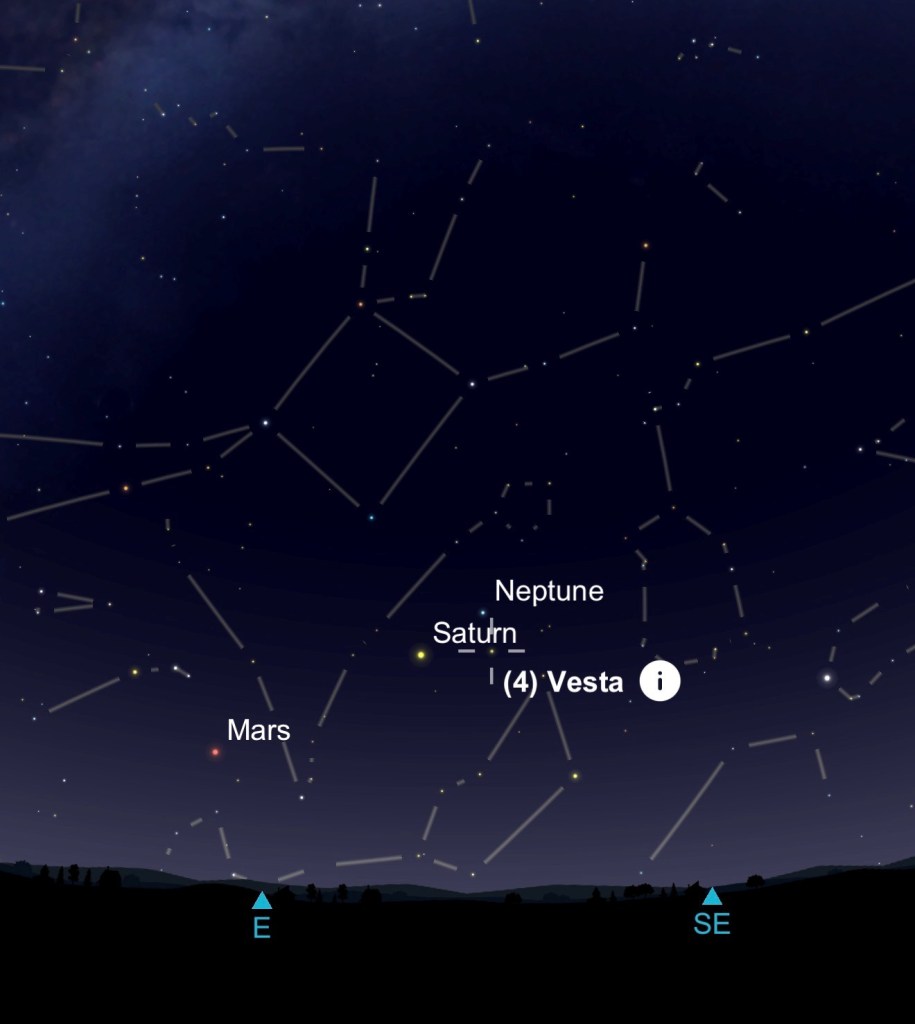
    Throughout May, Vesta will share the early morning sky with Saturn and Neptune, rising just before sunrise. Look low on the eastern horizon along the ecliptic, near the boundary of Pisces and Aquarius.

    Vesta location May 2026 – SkySafari.

    Unlike planets, Vesta won’t reveal a disk or surface detail in most backyard telescopes. The reward comes from tracking its motion. Over several nights, you can watch it shift among the stars—a subtle reminder that this “star” is actually a world in motion.

    So this May, take a moment to seek out Vesta. You’ll be looking at one of the earliest discovered members of the asteroid belt, a survivor from the dawn of the Solar System, and a world that almost was.

    Clear skies and happy viewing.

    #Astronomy #Space #STEM #STEMEducation #NASA

    Follow us at facebook.com/BackyardAstronomerAZ

    Check out the NAZ Astro mission of STEM education at facebook.com/NAZAstro

    Support STEM education patreon.com/NAZAstro

    Our awesome sponsors:

    facebook.com/manzanitains

    www.Manzanita-Insurance.com

    www.ManzanitaAccounting.com

    www.ManzanitaInsuranceAndAccounting.com

    www.BackyardAstroAZ.com

  • April 2026 – Earthshine: The Da Vinci Glow

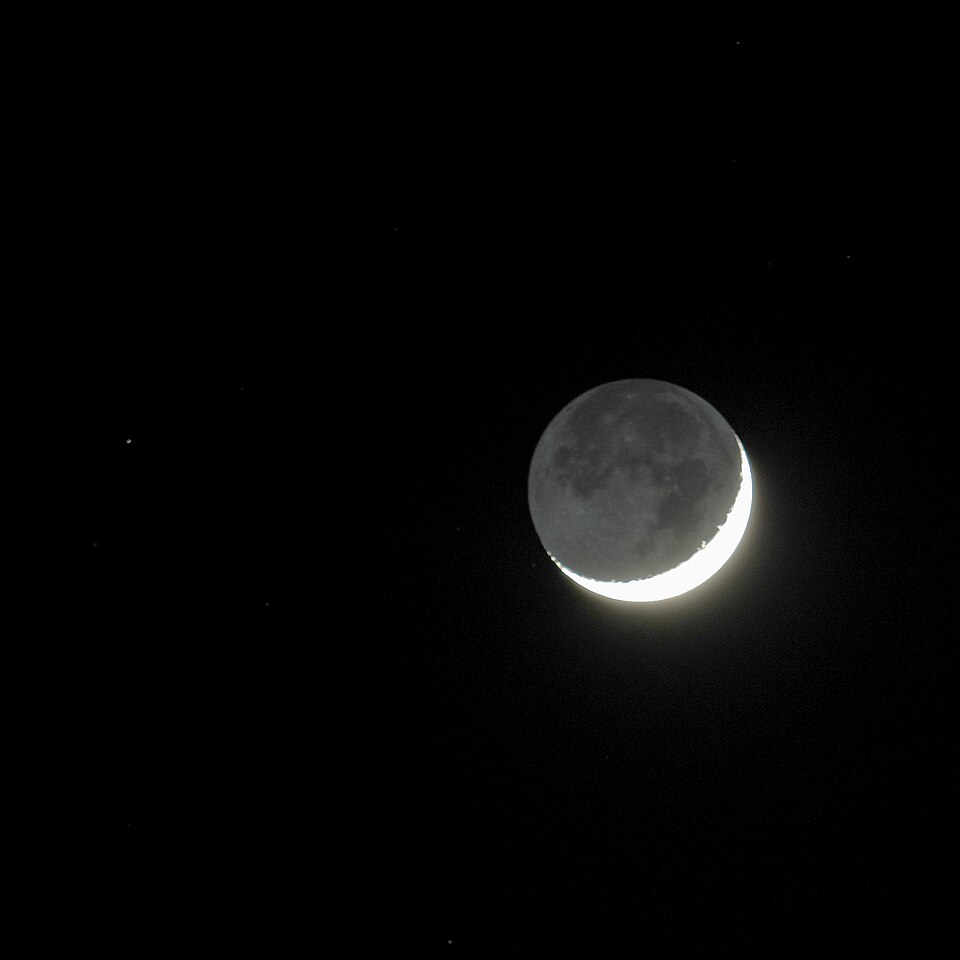
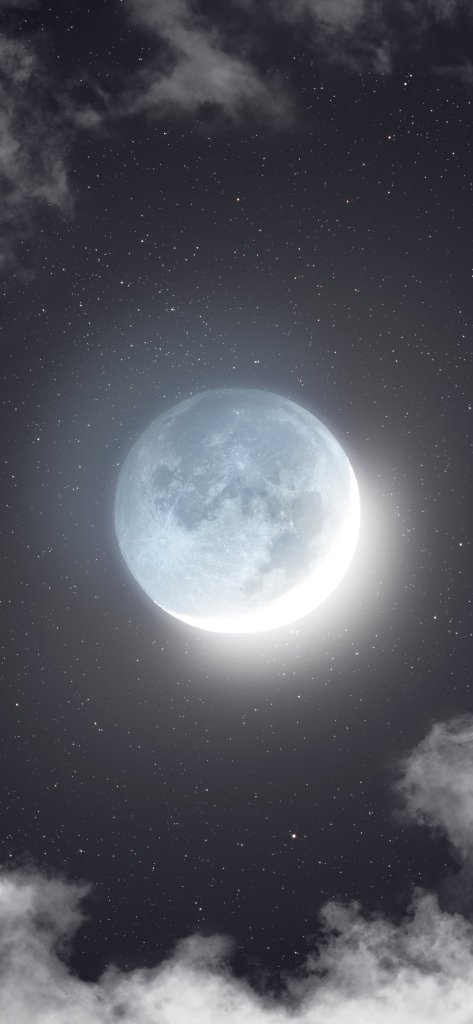
    Earthshine – Courtesy Bautsch, Wikimedia Commons.

    Step outside on a clear evening and look for a thin crescent Moon hanging low in the twilight. If the sky is dark enough, you may notice something unexpected: the rest of the Moon faintly glowing. Not bright like the crescent itself, but softly illuminated, as if the entire lunar disk were suspended in dim gray light.

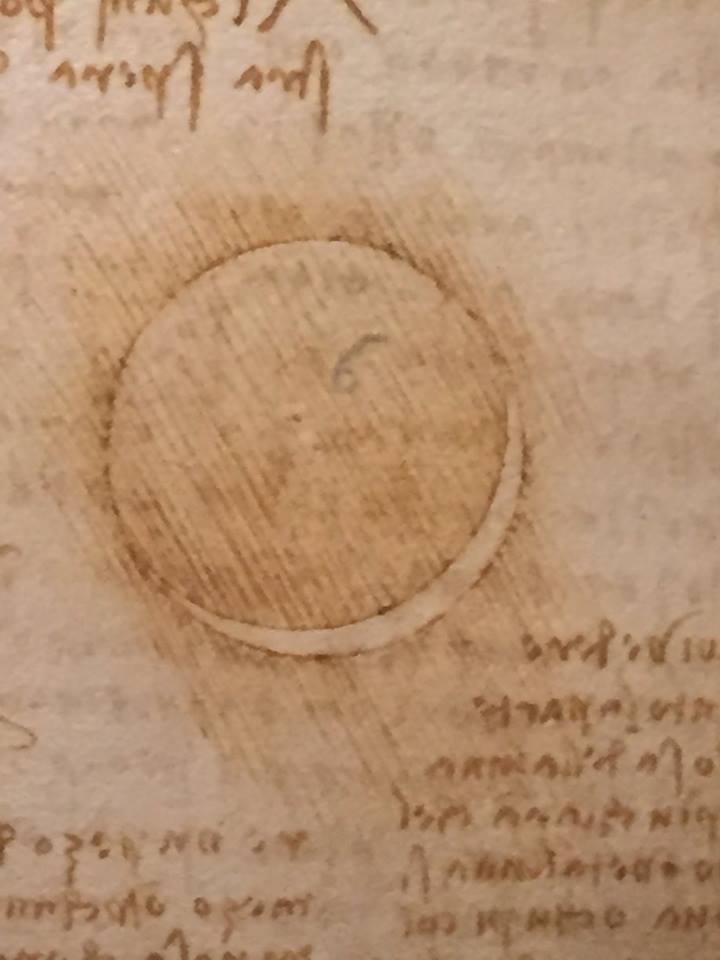
    This phenomenon is known as earthshine, sometimes called the Da Vinci Glow. More than five hundred years ago, the Renaissance artist and scientist Leonardo da Vinci correctly reasoned what caused it. The Moon’s night side, he proposed, is illuminated by sunlight reflecting off the Earth.

    Sketch of Earthshine by Leonardo Da Vinci from Codex Leicester (c. 1510).

    Just as the full Moon brightens our night sky, the Earth can do the same for the Moon.

    When the Moon appears as a thin crescent from our perspective, someone standing on the lunar surface would see nearly a full Earth in their sky. Our planet is far more reflective than the Moon, thanks to its clouds, oceans, and ice. Sunlight reflects off Earth, travels to the Moon, and softly illuminates the portion of the lunar surface that would otherwise be dark.

    It’s quite a journey for a ray of sunlight: Sun to Earth, Earth to Moon, and then back again to our eyes.

    The result is the ghostly glow that outlines the Moon’s darker hemisphere.

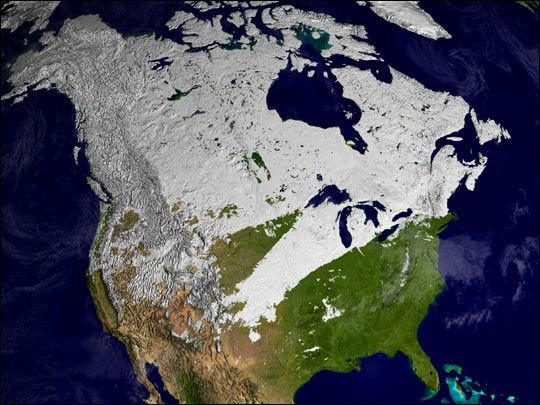
    Northern Hemisphere snow cover, February 2002 – Courtesy NASA.

    Earthshine is easiest to see when the Moon is in its crescent phases, just a few days before or after a new Moon. During this time the sunlit crescent is thin, allowing the dim Earth-lit portion to stand out more clearly.

    In April 2026, the new Moon occurs on April 17, making the best opportunities to observe earthshine occur on the surrounding nights.

    Look for it in the morning sky from April 14 through April 16, just before sunrise in the eastern sky. Another excellent window appears in the evening sky from April 19 through April 22, shortly after sunset in the west.

    You don’t need a telescope to see earthshine. In fact, it is often easiest to appreciate with the naked eye or a pair of binoculars, when the entire Moon fits comfortably in your field of view. Through a small telescope, the effect becomes even more striking. The dark portion of the Moon appears softly illuminated, revealing faint hints of maria and craters floating in the dim glow.

    Earthshine (composite) – Courtesy @AJamesMcCarthy

    Early spring can be one of the best seasons for earthshine in the Northern Hemisphere. Snow and ice left from winter increase Earth’s reflectivity, meaning more sunlight is bouncing off our planet and onto the Moon.

    What makes earthshine especially fascinating is that it reminds us that the Earth and Moon are constantly lighting each other.

    The Moon brightens our nights, guiding travelers and astronomers alike. At the same time, our own planet is shining back, casting its pale reflection across the lunar landscape.

    So the next time you see a slender crescent Moon in April’s twilight sky, look closely at the darker portion of the disk. That gentle glow you see is sunlight reflected from oceans, clouds, and continents — the light of Earth itself returning to the Moon.

    Clear skies and happy viewing.

    Adam England is the owner of a local financial services firm and moonlights as an amateur astronomer, writer, and interplanetary conquest consultant.  Follow him on Instagram @TheBackyardAstronomerAZ and at http://www.ManzanitaInsuranceAndAccounting.com
  • January 2026 – A Winter Sky Worth Watching

    The new year kicks off with cosmic fireworks as the Quadrantid Meteor Shower peaks in the early morning hours of January 3rd. Believed to originate from debris left behind by a long-lost comet noted by Asian astronomers more than 500 years ago, this short-lived but powerful shower radiates from the now-defunct constellation Quadrans Muralis. French astronomer Jérôme Lalande introduced the constellation in 1795, naming it after the instrument he used to chart the heavens.

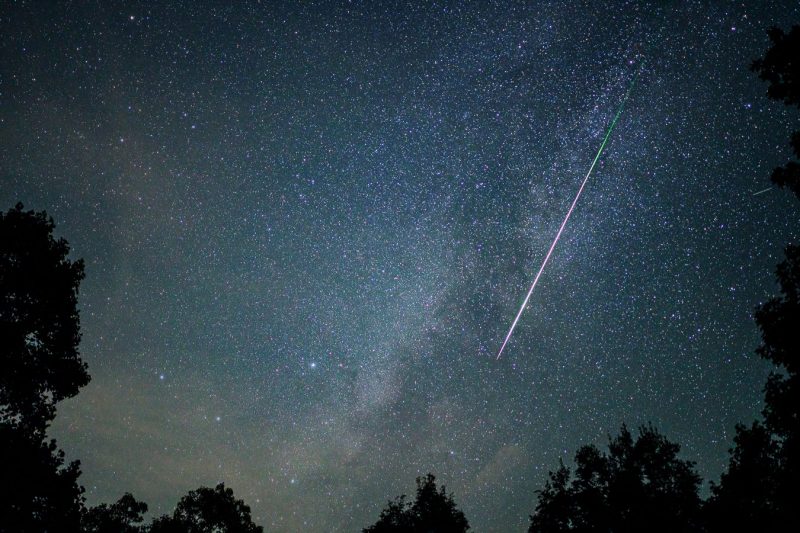
    Meteor over Asheville, NC – Courtesy Jason Reynolds, Wikimedia Commons.

    In the best years, the Quadrantids can produce up to 120 meteors per hour, making them one of the strongest showers of the year. Set your alarm for between 3:00 and 5:00 AM, bundle up, and look toward the handle of the Big Dipper to catch the show.

    A slight challenge this year will be the Super Wolf Moon, shining brightly in the western sky during the peak hours. Named for the packs of wolves often heard howling during long winter nights, the first full Moon of 2026 is also the first of three supermoons this year. While its brilliance may wash out some of the fainter meteors, the Moon will serve as a celestial guidepost. Just a few degrees away, you’ll find Jupiter and the Gemini twins, Castor and Pollux, glowing nearby.

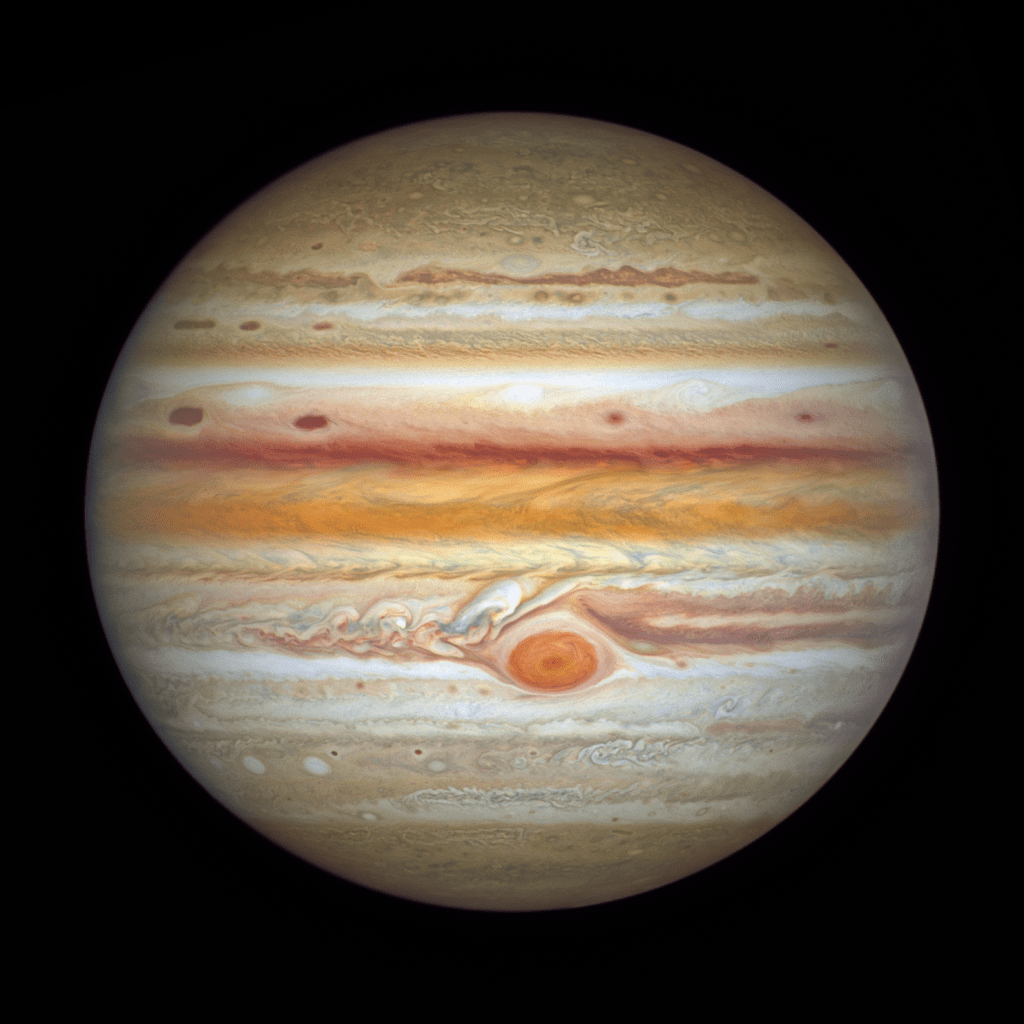
    Jupiter – courtesy the Hubble Space Telescope, NASA.

    Jupiter steals the spotlight this month, reaching opposition on January 10th. Fully illuminated by the Sun and at its closest approach to Earth, the king of planets will shine at its brightest. With steady winter air often delivering excellent seeing conditions, even modest telescopes should reveal Jupiter’s cloud bands and its four Galilean moons dancing night after night.

    Ancient cultures revered the start of the lunar cycle as a time for renewal and reflection. You can renew your own astronomical journey with the year’s first new moon on January 18th, ushering in the long, dark skies Northern Hemisphere observers wait all year to enjoy.

    Orion Nebula, JWST, Courtesy NASA/ESA.

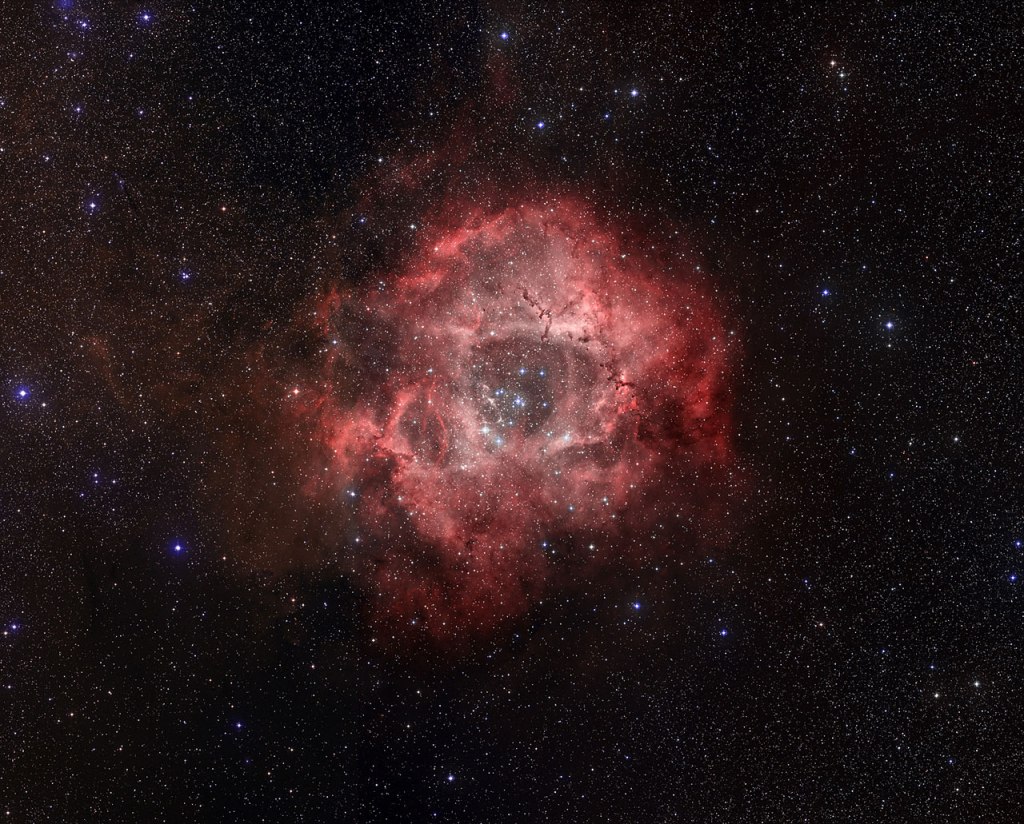
    In the early evening, Saturn and Neptune appear close together in the southwestern sky, while by around 9:00 PM, Uranus flirts with the Pleiades near the zenith. Jupiter rises in the east, and the Orion Nebula is easily spotted just below the three bright stars of the Hunter’s Belt. Roughly halfway between Jupiter and Orion lies the Rosette Nebula, a vast molecular cloud forming the rosy nose of the constellation Monoceros the Unicorn. The surrounding region is rich with open clusters, making it an ideal night to practice a bit of star hopping across the winter constellations.

    Rosette Nebula – courtesy the Hubble Space Telescope, ESA.

    So bundle up, step outside, and look up this January. Crisp winter skies are a gift to astronomers—both seasoned observers and those just beginning their journey. Wishing you clear skies and happy viewing in the year ahead.

    Adam England is the owner of a local financial services firm and moonlights as an amateur astronomer, writer, and interplanetary conquest consultant.  Follow him on Instagram @TheBackyardAstronomerAZ and at www.ManzanitaInsuranceAndAccounting.com

  • October 2025 – Lions and Comets and Bears, OH MY!

    Comet C/2025 A6 (Lemmon) as captured 9/24/2025 by Dimitrios Katevainis, courtesy Wikimedia Commons.

    Nearly every evening, the Steward Observatory’s 60-inch Cassegrain reflector takes thousands of photos, the same as it has for almost two decades.  From their perch atop Mount Lemmon at over 9,100 feet of elevation, just a few miles north of Tucson, Arizona, astronomers use this amazing instrument to image small patches of the sky measuring just 5 degrees field of view, or about the width of your fist outstretched at arm’s length.  For 30 seconds at a time, the highly sensitive camera on the telescope gathers the faintest photons of light for a resulting snapshot of space with a resolution of over 111 megapixels.  These detailed stills are compared night-after-night to look for even the slightest changes, the key indicator that some unknown object in the far reaches of our Solar System has been discovered.  On one cold night in January of this year, Carson Fuls, director of the Catalina Sky Survey, found one of these faint dots of light had moved, and then again, the next night.  From nearly 420 million miles away, he had discovered a new comet.

    Catalina Sky Survey, Steward Observatory 1.52m Telescope, Courtesy University of Arizona.

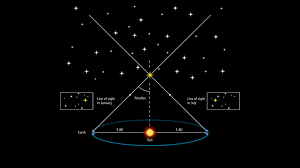
    Once a new comet is discovered, telescopes around the world – and in space – begin to take follow up observations of its path across the sky.  Using a method called parallax, these additional observations track the object against the distant background stars to measure its size, orbit, and distance.  Like looking at a far-off mountaintop, a closer object – such as a tree or building – may appear to move quite a bit as the observer takes a few steps left or right.  Similarly, as the Earth orbits the Sun, and the object moves along its own orbit, the seemingly static background of space offers a standard that scientists can use trigonometry to measure against. 

    Parallax example, Space.com

    The Catalina Sky Survey has discovered thousands of comets, asteroids, and other near-Earth Objects (or NEOs) during its time.  Commissioned by a congressional directive in 1998 to identify nearby objects 1 kilometer or larger, Mount Lemmon was chosen for this mission, and the University of Arizona has managed the discovery of more than 39,000 total objects, accounting for more than 50% of all NEO discoveries.

    Comet C/2025 A6 (Lemmon) imaged by Dimitrios Katevainis. Wikimedia Commons.

    Comet C/2025 A6 (Lemmon) is the official designation for this newly discovered visitor, coming to us from the furthest reaches of the Kuiper Belt.  Professional and amateur astronomers alike have contributed observational data, tracking it as having an aphelion of 244 AU, meaning its orbit takes it more than 240 Earth-Sun distances away.  Being that one AU is 93 million miles, that places its orbit as far as 22 billion miles distant.  The last time it made a pass through the inner solar system was approximately 1350 years ago. 

    Comet C/2025 A6 (Lemmon) location 21 October 2025. Courtesy TheSkyLive.com.

    Throughout the month of October, you can observe this long period comet as it moves across Northern Hemisphere skies.  Early October will find the comet in the constellation Leo Minor, the “Smaller Lion”, and progressing to Ursa Major, the “Great Bear”.  We know Ursa Major from its easily identifiable asterism, the Big Dipper.  On October 21st the comet will make its closest approach to Earth while in the constellation Boötes.  Look to the Western horizon just after sunset, and find the bright star Arcturus.  Approximately 10 degrees above and to the right of Arcturus, or two fists at arm’s length, observers with dark skies may see the comet and its tail visible to the naked eye, but certainly visible in a small pair of binoculars.  As the sky gets darker over the next hour, it will begin to brighten and move down to the horizon, until the tail disappears behind the mountains.

    Adam England is the owner of a local financial services firm and moonlights as an amateur astronomer, writer, and interplanetary conquest consultant.  Follow him on Instagram @TheBackyardAstronomerAZ and at www.ManzanitaInsuranceAndAccounting.com
    #Astronomy #Space #STEM #STEMEducation

    Follow us at facebook.com/BackyardAstronomerAZ

    Check out the NAZ Astro mission of STEM education at facebook.com/NAZAstro

    Support STEM education patreon.com/NAZAstro

    Our awesome sponsors:

    facebook.com/manzanitains

    www.Manzanita-Insurance.com

    www.ManzanitaAccounting.com

    www.ManzanitaInsuranceAndAccounting.com

    www.BackyardAstroAZ.com
  • September 2025 – In the Shadow of Titan

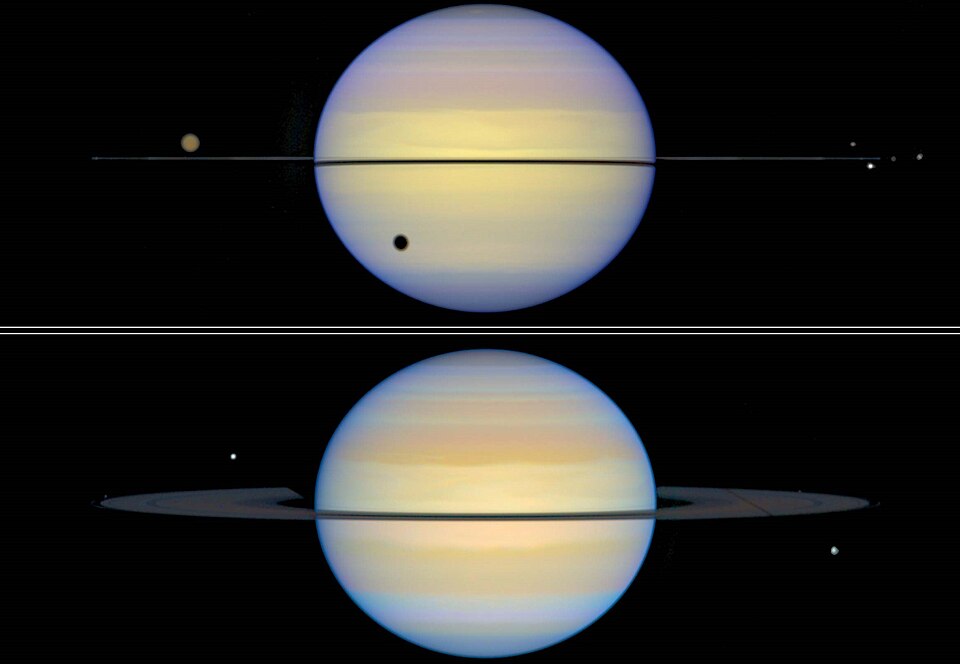
    Titan shadow on Saturn, Hubble Space Telescope, Courtesy NASA.

    It seems that discoveries across the Universe are announced almost daily. The Hubble Space Telescope, launched into low Earth orbit in 1990, has been a workhorse in this effort, capturing and analyzing light in multiple wavelengths to probe the unknown. A growing suite of other instruments adds to this quest: the famed James Webb Space Telescope, the twin TRAPPIST telescopes in Chile and Morocco, and the now-retired Kepler Space Telescope, which discovered thousands of exoplanets during its decade-long mission from 2009 to 2018.

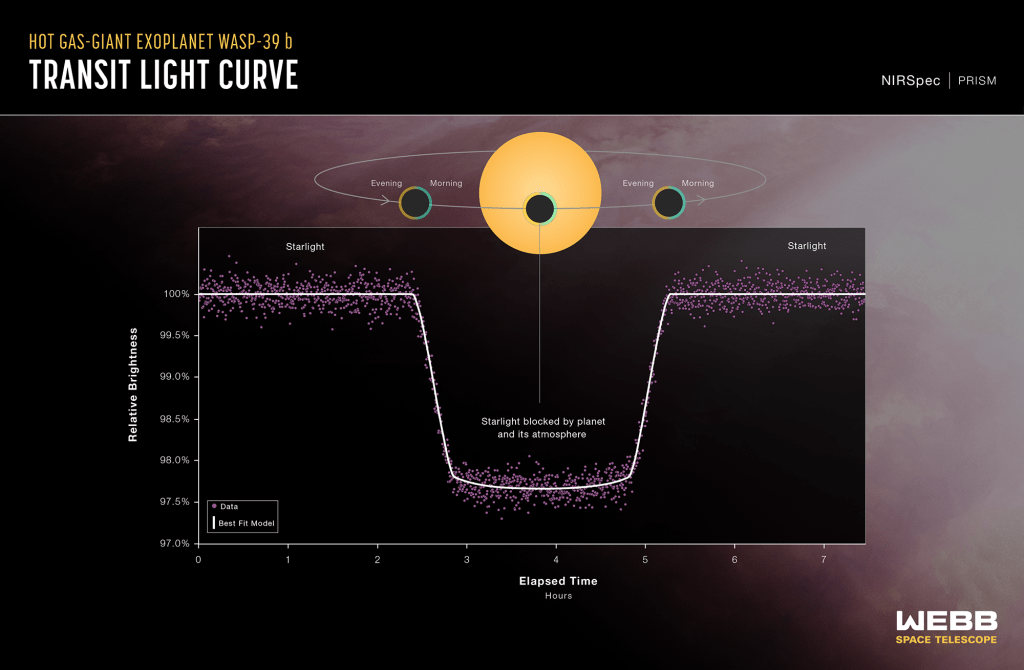
    Transit Light Curve, James Webb Space Telescope, Courtesy NASA.

    What these observatories share is the method they use to reveal hidden worlds: the transit method. By carefully measuring the dimming of a star as another body passes in front of it, astronomers can determine the size, mass, orbit, and distance of the interceding object. The most sensitive spectrometers can even parse starlight as it filters through an alien atmosphere, revealing its chemical makeup. From Earth, this technique lets us explore places light-years away without ever leaving home.
    The transit method, Courtesy Wikimedia Commons.

    But transit watching is hardly new. Ancient astronomers noticed these celestial crossings long before modern instruments. Pythagoras is credited with realizing that the morning and evening stars were both Venus. In 1032, Persian polymath Avicenna recorded what appears to be a transit of Venus across the Sun. Frescoes at the Mayan ruins of Mayapan on the Yucatán peninsula may depict similar events in the 12th or 13th centuries. By the 1600s, astronomers were regularly predicting and observing the transits of Mercury and Venus.

    Tomb Of Avicenna, Hamadan, Iran.  Wikimedia Commons.

    The early 20th century brought a new focus: the moons of the outer Solar System. Between 1907 and 1944, careful observations before, during, and after a transit revealed that Saturn’s moon Titan had an atmosphere—a discovery confirmed when astronomers began splitting its light into elemental fingerprints. Decades later, in 1979, the Pioneer 11 spacecraft became the first visitor to glimpse Titan up close.

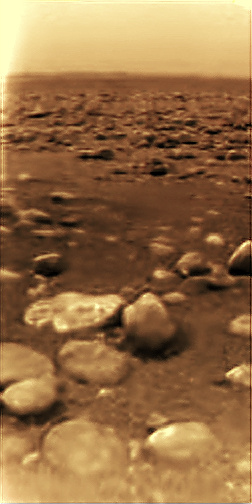
    Surface of Titan, Huygens Probe, Courtesy NASA.

    Titan remains one of the most intriguing worlds in our Solar System. The second largest moon after Ganymede, it is the only moon known to possess a thick atmosphere—denser, in fact, than Earth’s. Rich in nitrogen and methane, Titan’s skies shroud a surface carved by rivers, deltas, sand dunes, and glaciers. Its methane cycle, with lakes and rain that echo Earth’s water cycle, makes Titan feel oddly familiar despite its alien chemistry.

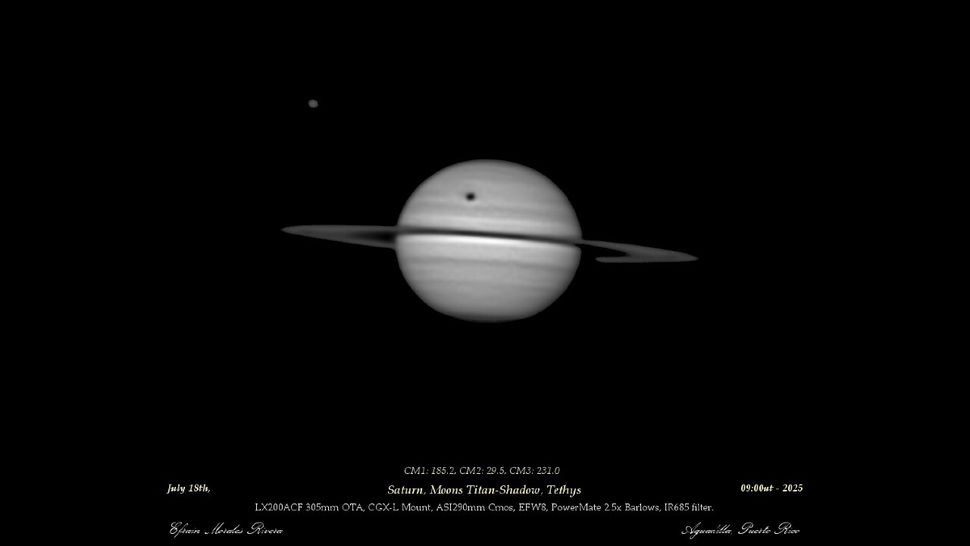
    7/18/2025 Transit of Titan, Efrain Morales, Space.com.

    And this month, you can see Titan’s presence for yourself. Backyard astronomers will have two opportunities to observe Titan’s shadow crossing the disk of Saturn. The first begins at 1:25 AM on September 4th, lasting about three and a half hours. The second starts at 1:09 AM on September 20th, lasting two and a half hours. An 8-inch telescope at 200x magnification or greater should reveal Titan’s tiny shadow creeping across Saturn’s golden globe. Even smaller scopes—4 to 6 inches—can still capture Titan itself as a bright companion near the ringed planet on most nights.

    So set your alarm, aim your telescope at the jewel of the outer planets, and watch as Titan casts its shadow. In those moments, you’ll be connecting with a tradition of skywatchers stretching back thousands of years—humans who, like us, couldn’t resist tracing the stories written in the light of distant worlds.

  • August 2025 – Early Risers

    The early bird may get the worm, but the early astronomer gets the universe.

    August 2025 belongs to the early risers—when the Moon leads the dance and the planets shine their brightest in the hours before sunrise. Watch as our lunar guide sweeps across the sky, spotlighting celestial wonders along the way.

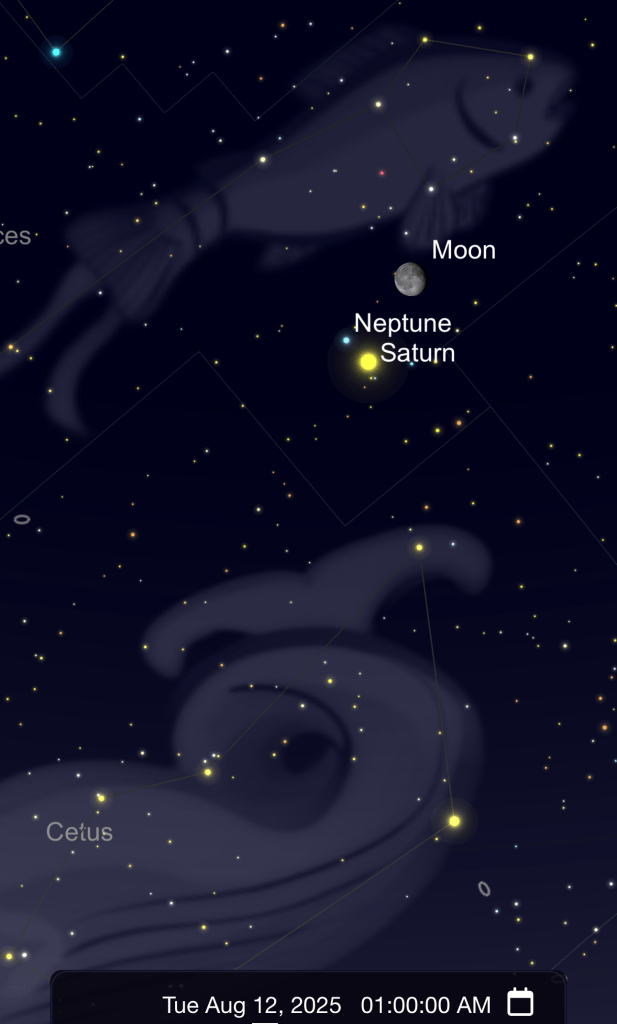
    Beginning around the 1 o’clock hour on Tuesday the 12th, the waning gibbous moon will be directly adjacent both Saturn and Neptune. While Saturn and its rings may be seen with telescope apertures as small as 3 inches, you will need at least an 8-inch scope to begin resolving the blue disk of Neptune. However, even smaller scopes will offer a blue dot near to Saturn this morning, showing how these close approaches are great opportunities to find new objects to observe.

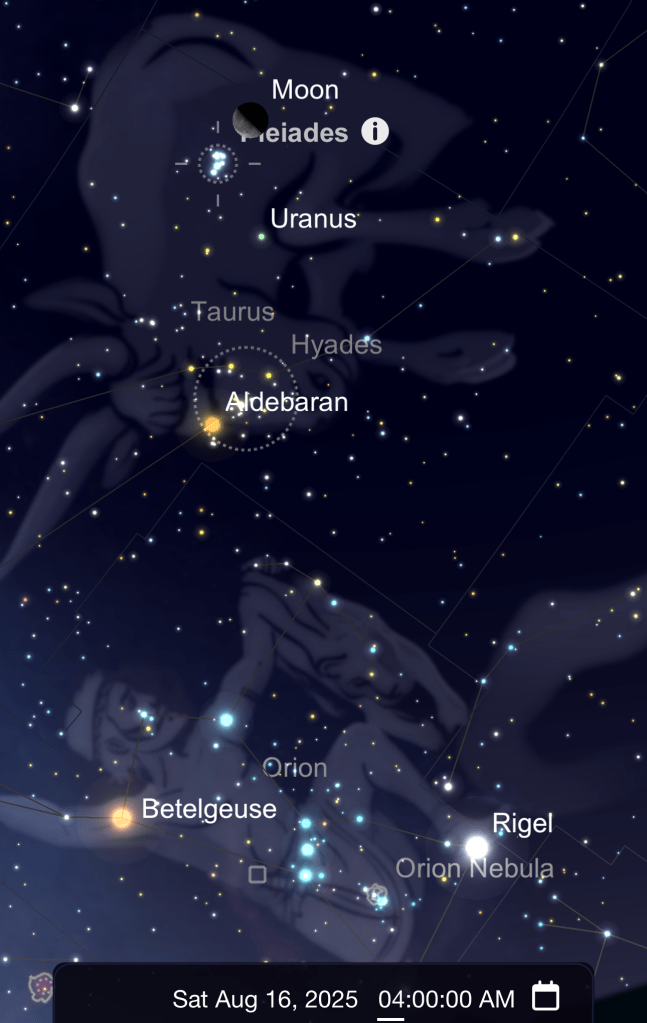
    As the moon passes into the third quarter, the morning of Saturday the 16th will find the moon near to the Pleiades open cluster and Uranus. Like Neptune, the pale cyan coloring and clouds of this distant world are best seen with scopes of 8 to 10 inches or larger.

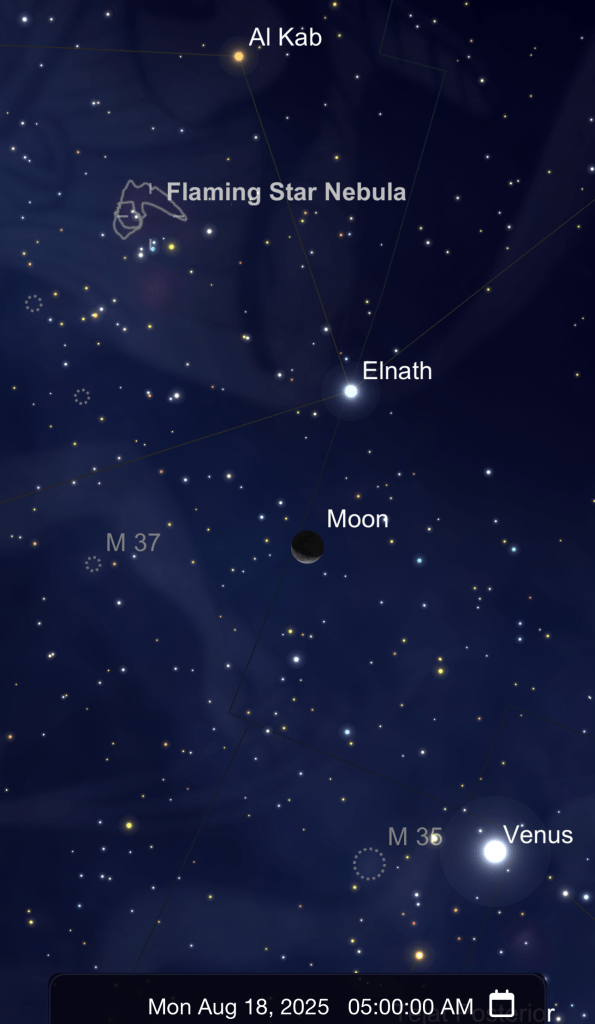
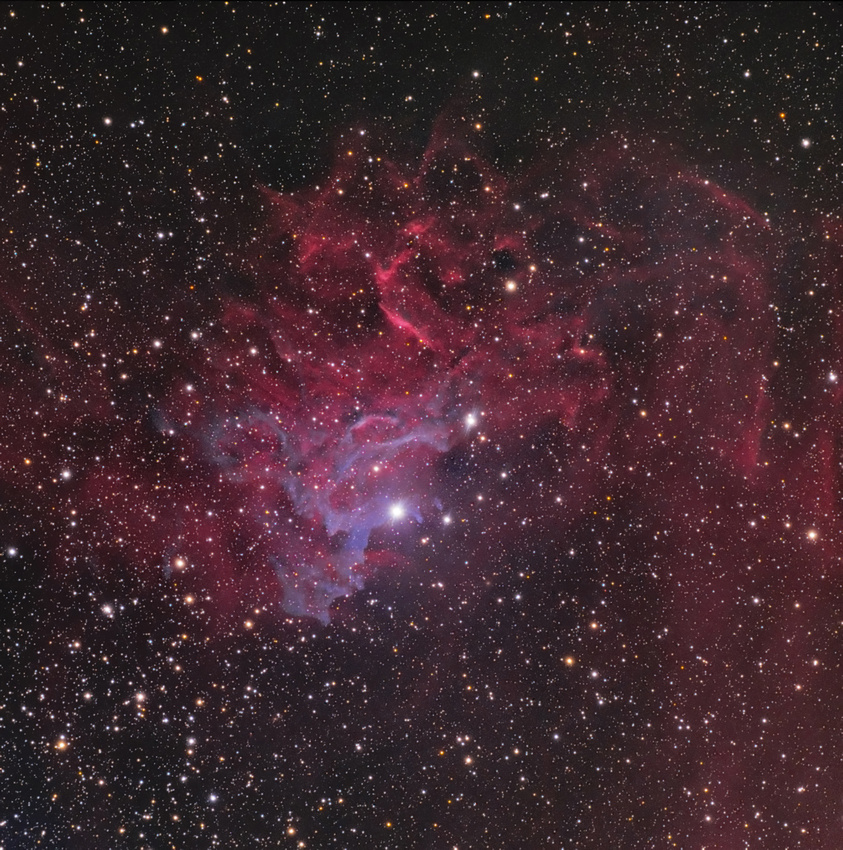
    The waning crescent moon of Monday the 18th will be near the bright star Elnath, one of just a handful of “linking stars”, being both the horn of Taurus and the knee of neighboring Auriga. Within just a couple degrees radius around the moon this night will also be Venus, the open clusters M35 and M37, the Pinwheel Cluster (M36) and Starfish Cluster (M38), as well as the Flaming Star Nebula.

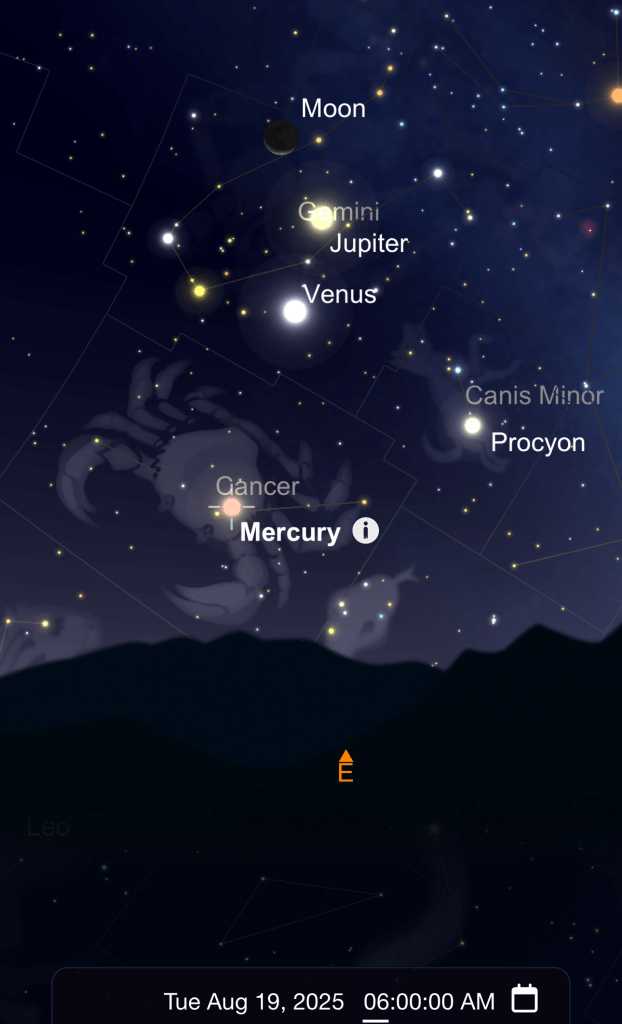
    On Tuesday the 19th, Mercury will emerge on the eastern horizon just before sunrise. This denotes its greatest Western elongation, or the highest point Mercury reaches in our sky, and the best time for viewing the Solar System’s innermost planet. Jupiter and Venus aligned above will help point the way.

    Backyard Astronomers across Northern Arizona can take advantage of our warm summer nights and dark skies this month to view many wonders of our universe. This may be a great opportunity to learn a little more about your telescope, using various eyepieces to practice “star-hopping” from our lunar guide to nearby planets, clusters and nebulae.

    Wishing you dark (and dry) skies this month!

  • July 2025 – Delta Aquariid Meteor Shower

    As summer unfolds over Prescott, Arizona, July brings two celestial events that promise to captivate both seasoned astronomers and casual skywatchers alike: the New Moon on July 24 and the Delta Aquariid meteor shower, peaking around July 30. These occurrences offer ideal conditions for stargazing, with dark skies and minimal moonlight interference.

    The New Moon phase, occurring on July 24, marks a period when the moon is positioned between the Earth and the Sun, rendering it invisible from our vantage point. This absence of moonlight provides the darkest skies of the lunar cycle, making it an excellent opportunity to observe faint celestial objects such as distant galaxies, nebulae, and star clusters. For Prescott residents, this means clear, unobstructed views of the night sky, free from the usual light pollution.

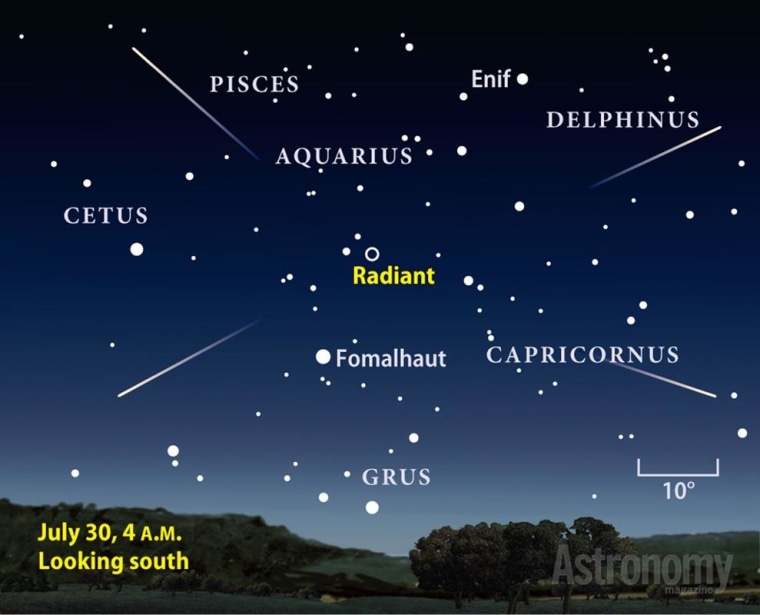
    The Delta Aquariid meteor shower is set to peak on the night of July 29 into the early morning hours of July 30. This annual event is caused by Earth passing through debris left behind by Comet 96P/Machholz. As these fragments enter our atmosphere, they burn up, creating streaks of light across the sky. The Delta Aquariids are known for their steady stream of meteors, with an average rate of 15–20 meteors per hour under optimal conditions. The shower has been observed for centuries and was first scientifically documented in the 19th century. Its radiant point lies in the constellation Aquarius, near the star Delta Aquarii, from which the shower gets its name.

    While the shower is best viewed from the Southern Hemisphere, observers in Prescott can still enjoy the spectacle. The radiant point, from which the meteors appear to originate, lies in the constellation Aquarius, near the star Delta Aquarii. To locate this point, look toward the southern sky after midnight. The meteors will be visible across the sky, but those radiating from the direction of Aquarius will appear to move in straight lines, while others may have curved paths.

    To make the most of these celestial events, consider finding a dark location away from city lights, such as Lynx Lake or the Prescott National Forest, to ensure the darkest skies possible. For the best meteor viewing, plan to be outside between 2 a.m. and dawn, when the radiant point will be higher in the sky, increasing the number of visible meteors. Bring a reclining chair or blanket to lie on, dress warmly as temperatures can drop during the night, and give your eyes 20–30 minutes to adjust to the darkness, avoiding bright lights or screens that can disrupt night vision. Patience is key, as meteor showers can be unpredictable; some periods may have numerous meteors, while others may have none.

    July offers a rare combination of events for stargazers in Prescott. The New Moon ensures dark skies, while the Delta Aquariid meteor shower provides a celestial display that is both beautiful and awe-inspiring. Whether you’re a seasoned astronomer or a casual observer, these events are an opportunity to connect with the cosmos and appreciate the wonders of the universe. Remember to check the weather forecast before heading out, as clear skies are essential for optimal viewing. Happy stargazing!