
Arc To Arcturus, Spike To Spica: Tracing A Line Through The Stars And American History This Independence Day– A Backyard Astronomer Special

The Big Dipper is one of those patterns that seems almost permanent once you learn it. Tonight, it is easy to pick out from a backyard in Arizona. It was just as easy to find from the deck of a wooden ship crossing the Atlantic in the 18th century, where a clear northern sky and a steady horizon were often all a navigator had to work with.
It does not take much imagination to picture that same shape hanging over tall ships, guiding long crossings when coastal lights did not exist and shorelines were still uncertain. Polaris would have carried the weight of navigation, but the Dipper was the pointer, the familiar signpost rotating quietly around the pole night after night.
From that same pattern, the first step is simple. Follow the arc of the Dipper’s handle outward and it lands on Arcturus.
Arcturus is one of the brighter stars in the northern sky, and once you’ve identified it a few times, it becomes almost impossible to miss again. It sits about 37 light-years away, which means the light reaching us now left that star in the around 1989. That is recent enough to overlap with a world that already feels familiar—satellites, early personal computers, the modern shape of global communication beginning to settle into place.
A lot has shifted since then, but not in ways the photons themselves could have witnessed. The light arriving at your eye is unchanged; the context around it is not.
Extend that same arc a bit farther, and the line continues toward Spica.
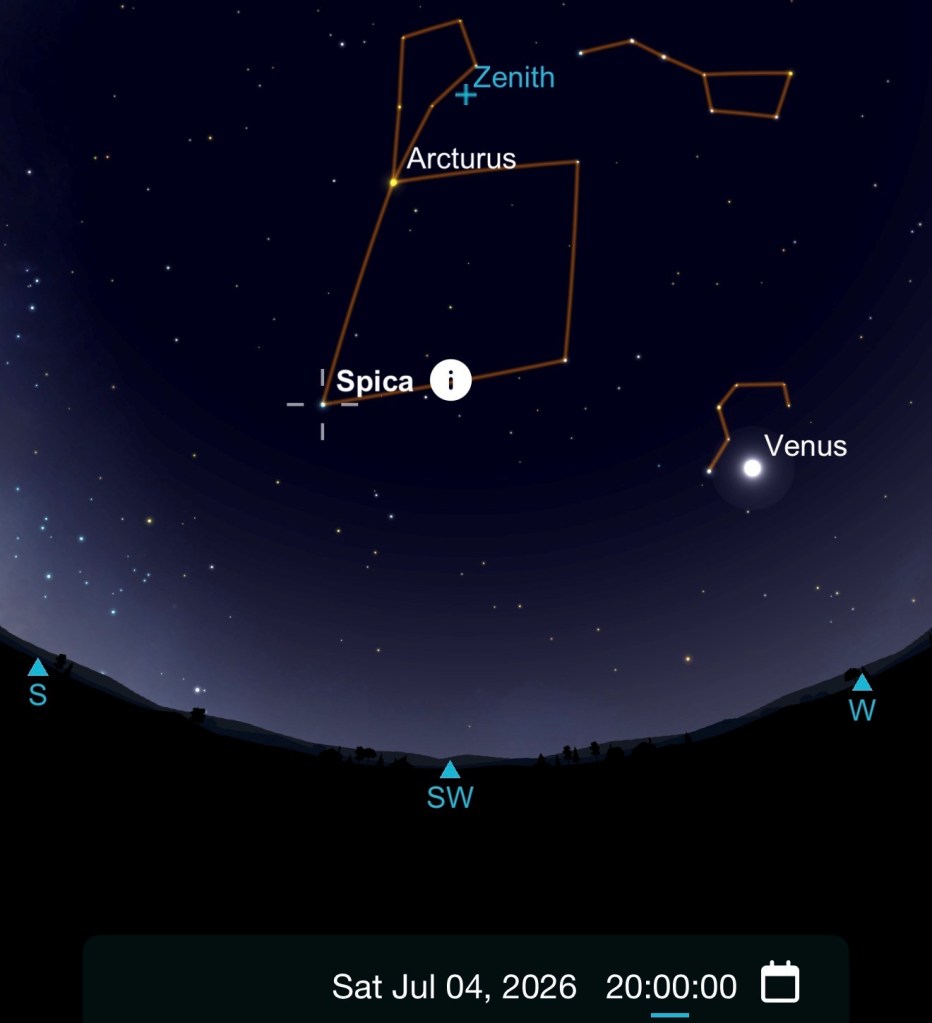
Spica is farther still, sitting roughly 250 light-years away. That distance places its light near the same point in time when the light of American independence first began its journey.
When that light began its journey, the United States did not exist. The idea of it was still forming, debated, and untested. Since then, the country has expanded, fractured, reformed, industrialized, digitized, and extended its reach far beyond anything imagined at the time. Through all of that, the photons from Spica have been in transit, moving steadily outward with no awareness of the changes unfolding beneath them.
So on a clear July night, there is something quietly fitting about that line across the sky. A simple hop from the Big Dipper leads to Arcturus, a relatively nearby star with light that has been traveling since late 20th-century Earth. Extend it again and you reach Spica, whose light has been en route across the entire span of American history.
Arc to Arcturus. Spike to Spica. A navigational trick, yes, but also a reminder that when we look up, we are never really looking at “now.” We are looking at layered history, arriving one photon at a time.
On Independence Day, the contrast feels sharper—an old sky overhead, and a relatively young nation still writing its own light into history.
Adam England is the owner of a local financial services firm and moonlights (pun intended) as an amateur astronomer, writer, and interplanetary conquest consultant. Follow him on Instagram @TheBackyardAstronomerAZ and at http://www.Manzanita-Insurance.com http://www.ManzanitaAccounting.com

