Category: Observing & Night Sky

  • Bullish About Astronomy

    Crab Nebula. Hubble Space Telescope.

    The Red Planet shines bright this month, transiting between the horns of Taurus, the bull, and up towards Gemini, the twins, at just over one AU from Earth.  One Astronomical Unit is the average distance from the Earth to the Sun, or about 93 million miles/150 million kilometers.

    The horns of Taurus are peaked by the bright stars Zeta Tauri and Elnath.  At apparent magnitudes 3.0 and 1.67, respectively, they should be quite easy to find by looking to the Southwestern sky after sunset.  Zeta Tauri is a binary star system, with the brighter  Zeta Tauri A 11 times more massive than our sun, and separated from its partner Zeta Tauri B by only 1.17 AU.  Being nearly as close to each other as we are to the Sun or Mars right now, we cannot see them as separate objects with backyard telescopes, though scientists have been able to measure the Doppler shift – or change in the frequency of their light spectrum – calculating an orbital period of just 133 days. 
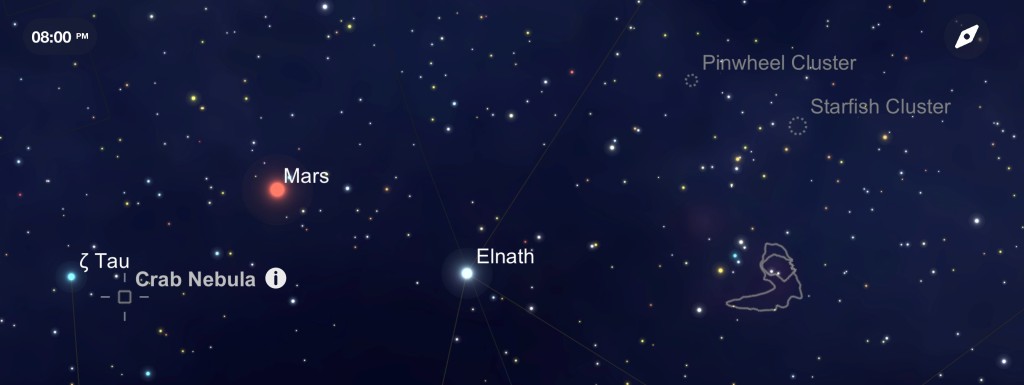
    Mars in Taurus, 3/15/2023 at 8PM MST.

    About 1 degree west of Zeta Tauri is the popular Crab Nebula.  You can approximate 1 degree in the sky by the width of your finger at arm’s length.  The Crab Nebula bears the designation M1 or Messier 1, as it was the first object recorded by Charles Messier in 1758 during his attempts to locate the predicted return of a comet, as previously calculated by its modern namesake, Edmund Halley.  This same nebula was independently discovered by multiple astronomers over the 18th century, and has since become one of the most studied and beloved objects in the night sky.  Modern observations by the Hubble Space Telescope, Chandra X Ray Observatory, and the Spitzer Infrared Telescope have continued to provide extraordinary detail into this magnitude 8.4 remnant of an ancient supernova which was recorded by Chinese astronomers in 1054.

    Defining the bull’s other horn, Elnath come from the Arabic meaning “the butting one”.  Relatively close at 130 ly distant, this giant star is 5 times the mass of our Sun, while putting out approximately 700 times more light.

    Mars, Courtesy Joel Cohen, taken 10/02/2020.

    While the Pleiades is the most familiar open cluster in the constellation Taurus, it is host to many other star clusters and nebulae.  The Hyades cluster is nearer the bright star Aldebaran in the face of the bull, with approximately 100 total stars filling a spherical void in space with the same age and chemical composition.

    Moving counterclockwise from the West around Elnath, backyard astronomers can find the Flaming Star Nebula (magnitude 6.0), Messier 38 or the Starfish Cluster (magnitude 7.4), and Messier 36 or the Pinwheel Cluster (magnitude 6.3).
  • An Ancient Visitor From The Outer Solar System

    The Upper Paleolithic is a segment of human prehistory starting around 50,000 to 12,000 years ago, and is characterized by the first known organized settlements, advancements in tools and weapons, and artistic work.  These early petroglyphs (carved or etched) and pictographs (painted) started with simple lines and dots, and soon evolved to include traced hands, animals, people, and boats.  While we cannot presume to know the full intent of the respective artists, some of these appear to have been purely artistic, while others seem to relay information on game animals, locations, and even seasons and the passage of time.  Lunar cycles, constellations, and unique astronomical events have been found worldwide, documented in these cave walls. 

    These ancient people certainly looked to the skies, as we know similar stories behind constellations carry across continents and millennia.  Archaeoastronomers study how these cultures understood the heavens and the impact it had on their civilizations.  From Chaco Canyon, New Mexico, to the dense jungles of Borneo, to caves across Europe, we find repeated patterns of stars, crescent moons, seasonal equinoxes and solstices, supernovas, eclipses, and the sudden appearance and retreat of comets.

    Comets became some of the first objects to be predicted, as short-period comets make their return in cycles of less than 200 years.  Well before the invention of the telescope in the early 17th century, astronomers measured these long-tailed visitors against historical records and saw patterns in their return.  However, some of these comets never matched up to historical records.  Using modern technology, we now identify these as long-period comets coming from the distant Oort Cloud, a bubble of icy bodies well beyond the orbits of Neptune and Pluto.  These comets are extremely difficult to predict how much they will brighten as they approach the Sun, with some visible during the day, and others only seen through binoculars.

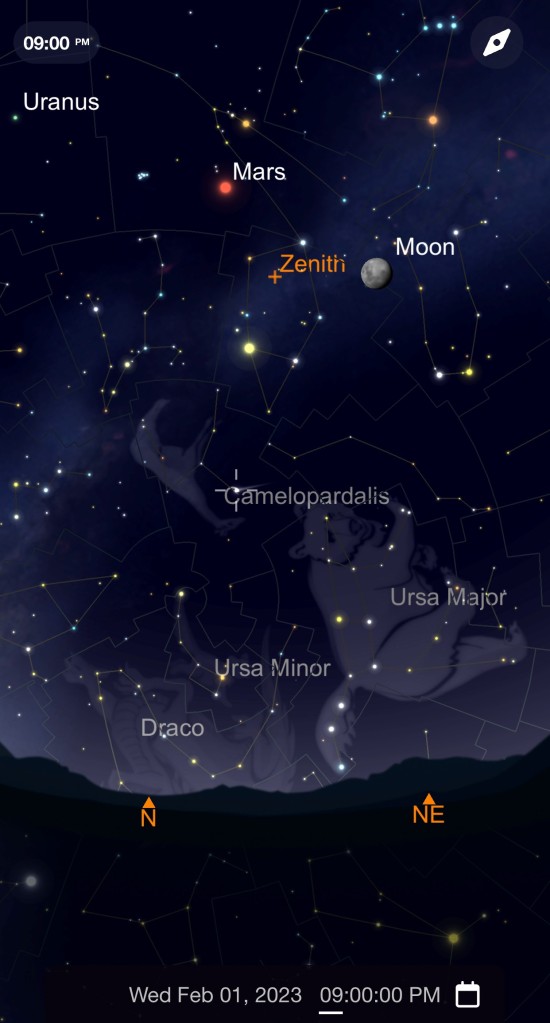
    Comet C/2022 E3 (TZF) is one of these long-period comets currently making its way through the inner Solar System.  Discovered at the Palomar Observatory in California on March 2nd, 2022, it reached perihelion – it’s closets approach to the Sun – on January 12th, became visible to the naked eye on January 17th, and will be closest to Earth on February 1st.  Clear skies permitting, step outside and look toward Polaris, the North Star.  Draw a line to the moon, and about a third of the way from Polaris, in the constellation Camelopardalis, you may be able to see this ancient interloper.  Grab a pair of binoculars or a telescope and you will certainly be able to resolve the fuzzy green tail of this comet, which last graced our skies and was seen by our ancestors nearly 50,000 years ago.

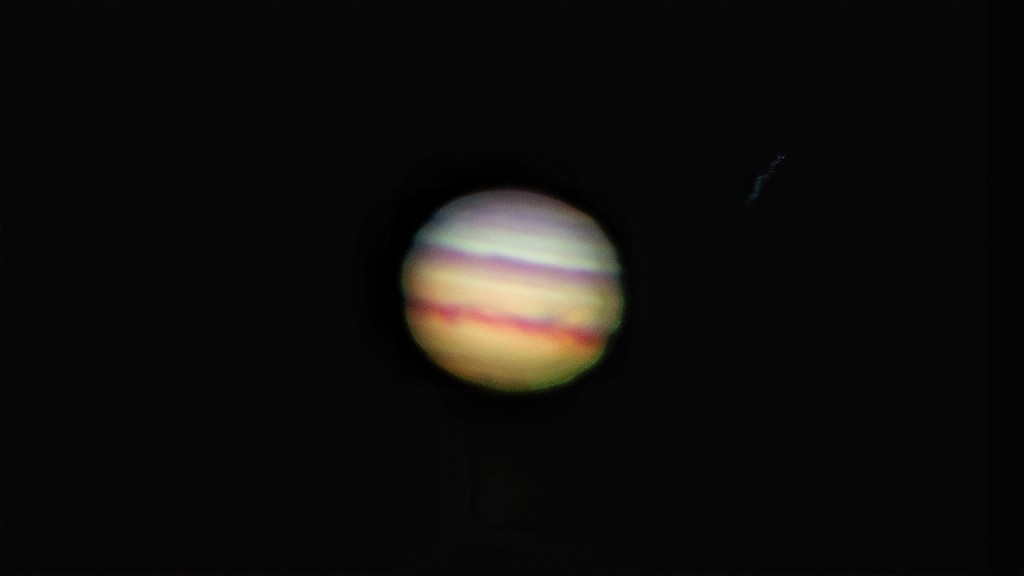
  • September 2022 – Jupiter

    Two months in a row we are fortunate to have the largest of our Solar System’s Gas Giants put on a stunning display.  While in August Saturn was at opposition, Jupiter will also be at its nearest and brightest to Earth on the night of September 26th.  Unlike the Saturnian opposition, however, when the Moon lit up the sky on August 14th at 93% fullness, on that Monday night in September, backyard astronomers the world over will appreciate the darkness afforded by a New Moon.

    Jupiter was the name given this planet by the ancient Romans in honor of their chief God.  This naming pattern follows the Grecian title of Zeus, the Babylonian designation of Marduk, the Sanskrit honorific of Brihaspati, the Hebrew epithet of Tsedek, and Nordic mythology of Thor, from which we still refer to a particular day of the week as “Thor’s-day” (Thursday).  Mùxīng as it is known in Chinese is so important in their mythology that the entirety of the zodiac revolves around the approximately 12-year cycle of Jupiter making a complete orbit of the Sun.

    If one was able to take all of the “stuff” in the Solar System – excluding the Sun – and push it together into a giant ball, Jupiter would still be more than twice as large as everything else combined.  Even the smallest of telescopes and binoculars can pick out the 4 Galilean moons orbiting the planet, though with larger scopes one can begin to resolve many more, with 79 known moons orbiting this giant.  On clear nights, you may also start to notice colored bands across the surface of the planet.  These are clouds of gas, like jet streams on Earth, with different currents moving in different directions and in colors ranging from white to orange and brown.

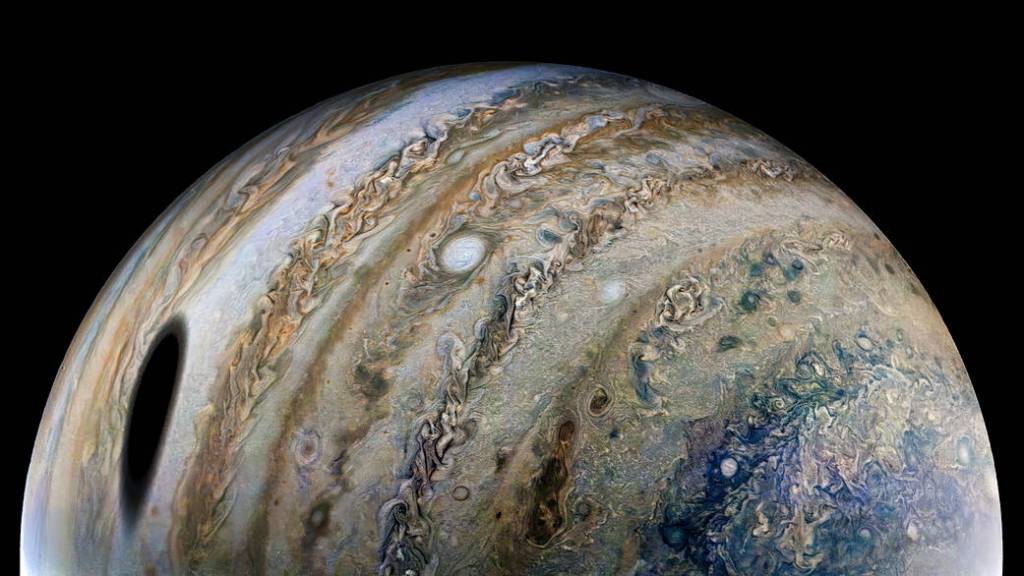
    The Juno spacecraft arrived in Jovian orbit in 2016 and has been studying the planet in detail ever since.  While your backyard observations will be in the visible light spectrum, Juno is able to study Jupiter’s gravitational field and magnetic field through microwave, infrared and ultraviolet astronomy.  In addition, the new James Webb Space Telescope has already gazed at Jupiter in the infrared, allowing scientists to merge data across light spectrum to understand more of how this giant planet formed and continues to evolve as the defender of our inner solar system today.

  • August 2022 – The Ringed Planet

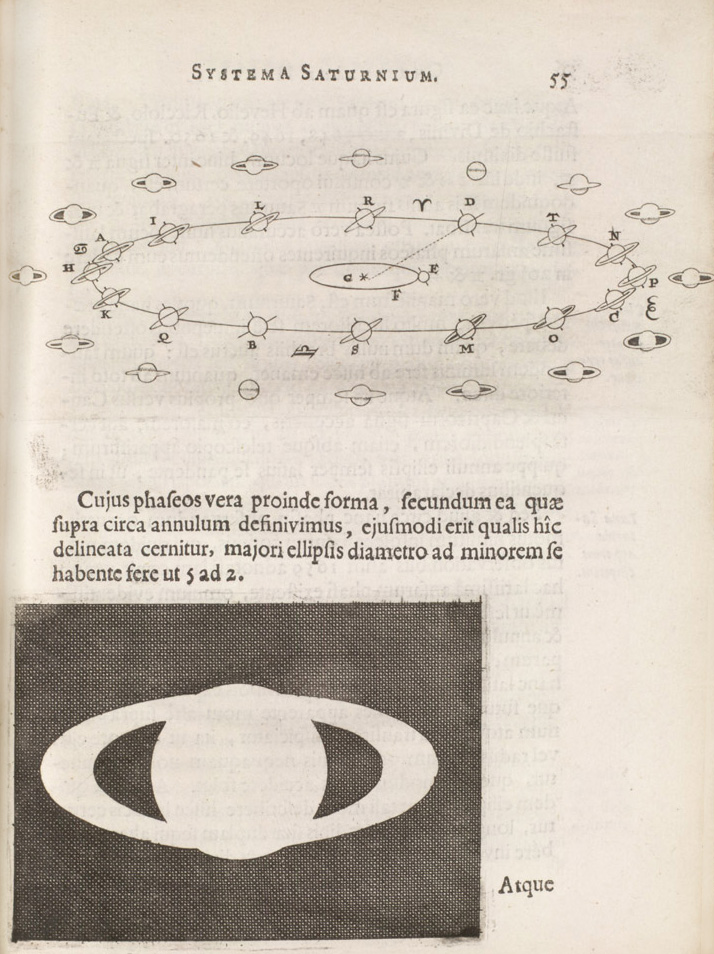
    The planet Saturn has intrigued astronomers – both professional and amateur – since Galileo first sketched what he thought were two odd-shaped moons on either side of the planet.  His final telescope at magnification 30x was still not quite able to resolve the rings that we love so much to gaze at.  Dutch mathematician Christiaan Huygens explained the rings of Saturn by 1659 and identified its moon Titan with a slightly larger telescope at 43x magnification.  Both major accomplishments for their time, we now benefit from even the most basic telescopes and binoculars able to show us the beautiful rings of Saturn and its moon Titan nearly any time of year.

    Saturn is the second largest of our solar system’s gas giants behind Jupiter, with a volume 763 times that of Earth.  Despite its massive size, the average density is less than that of water, and as such is only 95 times more massive than the Earth.

    In August, the planets align to give the best view of the year of this exceptional viewing opportunity.  Saturn reaches opposition on August 14th, meaning it is the closest to Earth, and also its brightest due to the Earthward facing side fully illuminated by the Sun.  It will be one of the brightest objects in the sky this month, moving Westward along the ecliptic, the path that all planets take across the Southern sky.  You can find it near the tail of the constellation Capricornus that night.

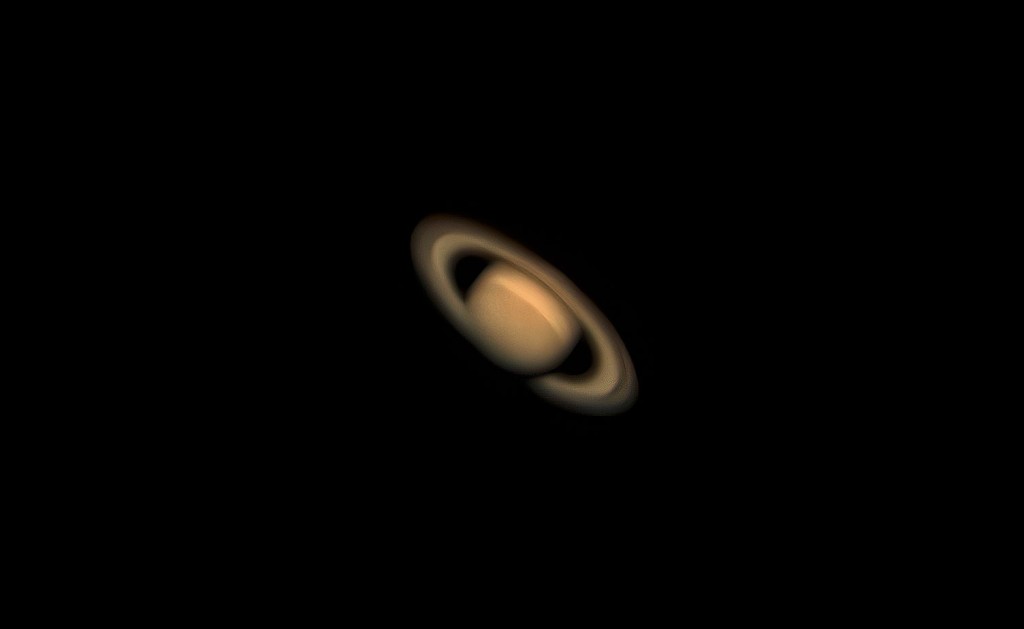
    At opposition, Saturn will be approximately 816 million miles away, a distance that takes light 73 minutes to traverse.  So, when you are gazing at the Ringed Planet, you are actually seeing light that left the Sun, travelled 1 hour 21 minutes to Saturn, and then back 1 hour 13 minutes to your eyepiece in Northern Arizona.  Those same particles of light may have taken upwards of a million years to escape the 430,000 miles of the Sun’s dense plasma, but we will discuss that in more detail another day.  If your telescope mirror is at least 2” or larger, you should also be able to see Titan off to the side, with the rings nearly making a line pointing to this moon that is larger than the planet Mercury.  Titan’s dense methane atmosphere often makes it appear slightly orange.

    The new James Webb Space Telescope will be photographing the planets outward from the orbit of Mars over the next few months and years and is sure to amaze.  In the meantime, if you are able to get a picture of Saturn through your telescope, share it with us on social media!

  • The Many Wonders of Boötes

    In the early summer months, the constellation Boötes moves to the western sky.  Adjacent the Big Dipper, some Ancient Greek Mythology tells of how Boötes invented the plough and was rewarded with a place in the heavens for this history-altering advancement.  Keeping in line with feeding the masses, the Yup’ik language – second most widely spoken Native American language after Navajo – of the Eskimo-Aleut people refers to this same grouping of stars as Taluyaq, literally translated as “fish-trap” for the funnel shape of the stars.  Many different Chinese constellations have focused around Arcturus, the brightest star in Boötes and in the Northern hemisphere, which was so important in their mythology that it’s position in the sky marked the beginning of the lunar calendar.

    Boötes is home to a plethora of deep sky objects, many of which represent the earliest discoveries after the invention of the telescope.  The easiest star to locate first is the bright orange-giant Arcturus.  Just under 37 light years distant, 25 times larger than our sun and 170 times as luminous, it should be a quick task.  The next brightest star is Izar, which viewed with a scope of diameter 3” or larger reveals a beautiful multi-colored double star.  Approximately the same distance but in the opposite direction of Izar is magnitude 11 galaxy Caldwell 45.  Six degrees to the Southeast of Arcturus is Pi Bootis, another double star visible to the naked eye.  Remember, you can easily approximate degrees in the sky with your hand at arm’s length – a fingertip is about 1 degree, three fingers about 5 degrees, and a clenched fist is about 10 degrees.

  • The History of the Telescope – Refractor vs. Reflector

    In 1609 Galileo pointed his rudimentary telescope at the heavens, finding three, and then four moons orbiting Jupiter.  He combined two polished glass lenses, slightly convex at different angles, and was able to magnify the image he gazed at.  This wasn’t a new technology, but a basic monocular had been used for mostly terrestrial purposes, allowing humans to peer across valleys and mountaintops, or at their military foes from great distances.

    Galileo’s first telescopes.

    This type of magnifying device is known as a refractor scope, for the way it bends or refracts the light as it passes through the lens.  The total light gathered across the surface is then bent to converge on a single point, with this distance from the lens to the converge point known as the focal length.  By combining two lenses of different focal lengths at either end of a tube it was discovered that the image one looked at could be greatly magnified.

    The technology of polishing lenses exploded, with royalty hiring glass makers to design bigger and better lenses for government sanctioned observatories and royal astronomers. However, as the lenses got bigger, the refracting process of light became more complicated.  Just like a child’s toy prism – or the cover of a Pink Floyd album – the light we see enter the glass is divided into different colors as the various wavelengths of light are slowed at different speeds while passing through the dense medium of the glass.  When this happens, a telescope can have an effect called chromatic aberration where the colors at the eyepiece don’t match up quite right and the image looks fuzzy.  The other problem was that as lenses got bigger, the glass became very heavy, and can only be supported from the thin edge of the lens so as not to obstruct the light passing through it.  And as the lenses got bigger, so did the tube, with the largest

    Newton’s reflector.

    To this end, a little-known polymath named Isaac Newton came up with a different type of magnification process in 1668, using a concave mirror to reflect instead of refracting the light back to the observer’s eye.  A secondary mirror placed above the mirror sends the light out the side of the telescope.  This solved all the main problems of the refractor, being the light was not divided into different wavelengths through the lens, the mirror could be fully supported on the back and therefore much stronger, and the light reflected back up through the tube and out at an angle allowed the tube to essentially be used twice, greatly reducing the long tubes of refracting telescopes to achieve the same focal length.

    Percival Lowell vs. Adam England – Who did it better?

    At present, some of the largest refracting telescopes have been used for great discoveries, such as the 24-inch telescope at Lowell Observatory which discovered the red shift of galaxies and mapped the moon for the Apollo missions.  Reflectors on the other hand have gotten much MUCH larger, including many across Arizona like the Discovery Telescope in Happy Jack with its 4-meter primary mirror.  This is also the format commonly used for the great space telescopes, with the James Webb Space Telescope’s 18 gold hexagon mirrors unfolding in early January 2022 to a completed primary mirror size of 6.5 meters.

    So, which is best for you?  Well, it depends on what you want to do.  Many of the images we have featured in this article over the years have been from Joel Cohen who has a 7-inch refractor he uses for astrophotography.  My personal telescope is a type of reflector called a Dobsonian, which is great for viewing but less so for astrophotography.  Whichever route you choose to go, I wish you clear skies!

  • The Subaru Cluster

    The dormant volcano Mauna Kea is the highest point in the Central Pacific and of the Hawaiian Islands. At such a height, the benefits of dry air above the clouds with little to no light pollution make it the preeminent site in the world for astronomical observing. As such, many large telescopes operate at its summit. One of these is the Subaru telescope of the National Astronomical Observatory of Japan.

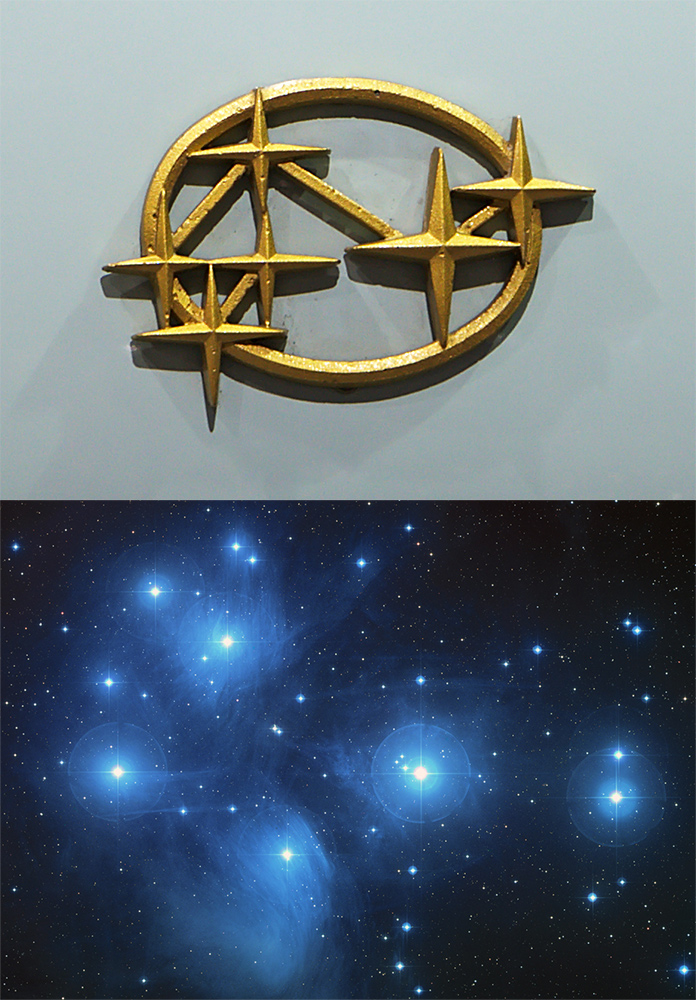
    Subaru, you say? They sold naming rights of a telescope to a car company? Well, no. The car company and the telescope were both named for the open star cluster Subaru which graces the fall and winter skies of the Northern Hemisphere. The closest naked eye star cluster to Earth, the six bright stars of Subaru glow hot blue and are surrounded by beautiful nebulosity that can be seen with even the smallest binoculars or telescopes. This cluster has been clearly recorded in dozens of ancient cultures and even referenced in the bible. The oldest known depiction of the night sky is a bronze disc found in Germany that dates to around 1600 BCE and is believed to include the sun, moon, and the stars of the Subaru cluster.

    Fast forward to 1953, when the Japanese businessman Kenji Kita combined six smaller companies across the manufacturing sector to create Fuji Heavy Industries, producing everything from scooters to cars to busses. Drawing from his love of the sky to constitute the combined six businesses he brought together, he named his first car the “Subaru 1500” with the logo a clear representation of the star cluster. Whoa, whoa, whoa. The brightest and best star cluster, most visible to the naked eye, with visible nebulosity, and you’ve never heard of it? That may be because Western culture traditionally uses ancient Greek and Roman names for the primary constellations, and we know “Subaru” as “The Pleiades”.

  • The Backyard Astronomer – Andromeda! 

    We live on Earth, which orbits the sun every 365.256 days as part of our Solar System.  Our Solar system is one of hundreds of millions of stars and similar systems that orbits the center of our Milky Way galaxy about every 225 million years.  We are familiar with the cloudy or “milky” swath above our heads that is visible on moonless nights throughout much of the year.  With advancements in radio astronomy in recent decades, we have been able to peer deeper into the sky and analyze the structure of our galaxy to learn we are on the outskirts of an arm in a giant spiral galaxy, held together by the gravitational pull of dark matter and a massive black hole in the center which we call Sagittarius A* – pronounced “Sagittarius A Star”.

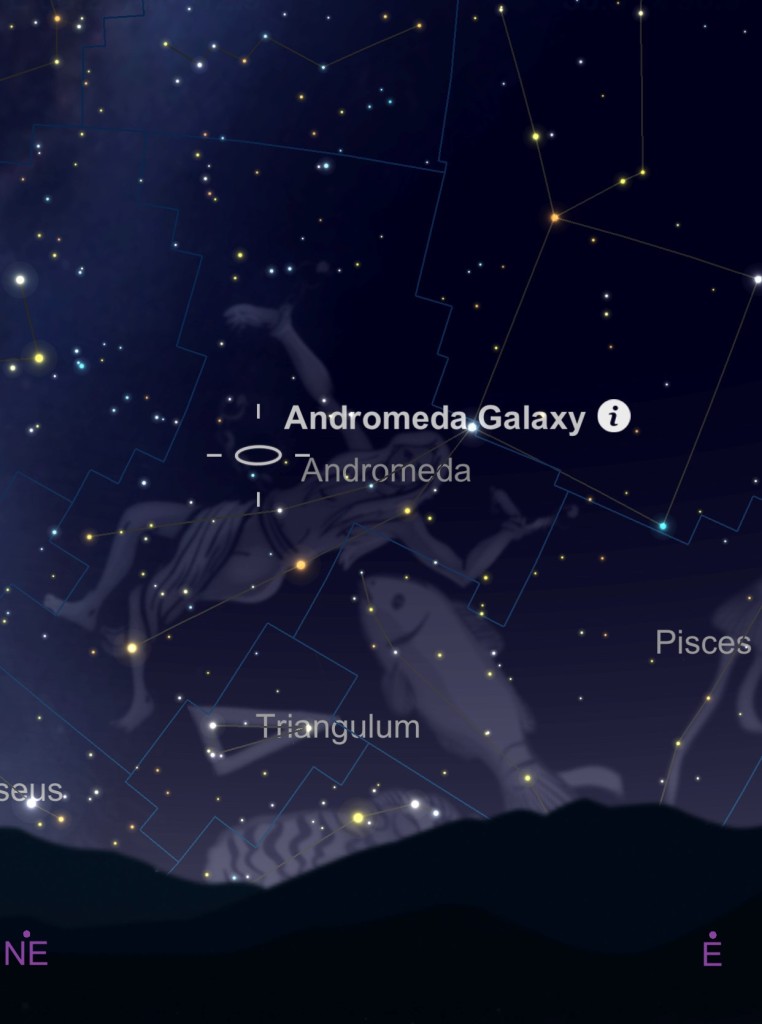
    Great Square of Pegasus and Andromeda, Screenshot, Sky Safari 2021

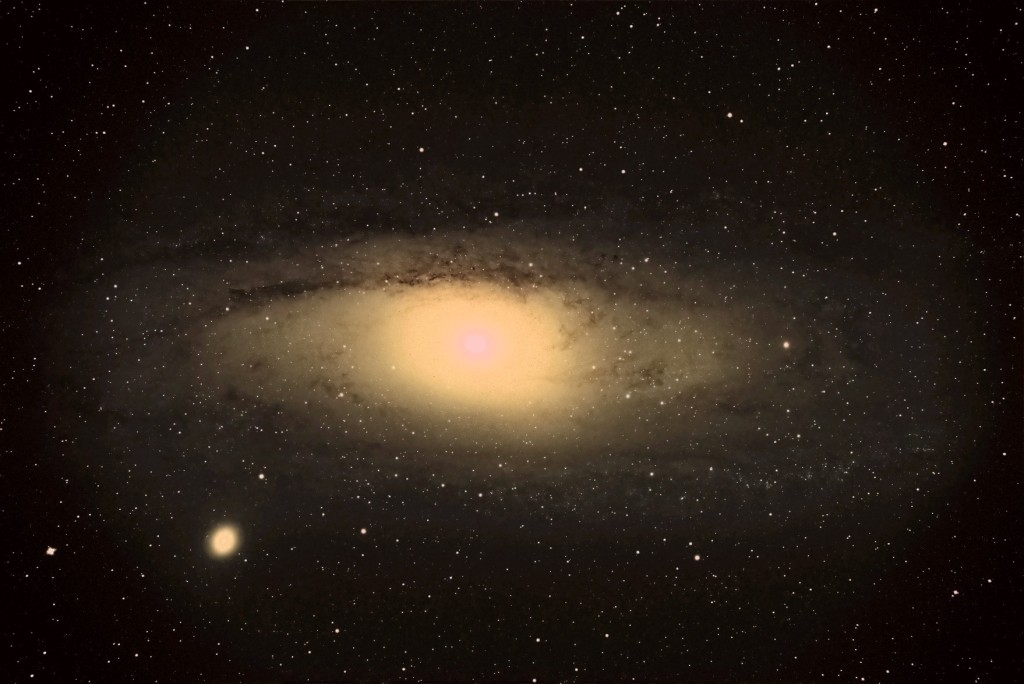
    For hundreds of years, we had to guess what the structure of our galaxy was, as we are inside of it and cannot see it from an outside perspective.  Our best approximation came from looking at our neighboring galaxies, some of which are visible to the naked eye.  Our nearest partner in space is the Andromeda galaxy.  Although it hangs out about 2.5 million light years distant, it is large enough and bright enough to have been documented over a thousand years ago – long before the advent of the telescope.  In the tenth century Persian astronomer Abd al-Rahman al-Sufi described Andromeda as a “nebulous smear”, with later astronomers using rudimentary telescopes to define the blurry spot in the sky as an “island universe”.  With a diameter more than 6 times that of the full moon, Andromeda is one of the largest objects that astronomers can see with either the naked eye or simple ground-based equipment, and many astronomers have spent their lives dedicated to researching it.  However, it was not until Edwin Hubble studied Andromeda in 1925 that we truly understood it was a separate galaxy at such as distance from our own.  This realization expanded our understanding of the universe from essentially believing in one galaxy to now knowing there are upwards of two trillion separate galaxies in the observable universe.

    Image courtesy Joel Cohen, Andromeda, 12-21-2020

    October is arguably the best month to view Andromeda in the evening sky, reaching the zenith (directly above you) around midnight.  October 6th is the new moon, and about an hour after sunset that evening Andromeda will be approximately 30° above the Northeast horizon.  You can find it by looking for the Great Square of Pegasus – an easily identifiable asterism – with the bright double star Alpheratz forming the northern corner.  Two streams of stars seem to pour left from this point, and about 12° from Alpheratz (slightly more than the size of your fist held at arm’s length) and just above the top line of stars will have you looking at a cloudy patch of sky.  Bust out the binoculars and you will see this is Andromeda, and then with the telescope you will begin to resolve the bright galactic center and swirls of stars around it.  You will see Andromeda just slightly off from edge on, so it should look like a long oval getting brighter and denser towards the center.

  • The Backyard Astronomer – The Summer Triangle and The Dumbbell Nebula

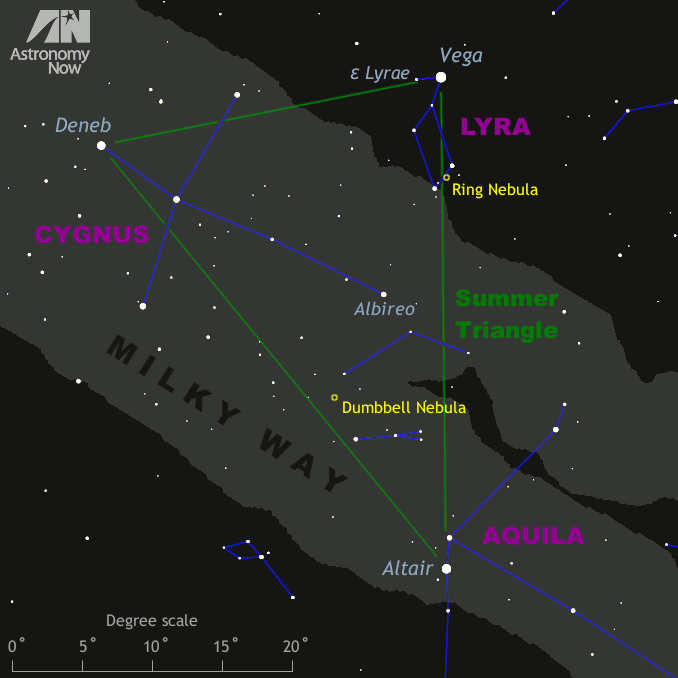
    In July we talked about using the Summer Triangle asterism to locate Messier 57, the Ring Nebula.  If you were able to make it to our August Star Party at Pronghorn Park in Prescott Valley, you most likely were able to view it and the planets Saturn and Jupiter shining bright at opposition.  M57 however is just one of the heavenly surprises hiding within the Summer Triangle.

    Image courtesy Ade Ashford, www.astronomynow.com

    One of the three points of the Summer Triangle is Deneb, the brightest star in the constellation Cygnus, the Swan.  The main stars of the Swan make up the Northern Cross, making it easily identifiable to the naked eye just after sunset.  Move down from Deneb to about midway between Vega and Altair, and the main body of the Northern Cross is formed with Deneb at the top and Albireo at the bottom.  Inversely, the Swan is viewed as diving down, with Deneb at the Tail and Albireo as the head.  Albireo appears as one bright star until a look through your binoculars or telescope reveal it to be a fun double star, with Albireo A being the brighter yellow star and Albireo B a smaller blue star.  It is believed that these two stars are not actually a binary system and orbiting each other, as Albireo B is most likely 300 light years further past Albireo B, and just appears to be a neighbor as viewed from Earth.

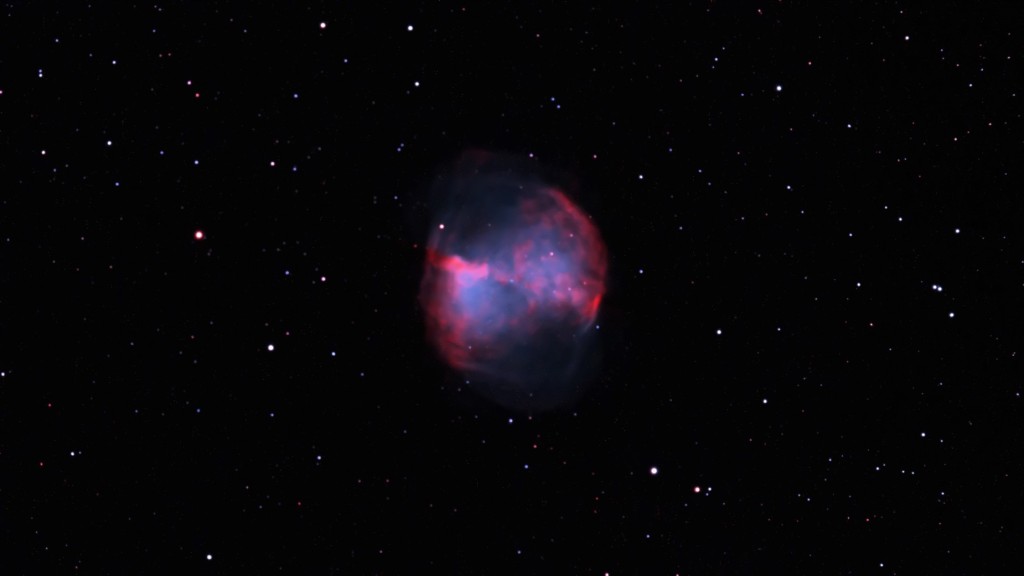
    The Dumbbell Nebula (M27) by Joel Cohen

    Another fun object to view in the Summer Triangle is M27 – The Dumbbell Nebula.  The first planetary nebula to be discovered during Messier’s charting of non-comets, The Dumbbell nebula is much larger and closer than the Ring Nebula and has a higher reflectivity.  This makes it much easier to find with binoculars, and higher magnification with a telescope reveals a beautiful shape and some color.

  • The Backyard Astronomer – The Dog Days of Summer and Giants at Opposition

    The “Dog Days of Summer” is an expression often used to define a seasonal period of stagnation or inactivity, usually brought on by long days and extreme heat.  In the Arizona Central Highlands – similar to that experienced by our ancient predecessors in Greece and Rome – this time correlates with the beginning of the monsoon season, connected with heat and drought, but also sudden thunderstorms.  While we may feel like spending this time laying in a backyard kiddie pool with our dog, the term has absolutely nothing to do with terrestrial canines, and everything to do with astronomy.

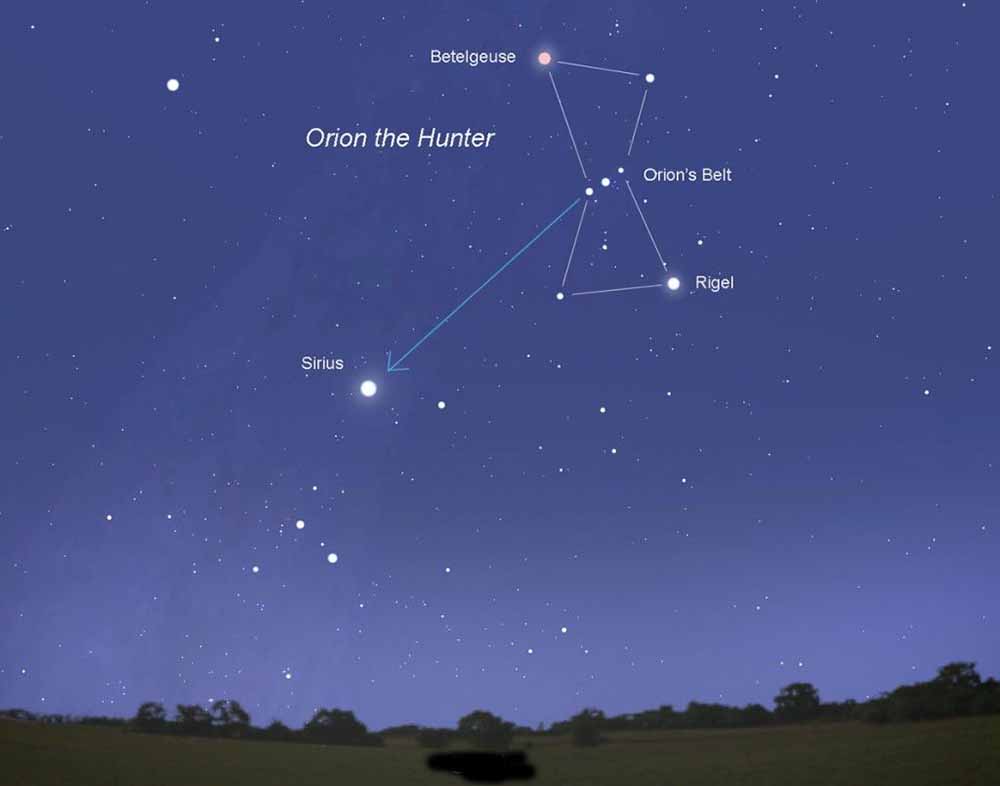
    Sirius – http://www.crystalinks.com

    The three stars of Orion’s belt point almost directly to the bright star Sirius which, in ancient times, returned to view in the Northern hemisphere at the hottest phase of summer, and just prior to the annual flooding of the Nile River valley.  Being not only the brightest star in the sky but also in its constellation Canis Major “The Greater Dog”, it was often referred to as the “Dog Star”.  It is from this reference that we still call this time of year the “Dog Days of Summer”.

    Saturn – Joel Cohen

    This year, we can experience the opposition of both Saturn and Jupiter during this time, as we reach closest approach to these gas giants on August 2nd and 19th, respectively.  Just a few days on either side of the August 8th New Moon, this is the best opportunity of the year to view details of these planets and their natural satellites.  With the Sun giving us the brightest illumination on these evenings, even small to medium sized telescopes can pick out the weather bands of Jupiter, ring divisions around Saturn, and a handful of moons around each.  Specifically with Jupiter, watch over consecutive nights and sketch the locations of the four Galilean moons you see, documenting how they change position during their orbits from evening to evening.

    Jupiter – Joel Cohen

    Join us the evening of August 7th at Pronghorn Park in Prescott Valley for the opportunity to view these and other objects in the night sky!

    If you would like to learn more about the sky, telescopes, or socialize with other amateur astronomers, visit us at www.prescottastronomyclub.org or Facebook @PrescottAstronomyClub to find the next star party, Star Talk, or event.