
The Upper Paleolithic is a segment of human prehistory starting around 50,000 to 12,000 years ago, and is characterized by the first known organized settlements, advancements in tools and weapons, and artistic work. These early petroglyphs (carved or etched) and pictographs (painted) started with simple lines and dots, and soon evolved to include traced hands, animals, people, and boats. While we cannot presume to know the full intent of the respective artists, some of these appear to have been purely artistic, while others seem to relay information on game animals, locations, and even seasons and the passage of time. Lunar cycles, constellations, and unique astronomical events have been found worldwide, documented in these cave walls.
These ancient people certainly looked to the skies, as we know similar stories behind constellations carry across continents and millennia. Archaeoastronomers study how these cultures understood the heavens and the impact it had on their civilizations. From Chaco Canyon, New Mexico, to the dense jungles of Borneo, to caves across Europe, we find repeated patterns of stars, crescent moons, seasonal equinoxes and solstices, supernovas, eclipses, and the sudden appearance and retreat of comets.
Comets became some of the first objects to be predicted, as short-period comets make their return in cycles of less than 200 years. Well before the invention of the telescope in the early 17th century, astronomers measured these long-tailed visitors against historical records and saw patterns in their return. However, some of these comets never matched up to historical records. Using modern technology, we now identify these as long-period comets coming from the distant Oort Cloud, a bubble of icy bodies well beyond the orbits of Neptune and Pluto. These comets are extremely difficult to predict how much they will brighten as they approach the Sun, with some visible during the day, and others only seen through binoculars.
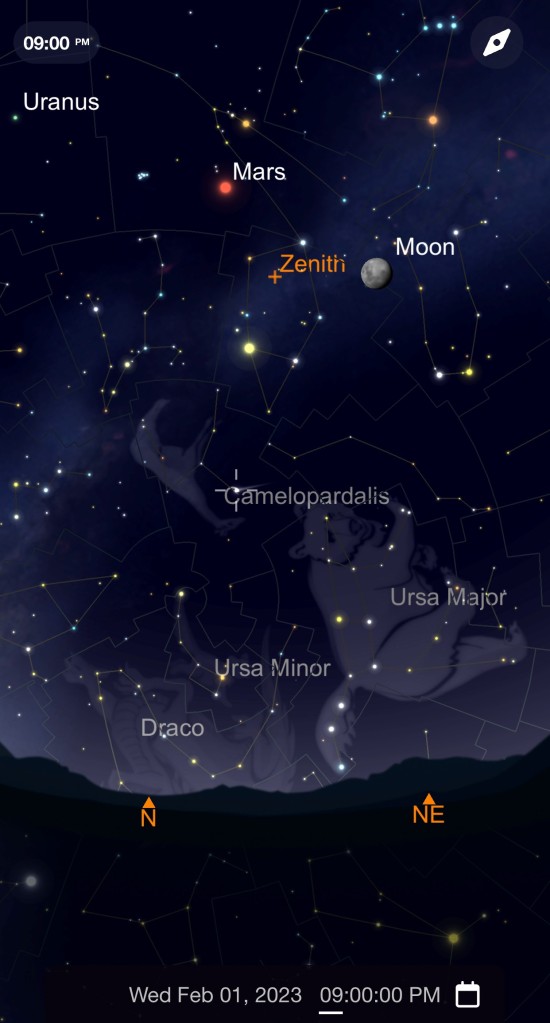
Comet C/2022 E3 (TZF) is one of these long-period comets currently making its way through the inner Solar System. Discovered at the Palomar Observatory in California on March 2nd, 2022, it reached perihelion – it’s closets approach to the Sun – on January 12th, became visible to the naked eye on January 17th, and will be closest to Earth on February 1st. Clear skies permitting, step outside and look toward Polaris, the North Star. Draw a line to the moon, and about a third of the way from Polaris, in the constellation Camelopardalis, you may be able to see this ancient interloper. Grab a pair of binoculars or a telescope and you will certainly be able to resolve the fuzzy green tail of this comet, which last graced our skies and was seen by our ancestors nearly 50,000 years ago.

