Category: Observing & Night Sky

  • May 2025 – Life In The Cosmos

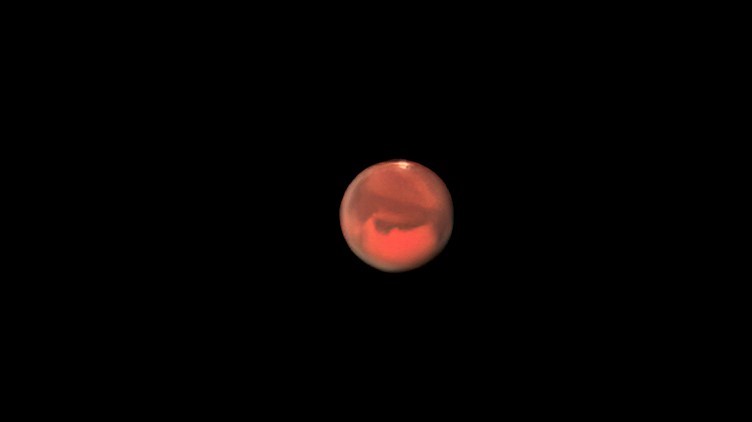
    Mars 10-02-2020, courtesy Prescott Astronomy Club member Joel Cohen.

    Humans have likely always looked at the sky and wondered if we are alone in the universe.  From the classical Roman god messenger Mercury to the angelic hosts of the Abrahamic religions, ancient belief systems often referred to Gods and other visitors as omnipotent beings capable of traversing Heaven and Earth.  As technology improved and enhanced humanity’s understanding of the universe, the habitability of neighboring planets became a legitimate scientific endeavor.  Natural geographic features of Mars were (incorrectly) interpreted as intentionally engineered, and the idea of intelligent Martians and Vesuvians populated the themes of science fiction.  Our fleet of robotic investigators throughout the Solar System can now confirm that no advanced species constructed canals on Mars, and that intelligent life – as we know it – could not survive on these inhospitable worlds.   This insight has led us to look deeper into the history of our own planet to discover what the origins of life may be.

    Martian canals, Percival Lowell, courtesy Wikimedia Commons.

    Taking it back a few hundred million years, the “Cambrian explosion” was a time in Earth’s history when life grew from single celled organisms to multi-cellular, complex life.  Fossil records show this began in the oceans, with large populations of phytoplankton gobbling up the abundant carbon and using sunlight as energy to convert up to half of the oxygen in our atmosphere.  One byproduct of this process is the compound Dimethyl Sulfide, which is only known to be naturally produced through this process.

    Astrobiologists use many different factors in the search for extraterrestrial life.  Earth-like conditions for habitability have led us to define the Goldilocks Zone where a planet may orbit its host star in a way that it would neither be too hot nor too cold, but “just right” for liquid water to exist.  A breathable atmosphere like ours would optimally be composed of about 3:1 nitrogen to oxygen, with trace amounts of other elements and compounds such as carbon dioxide, methane, and – you guessed it – dimethyl sulfide.
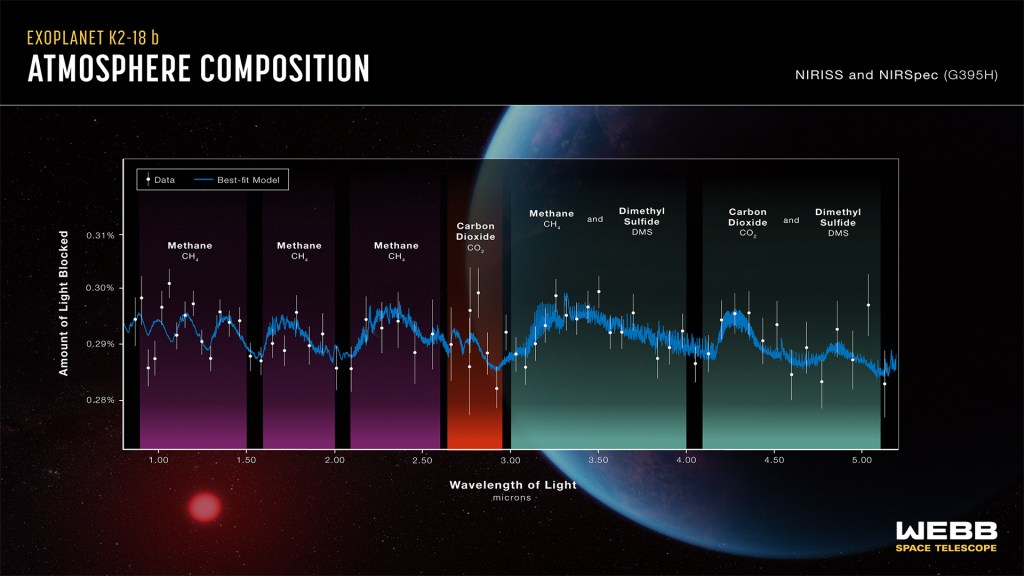
    K2-18b JWST spectra, courtesy NASA.

    The James Webb Space Telescope was constructed with extremely sensitive instruments that can measure the atmosphere of distant worlds by studying the light that has passed through it.  At 124 light years distant in the constellation Leo, the exoplanet K2-18b just happens to be in this Goldilocks Zone around a red dwarf star and about 8 times the mass of Earth. Following up on observations made by the Kepler and Hubble telescopes, JWST data indicates the atmosphere is likely made up of hydrogen, carbons, methane, and dimethyl sulfide.  If this is the case, it is possible that a form of early photosynthesis is active in the oceans of this alien world.

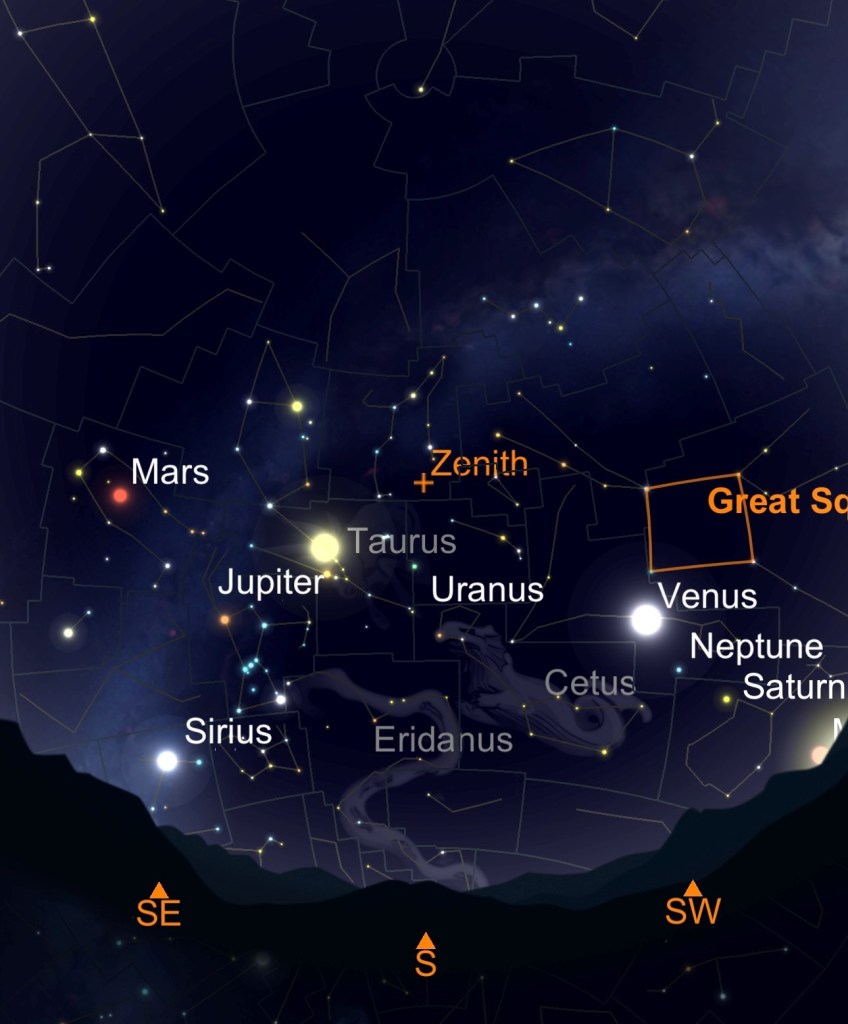
    Leo and Mars, May 2025, SkySafari

    As the constellation Leo moves to the southwest throughout the Spring, the planet Mars will enter the constellation later in the month of May.  While observing the Martian “canals” from your own backyard, your field of view may well include distant worlds teeming with the earliest forms of microbial life.

  • April 2025 – Clear Skies and Comet Tails

    Astronomers love to get lucky.  It’s a true art of patience, “waiting for the stars to align”, both metaphorically and physically speaking.  Despite Arizona’s more than 300 days of Sun each year, a storm may roll over and obscure our view, as we experienced with the lunar eclipse in March, and also with the Solar Eclipse in April 2024.  Maybe T Corona Borealis – The Blaze Star – will burst as a nova when we have an excellent view of the Northern Crown this year; or maybe Earth will be halfway around the Sun, and the stars gracing our night sky will be from the opposing hemisphere of our Milky Way galaxy; or perhaps you’ve been looking forward to a planetary conjunction to image two planets in one frame, and the full Moon decides to cover it up, and shine blindingly across your star party.

    Sometimes, however, astronomers do get lucky.  Statistically speaking, April tends to afford Arizona astronomers clear skies, and the deep chill of winter nights soon give way to more agreeable observing temperatures.  Seems like we’re starting to get lucky.

    Image courtesy Wikimedia Commons: First place in the 2021 IAU OAE Astrophotography Contest, category Meteor showers: Geminid Meteor Shower from China, by Dai Jianfeng, China.

    Then there’s that blasted moon.  Many beginning astronomers may hone their skills on the lunar craters, but soon find the bright glow of neighboring Luna a hinderance to celestial events and deep sky observing.  For this reason, the Prescott Astronomy Club will host public Starry Nights Star Parties on or near the new moon, affording the darkest skies possible. Visit www.prescottastronomyclub.org to find the next public event you can attend.

    While weather is unpredictable, and the moon is like clockwork, these are both short term considerations.  Periodically, the universe sends us longer duration events, such as comets.  A comet may take hundreds or even thousands of years to come near Earth on its elliptical path around the Sun, then disappearing again into the vast outer reaches of our Solar System.  Even after no being longer visible to our eyes or our telescopes, these comets leave a trace of their journey floating in space.  Having been blasted by the solar wind, the comet’s tail will begin to disintegrate and vaporize, and the tiny particulates reminiscent of snow and sand and dust will linger, until acted upon by another celestial body.  If that body happens to be the atmosphere of the Earth, then we might just get a show.

    Screenshot

    The Lyrids meteor shower peaks this year around the night of April 21st-22nd.  Usually producing around 20 meteors per hour, these shooting stars will burn in our upper atmosphere and produce bright trails across the night sky.  Luckily, the waning moon will be below the horizon for most of that night, rising in the East at the 4 o’clock hour.  The Lyrids are named from where they appear from in the sky, near the constellation Lyra, the Lyre.  A small and simple constellation, it is easy to locate, as anchored by the bright star Vega.  Look to the East in the hours after midnight, and pan upwards to the Zenith.  The brightest star you find will be Vega, and, weather permitting, you may enjoy one of the best meteor showers of the year.

  • February 2025 – Planetary Alignments

    “The planets are aligned for the first and last time in 396 billion years!”

    Well, not quite.

    Headlines like the above have become common click-bait in the last few weeks, as most of our solar system’s planets have been visible in the night skies throughout this Winter.  Enjoying this sight from our terrestrial vantage point, it’s easy to see how one might assume the planets are neatly ordered in a rare fashion.  However, orbital mechanics can be a little difficult to grasp from such a perspective.


    So let’s step out of the box, er rather, step off the sphere that is our Earth.

    To start off, a true alignment in space, where multiple bodies are in a nearly straight line with each other,  is known as a syzygy – which just so happens to be one of my absolute favorite words in the English language.  But I digress.

    Looking down on our solar system, of course the Sun is the gravity monster at the center which holds everything together, and all the other stuff is spinning around it.  The rocky planets all complete an orbit relatively quick, from Mercury at 88 days to Mars at 687 days, and Earth somewhere in the middle at 365 days, 6 hours, and 9 minutes, give or take.

    The Gas Giants are another story.  One Jovian (Jupiter) year is equivalent to 12 Earth years, Saturn needs 29.4 years to run a whole lap, Uranus jumps up to 84 years to round off its circuit, and Neptune takes a whopping 165 Earth years to complete one orbit of our star.  Neptune was only discovered in 1846, so it just barely celebrated its first discovery anniversary in 2011.  Happy belated birthday, Neptune.

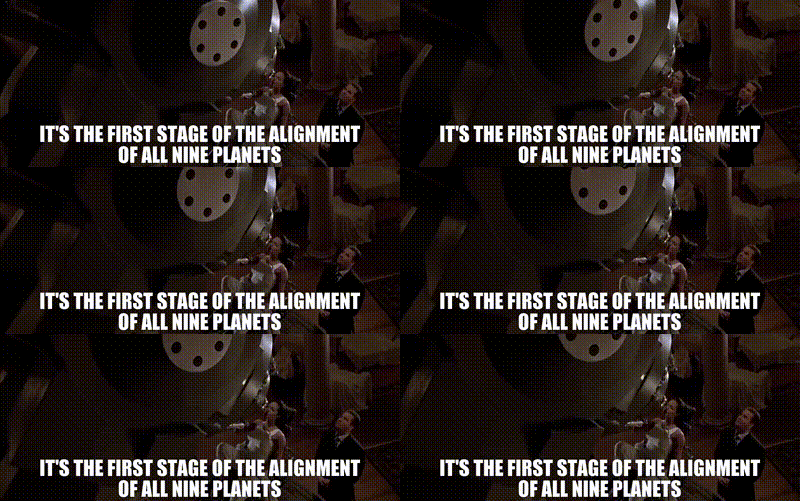
    Since these eight planets are moving at various speeds and across such vast distances in space, it’s not everyday that they will all be in a perfect line – or syzygy.  On average, Mercury, Venus and Earth will line up about every 40 years, but the time increases exponentially for each planet we add to the equation beyond Earth.  In the 2001 Angelina Jolie video game adaptation of “Lara Croft: Tomb Raider” the plot centers around a planetary syzygy that will imbibe the Illuminati with omnipotence via an ancient artifact.    Tony Flanders of Sky and Telescope Magazine did some math, and calculated approximately once in 396 billion years for all eight planets to be within a 3.6° arc of a true syzygy.  For comparison, our Solar System is only 4.6 billion years old.  Let’s take it a little further.  If the planets were within 1° of a perfect alignment, to of course aid the Illuminati in such a valiant endeavor, Tony determined we will be waiting about 13.4 TRILLION years.  That is 1,000 times longer than our entire universe has even existed. 

    So, no, the planets are not aligned in syzygy.  Odds are, they will probably never line up in such a fashion during our Sun’s expected life of about 10 billion years.  They are, however, putting on a fabulous procession across our winter night sky, which you can enjoy just by stepping outside right after sunset, and following the ecliptic across the Southern sky.

    My deepest condolences to Lara Croft, the Illuminati, and click-bait article writers everywhere. 

    Adam England is the owner of a local financial services firm and moonlights as an amateur astronomer, writer, and interplanetary conquest consultant.  Follow him on Instagram @TheBackyardAstronomerAZ and at http://www.Manzanita-Insurance.com

  • January 2025 – The Pleiades: 7 Sisters From 6 Stars?

    Pleiades, Courtesy NASA.

    Most everyone on Earth can pick out a few basic star clusters, constellations, or asterisms, despite their respective language, culture, or even level of education.  Orion’s belt is probably the most common of these, with the three bright stars Alnitak, Alnilam and Mintaka forming a near perfect line in our Northern Hemisphere winter, but visible from latitudes spanning most of our planet.  Similarly recognizable at the same time of the year is the Pleiades star cluster.   Rising in the East about an hour before Orion, we know the Pleiades as the “Seven Sisters” of Greek mythology, and the tight grouping of six bright blue stars has been an easy waypoint for seafarers, farmers, fisherman, calendar makers and sages for thousands of years. 

    Orion chasing the Seven Sisters, Courtesy WikiHow.

    Let’s back up to that last sentence – “Seven Sisters” and yet only six bright stars?  Didn’t the Ancient Greeks discover all sorts of advanced mathematics?  Certainly, they knew the difference between 6 and 7.

    Turns out, the Greeks weren’t the only ones in this conundrum.

    Danish folklore tells of six brothers who rescue a kidnapped princess, and torn between which brother she likes best, God offers for all seven to live forever together in the heavens.

    In Ukraine, the legend includes seven maids who so beautifully danced and sang to honor their gods that upon their deaths, they were brought to the stars to continue dancing for eternity.

    The Nebra Sky Disc was found by metal detectorists in Germany in 1999, dated to around 1600 BC, and is recognized as the oldest depiction of astronomical phenomena, including a grouping of seven stars believed to represent the Pleiades.

    Jumping continents, the Cherokee warn rambunctious children to behave with the story of the Seven Boys, six of whom flew off to heaven, with one being pulled back down to Earth by his mother, becoming the first pine tree. 

    Stretching even further across vast oceans and time, the Aboriginal peoples of Australia have various regional stories of the Pleiades, including seven sister who first learned to make fire, and separately, seven sisters who fled from the unwanted attention of a man chasing them.  This is strikingly similar to the Greek story of Orion the Hunter chasing the daughters of Pleione.

    It wasn’t until Galileo first gazed at the cluster though his rudimentary telescope in 1610 that he observed 36 stars in this grouping, and we now count more than 1,000 stars in this stellar nursery. 

    So how did all of these ancient cultures, separated by thousands of miles and thousands of years, all include seven stars in their stories, while only able to see six with the naked eye?

    Computer modeling of this volatile region of space shows that while some stars have moved further apart in the relatively young 100 million years since their cosmic birth, others have been pulled closer together by gravity.  Nearly 100,000 years ago, as viewed from prehistoric Earth, the star Pleione would have been discernible as a separate, seventh star from its current position close to Atlas, which we see today as a double star through our binoculars and telescopes.  As such, archeoastronomers have posited the theory that the origins of these stories may well predate any object, culture or language we know of, and that the genesis of the seven stars may have traveled across the globe with our earliest ancestors 100 millennia ago.

    Adam England is the owner of Manzanita Insurance and Accounting and moonlights as an amateur astronomer, writer, and interplanetary conquest consultant.  Follow him @ Facebook.com/BackyardAstronomerAZ and Instagram.com/TheBackyardAstronomerAZ

    www.Manzanita-Insurance.com

    www.ManzanitaAccounting.com

  • November 2024 – The Great Square of Pegasus

    The ancients clearly had two things going for them: wonderfully dark skies and fantastic imaginations.  It can often be difficult for the modern backyard astronomer to pick out constellations and imagine a Great Bear, a Hunter, or a horse with wings, just by connecting the twinkling dots in the sky.  Light pollution certainly has an impact on our ability to decipher some of these celestial images, with brighter lights preventing us from seeing many of the dimmer stars in the sky.  Some online tools can help one find relatively dark areas for astronomical viewing, such as lightpollutionmap.info, where one can see the major metropolitan areas of the Southwestern United States pockmarked against the more desolate (and DARK!) regions that may be just a short drive away.  Even with our good fortune to live in a fairly dark area, some of those constellations can still be a challenge.

    For this astronomer, Pegasus is one of these constellations.  Usually depicted upside down between the neighboring Aquarius to the south and Andromeda to the North, and bordered by the two fish of Pisces to the East, I still have a difficult time coming to the same conclusion of a winged horse when I look to the South during the Fall.  Alternatively, I can quickly pick out the four bright stars that form a near perfect square – the asterism oft referred to as the Great Square of Pegasus.  Roughly outlining the body and wings of a sensational stallion, two white and one each red and blue stars denote the corners of this heavenly box, residing just above the ecliptic.  You can follow the stars off the southern and western corners to envisage the head and front legs of this airborne equine.  As you explore around the Great Square, there are a may dark sky objects you can find.

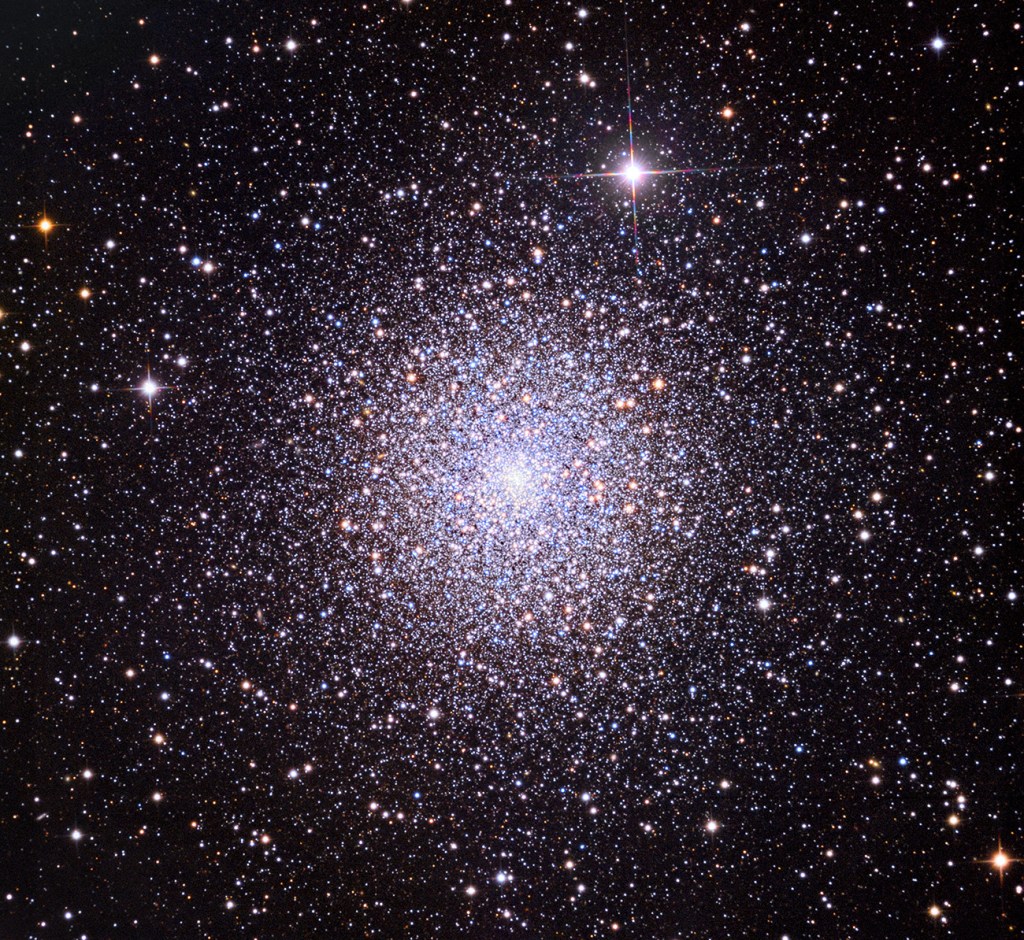
    M15, Courtesy Adam Block, Mount Lemmon.

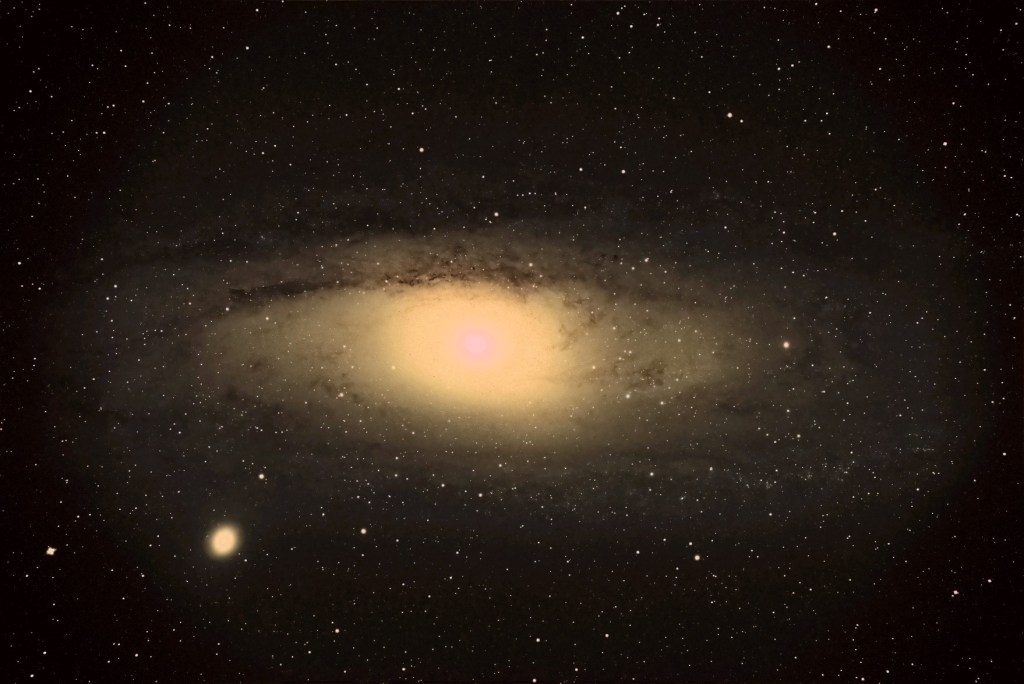
    Moving to the Southwest of the Great Square is the red star Enif, marking the horse’s muzzle.  Just to the west of this star is M15, a prime target for fans of globular clusters.  Do you prefer galaxies?  Look to the North of the bright white star Alpheratz, the top corner of the square, and you can find M31, the Andromeda Galaxy, the closest galaxy to our own Milky Way.  You can also use the square to guide you to other objects, such as the Triangulum Galaxy.  Draw a line between the top two stars in the sky, look approximately the same distance east, and you will find one of the only deep sky objects which – with dark skies and good vision – humans have been able to see with the naked eye for thousands of years, even if they did not yet know what it was.

    M33, courtesy Joel Cohen, Prescott Valley, AZ
    Andromeda Galaxy, courtesy Joel Cohen, Prescott Valley, AZ.
  • August 2024 – The Sky Is Falling!

    Recently there have been a string of stories in the news regarding objects falling from space.  Both the universe and humanity have contributed to these episodes, such as a recent fireball that burned bright over New York City, or the Florida family who in April received quite the surprise when a piece of refuse from the International Space Station crashed through the roof of their home.  So, what is going on?  Are we now living in the space-junk-pocalypse?

    Tunguska Event, courtesy of Wikimedia Commons.

    To put it simply – no, objects falling from the heavens is not a new phenomenon.  Over 3600 years ago in the Dead Sea valley, evidence points to the destruction of a city from a fireball bursting in the air and causing the deaths of around 8,000 inhabitants.  Russia has been hit twice in the last century or so, with the 1908 Tunguska event leveling 80 million trees across 830 square miles of unpopulated Siberia, and again in 2013 when the city of Chelyabinsk experienced a massive shockwave from an approximately 59ft wide space rock that caused millions of dollars in damage to more than 7200 buildings.

    Smaller and more isolated events can still cause harm.  In 1888 a town in Iraq experienced a bolide that exploded and rained down stones on the villagers, killing one and paralyzing another.  Closer to home, Alabama resident Ann Hodges was resting on her couch in 1954 when a grapefruit sized rock smashed through her roof, bounced off her radio and smacked her on the side of her torso.

    Ann Hodges meteorite, courtesy of University of Alabama.

    Since the dawn of the Space Age with the launch of Sputnik I on 4 October 1957, we humans have continued to send terrestrial materials into orbit around Earth.  As satellites age and die, or fail prematurely, orbital decay drags these inert bodies from the sky, and the intense heat of atmospheric friction often disintegrates most if not all of the object.  What remains has a high probability of falling in the ocean, or some inhospitable corner of the Earth, but the law of averages tells us that the more stuff we put up there, the more we will see some coming back down.

    On 9 May 2024, a farmer in Saskatchewan was prepping his fields for seed when he found an object the size of a truck hood sticking out of the ground.  This was the second time in 2 years that a piece of a SpaceX rocket had survived reentry, against expectations, but that doesn’t make them the only culprit.  In 2000, worldwide orbital launches tallied at 85.  The year 2023 saw 223 launches, and 2024 is set to blow that record out of the sky – pun intended. 

    Saskatchewan farmer and space junk, courtesy Gillian Massie, X/Twitter.

    As more players have entered the growing space economy, the United Nations Office of Space Affairs has formulated ground rules for both governmental and commercial entities and the liabilities they incur.  115 countries are party to the Outer Space Treaty, which says the launching state (government) is ultimately responsible for anything that originates from their sovereignty, which is often passed on to private space companies through insurance policies.  Likewise, most standard home insurance policies do cover falling debris also.

    So, rest assured, Chicken Little – you have a far better chance at winning the lottery or being eaten by a shark than that of being hit by space junk.  But it does happen!

  • July 2024 – T Coronae Borealis – The Blaze Star

    The Ancients observed many of the same “naked eye” phenomena that we also see today, and although their understanding of these astronomical events was limited, they knew something unique was occurring.  Episodes such as a lunar or solar eclipse or the passing of a comet could be seen as messages from the heavens, heralding great events or omens of destruction.  We know now that these astronomical events have no impact on the sociopolitical landscape, nor do the stars you are born under determine specific personality traits, however it was by tracking these happenings that patterns began to emerge.

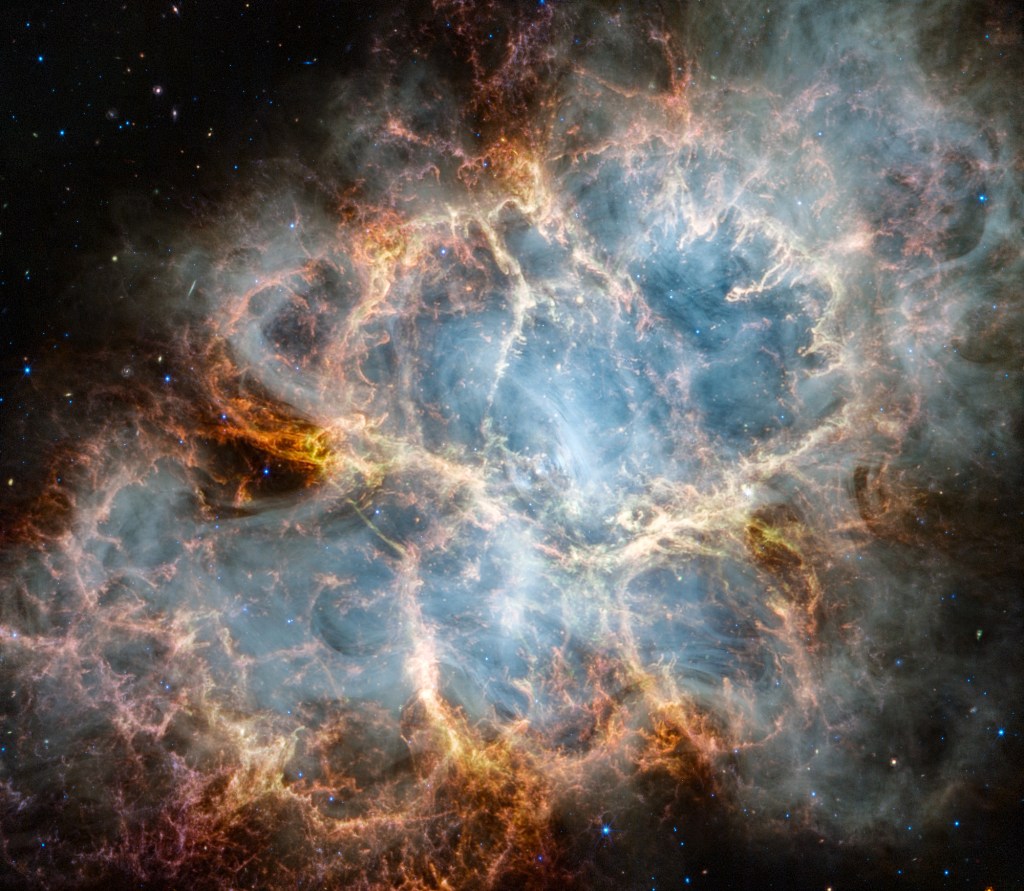
    Crab Nebula, courtesy NASA James Webb Space Telescope.

    Meteor showers were one of the first sights to be known as regularly occurring.  As humans worldwide saw these recurring fireballs seasonally and in specific parts of the sky, we refer to most meteor showers based on the constellation they appear to stem from.  Likewise, astronomers from many cultures documented a “guest star” that appeared on 10 July 1054 and continued to shine bright through April 1056.  Compiling astronomical records from Chinese, Islamic, European, and Native American cultures lead us to the Crab Nebula, giving us nearly 1000 years of recorded history of this distinctive event.

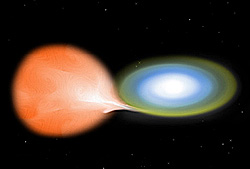
    Artist rendering of nova, courtesy of NASA

    Other novae have been registered in the same location many times over the centuries.  Where a supernova registers the end of a star’s life as it bursts into a nebula, a recurrent nova continues to feed off a neighboring star again and again, establishing a pattern of brightening and dimming.  Enter T Coronae Borealis stage left.

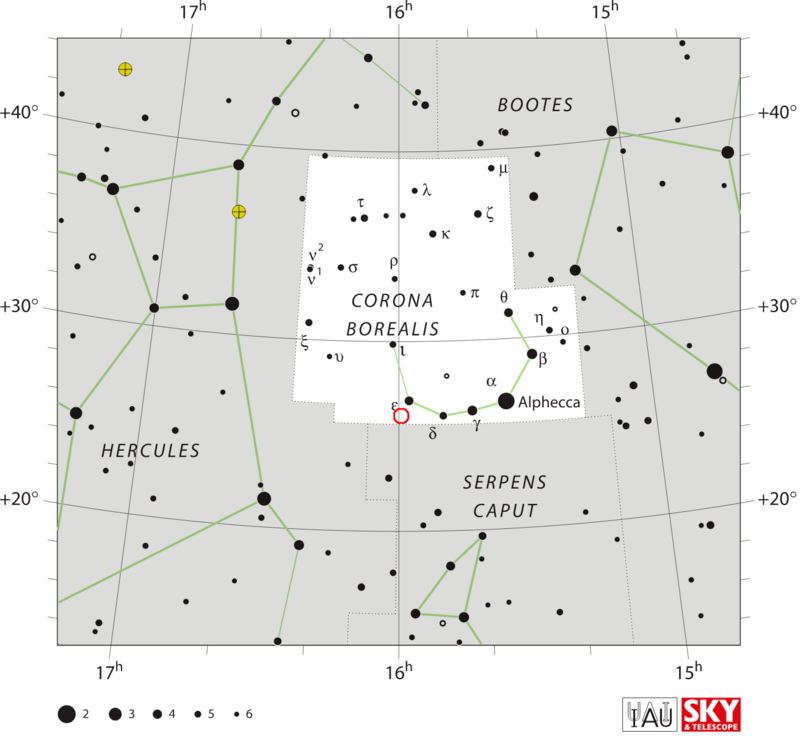
    Location of T Coronae Borealis, courtesy of IAU.

    The small constellation Coronae Borealis – The Northern Crown – is essentially 7 stars in a semicircular arc, filling the space between Hercules and Boötes.  This void contains just a few faint galaxies that are difficult for even seasoned backyard astronomers to view, but one of the stars holds a secret.  Every 78 years, T Coronae Borealis or the Blaze Star suddenly brightens from a dim magnitude 10 to a peak of near magnitude 2.  The smaller, hotter white dwarf continuously sucks the outer layers off the larger, cooler red giant, separated by only have the distance from the Earth to the Sun, forming a large accretion disk surrounding the white dwarf, and all hidden away inside a thick cloud of gas and dust.  After slowly devouring its larger neighbor for three quarters of a century, the white dwarf gets stellar indigestion and ejects huge volumes of material into the cosmos, brightening tremendously as it does.  This recurrent brightening has been documented by astronomers in 1866 and 1946, with historical records dating as far back as 1217 recording a similar event in the same part of the sky likely to be the Blaze Star.  We can’t predict exactly when this will happen, so keep your eyes to the Northern Crown and Blaze Star this summer for an extra special surprise.

  • June 2024 – Planets on Parade

    Around 4.5 billion years ago, our solar system was nothing more than a large cloud of gas and dust, not much different than the Orion Nebula (Messier 42) that we enjoy looking at with our backyard telescopes every winter.  Composed of mostly hydrogen, the cloud coalesced over millions and billions of years until a catalyst – most likely the shockwave from a nearby star exploding as a supernova – jolted the cloud into a spin and collapsing in on itself.  The dense center of the nebula became our sun, the cloud flattened into a disk, and clumps of gas further out spun up into the gas giants that dominate our outer solar system.  Scattered between these gas giants were pockets of primordial dust, left over from the very first stars and planets that populated our universe.  This dust collided and stuck together as it began to form larger and larger rocky bodies, eventually the size of small planets called planetesimals.  Dozens or possibly hundreds of these baby planets collided over hundreds of millions of years, forming the rocky planets of our solar system today, and scattering debris across the cosmos as asteroids and comets and moons.

    From that initial shock that jolted our solar system into motion, everything continued to spin.  Throughout eons of chaos and disorder, the rotation of the planets and moons and asteroids and comets and even the sun itself persisted.  The flattened disk that was the nursery for the birth of planets maintained a consistent path through space, which today we call the ecliptic.  As viewed from Earth, the ecliptic is the superhighway on which the sun and planets travel across our sky.  Despite the violent early days of the solar system and the catastrophic collisions of protoplanets, none of the eight major planets ever strayed more than a few degrees from this original orbit.  As such, we can look out and quickly identify the planets wandering against the backdrop of static stars.  For this reason, the word planet comes from the Greek planetes meaning “wanderer”.

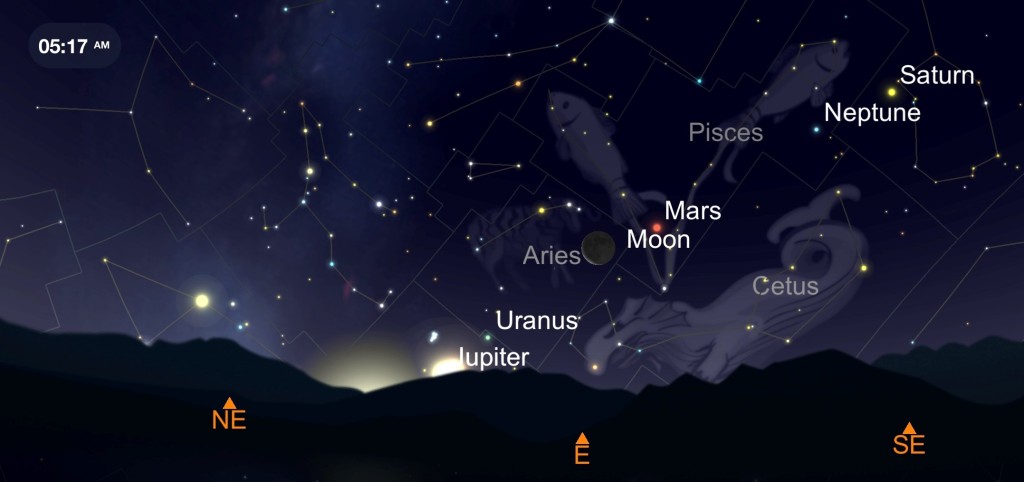
    Early in the morning of June 3rd these wanderers will come together for a relatively rare celestial alignment.  In the hour prior to the sun rise at 5:17AM, look to the East to see up to 6 planets followed closely by the Sun.  Starting to the Southeast, Saturn will shine brightly.  As you move down to the East you will pass Neptune under the belly of Pisces, Mars glowing red near the crescent moon, followed by Uranus then Jupiter peeking over the horizon.  Venus may be visible in the best observing situations, however Mercury will certainly be obscured by the rising Sun.

  • April 2024 – Solar Cycles and Sunspots

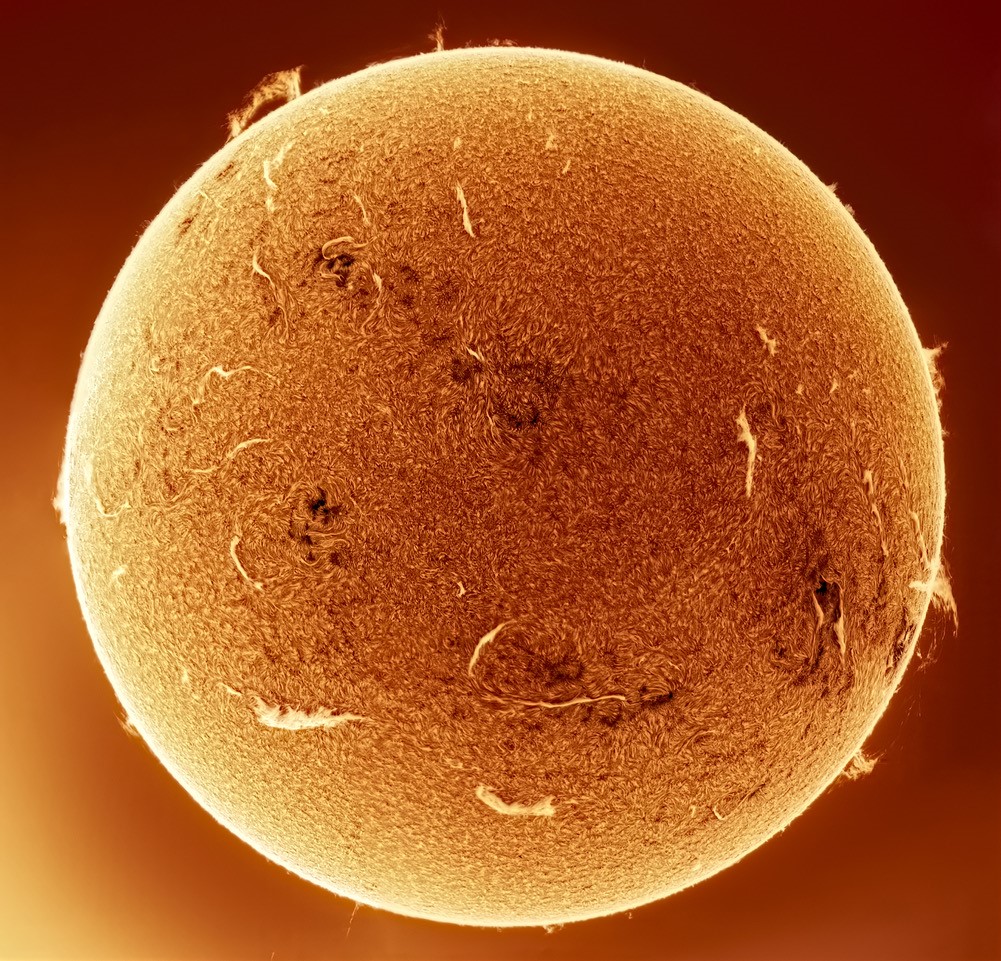
    Our Sun, courtesy Mark Johnston, Phoenix Astronomical Society @AZAstroGuy

    Nearly 3,000 years ago, The Chinese Yi Jing or “Book of Changes” documented small, irregular concealments in the surface of the Sun.  By 300 BC, both Eastern and Western cultures were documenting their changing views of our star, and the patterns that would grow and then disappear on its disk.  English Monk John of Worcester is the first known to have captured these obscurations in his drawings dating to 1128, and just a year after Galileo showcased his first optical telescope in 1609, English astronomer Thomas Harriot turned one of these new inventions to the leading lady of our Solar System.  Taking from the work of so may great minds before him, Danish astronomer Christian Horrebow first proposed a regular cycle in 1775, noting, “it appears that after the course of a certain number of years, the appearance of the Sun repeats itself with respect of the number and size of the spots.”  By 1852, Swiss astronomer Rudolf Wolf compiled all the data available to him, finding an approximate 11-year period from one minimum through maximum and back to minimum.  Choosing to begin with the best possible documented records, Wolf denoted February 1755 as the beginning of Solar Cycle 1, with Solar Cycle 25 having begun in December 2019, and estimated to peak during Mid 2024.

    Though I must suppose these early solar astronomers spent much of their later years suffering from poor vision after a lifetime of staring at the Sun, we now have technology allowing anyone to document their own backyard observations of our closest star.  The more complex Hydrogen Alpha (H-Alpha) filters allow an extremely narrow bandwidth of the light spectrum through a lens to the eyepiece of one’s telescope or camera sensor.  The simpler form many of us are familiar with are the cardboard solar glasses you might find at an eclipse or other educational event, with lenses made of thin polymers reducing the sun’s penetrating radiation to the equivalent of shade 14 welding glass.  NASA and the ESA have also provided us with the ability to view the sun remotely in many different wavelengths, courtesy of the Solar and Heliospheric Observatory – or SOHO – launched in 1995.  Continuing to provide valuable observations of the sun nearly 30 years later, the SOHO Viewer app is available on most mobile platforms, allowing backyard astronomers to observe sunspots, prominences, and solar flares in real time. 

    More than just observing dark spots on the Sun, Solar Maximum can have diverse impacts on the environments of the Solar System.  Periods of Solar Maximum may be accompanied by flares and storms, the largest of which are known as CMEs or Coronal Mass Ejections.  In December 2021, Mars suffered a direct hit from a CME, and both orbiting and ground craft there documented how it affected the Martian atmosphere.  Closer to home, 1859’s Carrington Event during Solar Cycle 10 caused Aurorae to be visible from the poles to the equator.  Telegraph operators worldwide experienced electrical shocks, disconnected the power from the equipment, and were still able to send and receive messages, with some operators reporting better transmission for up to two hours, despite not being connected to a power source.  Multiple telegraph offices even reported fires starting from such high electromagnetic activity.

    Check with your local library and the Prescott Astronomy Club for events relating to the April 8th solar eclipse, and use your safe viewing instruments to enjoy this event and document the number of sunspots and prominences you observe during this Solar Maximum.

  • March 2024 – Vernal Equinox and Spring Beehives

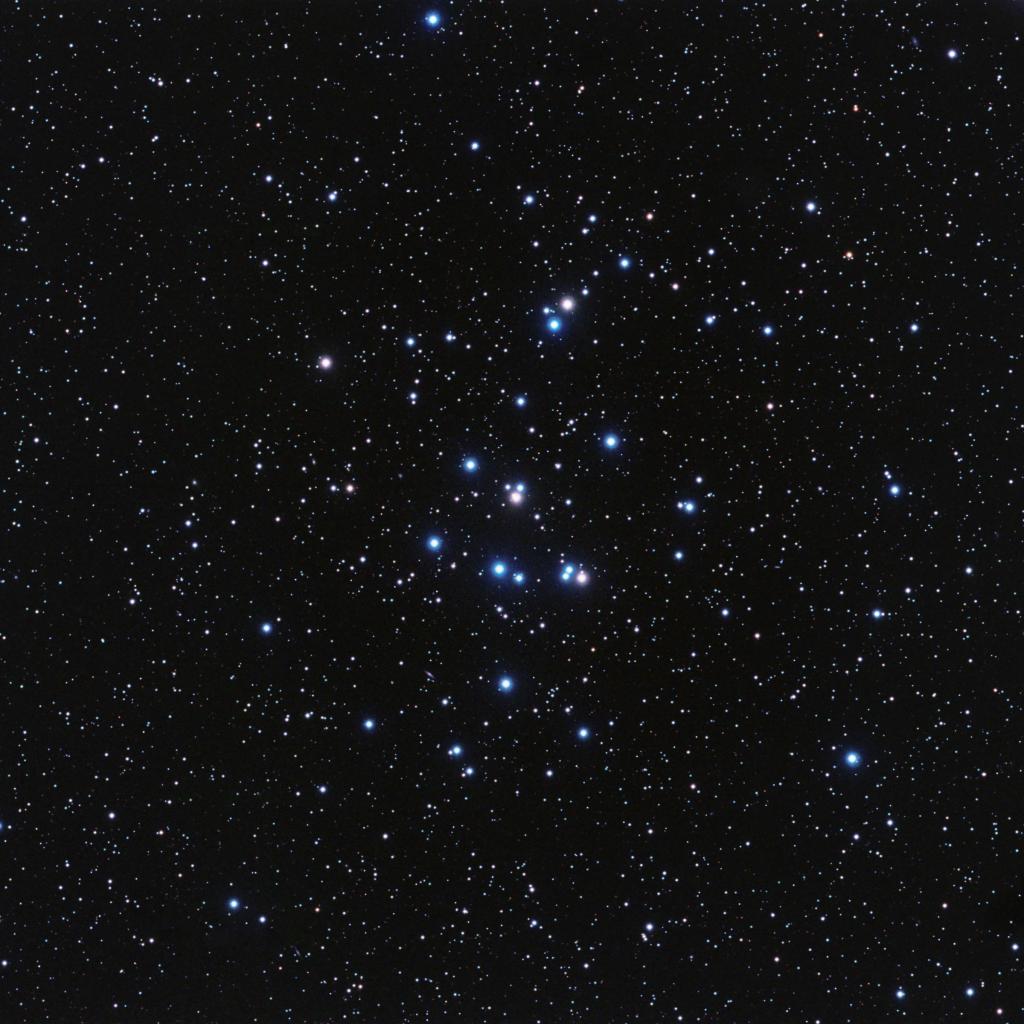
    Beehive Cluster, Courtesy Stuart Heggie, NASA JPL.

    Tuesday, 19 March, at exactly 8:06 PM MST, denotes the moment when the Sun will again be directly over Earth’s equator.  As viewed from Central Yavapai County at approximately 34.54° N, we will see the Sun appear to rise and set due East and due West, respectively.  This is the Vernal Equinox, the rebirth of the Northern Spring, and a day celebrated by cultures around the world as an emergence from the long, cold Winter.

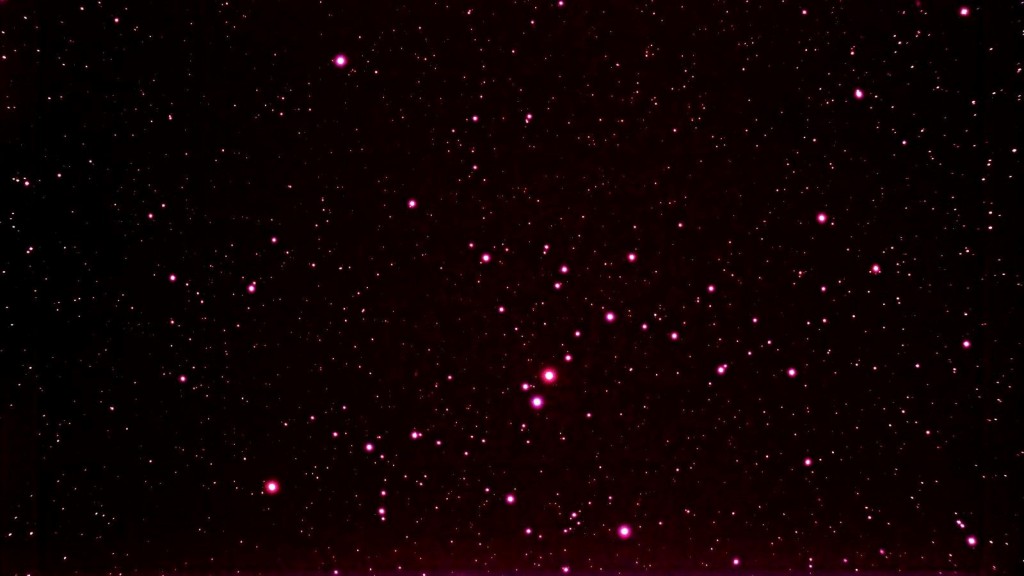
    Beehive Cluster, Courtesy Joel Cohen, Prescott Astronomy Club.

    Many ancient cultures began their calendar on the equinox, including Babylon, Persia, and even carries through to modern times with the official government Indian National Calendar or Shaka Calendar.  The Angkor Wat complex of Cambodia was built nearly a millennium ago, with near perfect alignment to the Equinoxes, including the rising and setting of the sun over the central lotus tower on those dates, as well as sculptures and carvings that depict numerical representations of the number of days between each the Summer and Winter Solstices with the central Equinoxes.  Western cultures, heavily influenced by the spread of Christianity, connect the Easter celebration to the equinox.  The Paschal full moon, named from the Aramaic word for Passover, denotes the first full moon proceeding the vernal equinox, which this year will illuminate the night skies on March 25th, after which Easter is celebrated on the following Sunday.  Due to the celestial mechanics of the equinox and the Lunar cycle, this may place Easter as early as March 22nd in some years or as late as April 25th in others.  This pattern of celebrating of death and resurrection is not unique to Christianity and was likewise observed with direct correlation to this celestial event in the Roman festival of Hilaria and the Pagan holiday of Ostara.  And throughout the Arab world, Mother’s Day is commonly celebrated on the spring equinox.

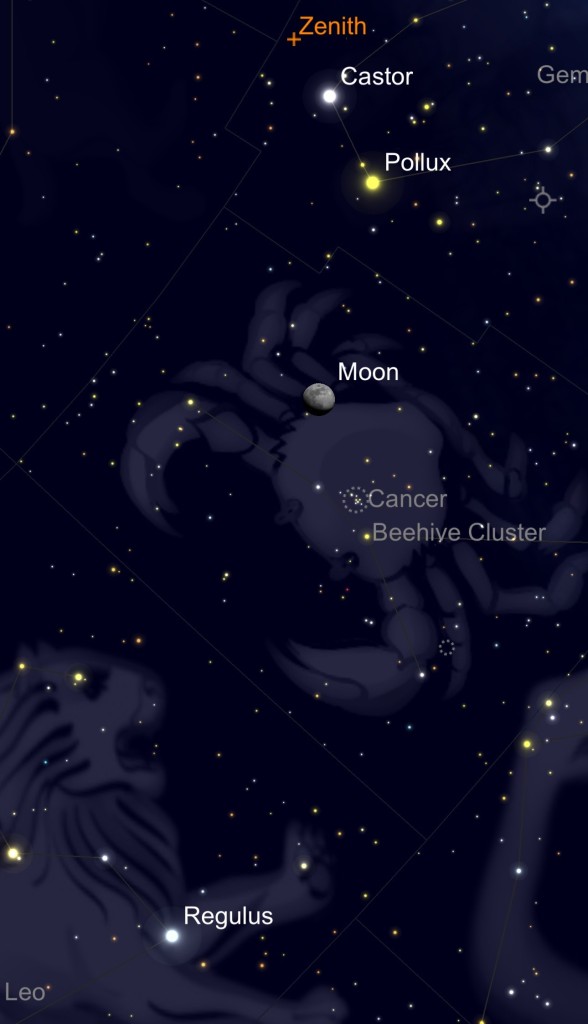
    Beehive Cluster on Vernal Equinox, SkySafari, 3/19/2024.

    The 2024 equinox on March 19th will see the waxing gibbous moon spend the evening in the constellation Cancer, the Crab.  Lying tangent that night to one leg of a triangle connecting the bright stars Regulus, Pollux, and Procyon, the Moon may guide you to the Beehive Cluster, as separated by just a few degrees.  With over 1,000 stars, and one of the closest open clusters to Earth, this is one of the best objects for a backyard astronomer to find with their small telescope or binoculars.  Lying midway between Pollux and Regulus, this stellar nursery was documented by Galileo, Messier, Shur, and many other astronomers over the centuries.  Add yourself to that list of astronomers on this night and count how many stars you can discern in this hive of activity, then revisit the Beehive Cluster later in the month when the bright moon has moved away and see if you are able to resolve more of the bees of the Beehive Cluster.