A lesser-known and relatively modern constellation occupies the void between Orion, Canis Major, Hydra and Gemini, though the stars are difficult to see with the naked eye due to modern light pollution. Monoceros – mono meaning “one” and ceros meaning “horn” – the Unicorn is a simple 7-point constellation, though only two of the stars are usually discernible without the aid of binoculars or a telescope. Coined by Dutch cartographer Petrus Plancius in the 17th century, Monoceros contains many intriguing objects for the amateur observer.
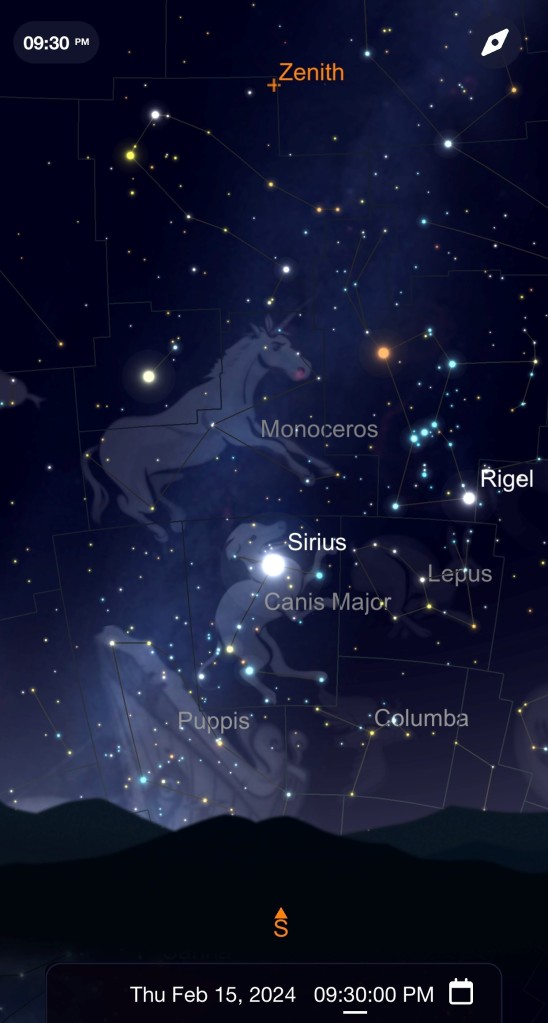
The nose of the unicorn is quite easy to locate. Start with the bright orange shoulder of Orion, the easily identifiable star Betelgeuse and the dimmer blue star Meissa that marks the Hunter’s head. Draw a line from Meissa to Betelgeuse, continuing nearly that same distance again to the Southeast of Betelgeuse to find the binary system ε Monocerotis, denoting the nose of the unicorn. Just a slight look continuing to the east will place the Rosette Nebula in your view.
Orion and Monoceros, SkySafari, 2/15/2024.
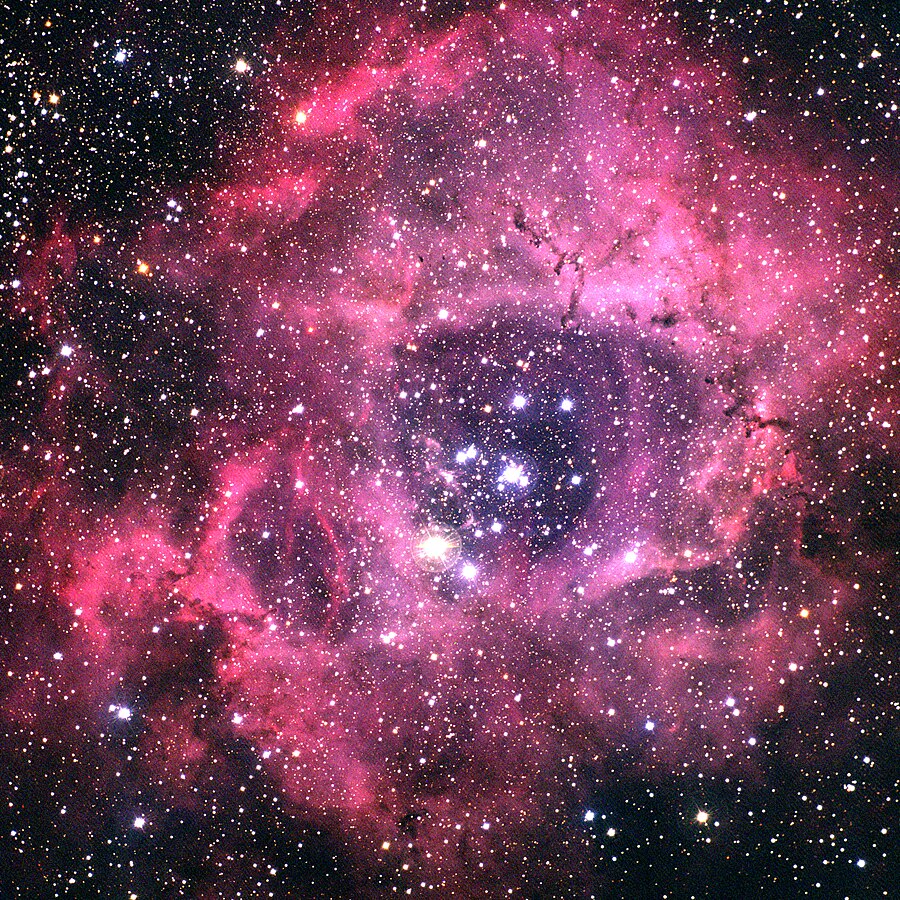
About 5,200 lightyears distant, the Rosette Nebula takes its name from the stylized floral design, often seen as a textile rose awarded for competitions. English astronomer John Flamsteed first noted the nebula in 1690, noting its circular shape and dark center, reminiscent of a rose. Approximately 130 lightyears across, this emission nebula is a star nursery, estimated at a mass of more than 10,000 solar masses, or the equivalent of 10,000 of our suns. The intense radiation of the juvenile stars in this densely packed space excites the molecules in the clouds of gas and dust around them, off putting more and more radiation in a chain of events that continuously sends ever increasing quantities of ultraviolet and x-ray radiation in all directions. For us, this equates to a beautiful nebula, perfect for our viewing pleasure. At apparent magnitude of 9.0, even small telescopes can resolve this stellar breeding ground.
Enjoy the Rosette Nebula, Monoceros, and the Orion constellation in the Southern sky in the early hours of the evening throughout the month of February. Wishing you clear skies!
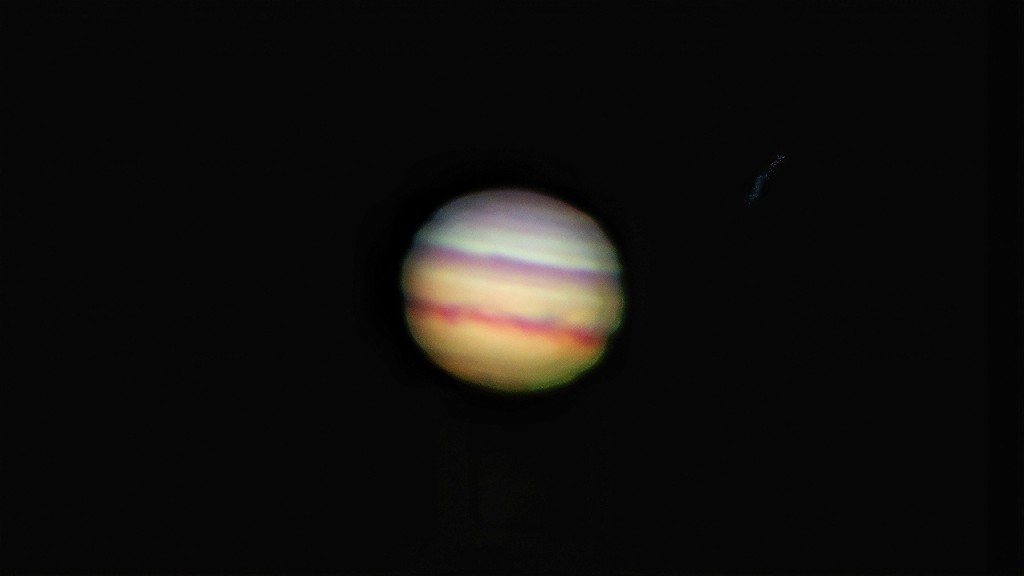
Jupiter, Courtesy Joel Cohen imaged from Prescott Valley, 2020.
The planet Mercury is a unique specimen within our solar system. Orbiting every 88 days, this closest rocky body to our Sun has no geological activity and virtually no atmosphere. Its surface is pockmarked with testimonies of destruction, and with nothing to erode the signs of billions of years of impact events, making it a dense, grey, blemished world. The ancients knew of Mercury, and many cultures named it relative to its proximity to the Sun and its quick movements across the sky. Being so close to the Sun, Mercury is often not visible to terrestrial viewers, however on the morning of January 12th Mercury will be 23.5 degrees from the Sun, its Greatest Western Elongation. Look to the Eastern Horizon in the hour before sunrise to catch a view of this elusive wanderer.
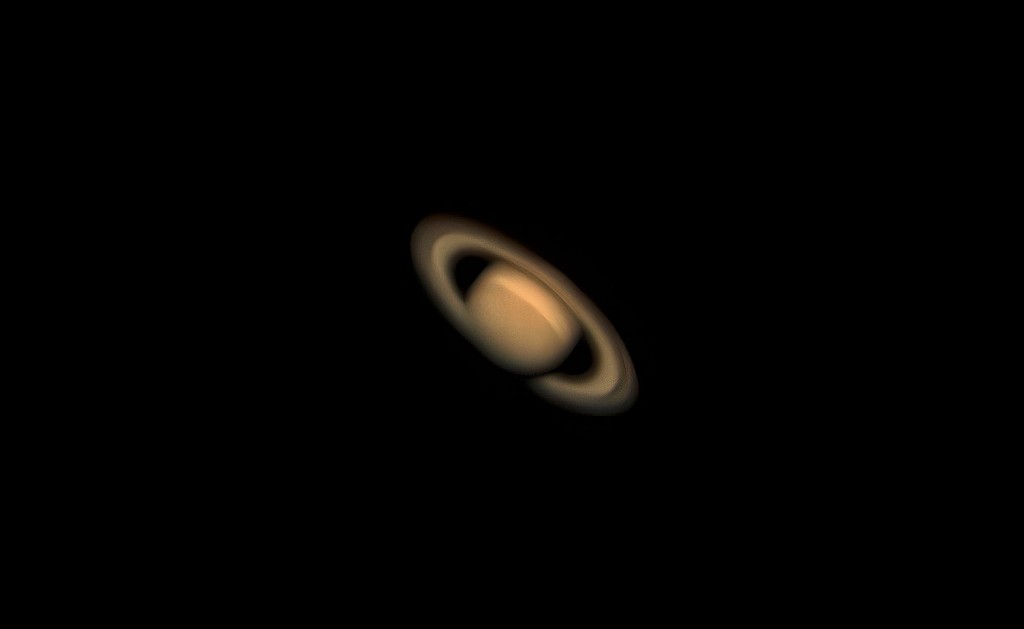
Saturn, Courtesy Joel Cohen imaged from Prescott Valley, 2020.
On the evening of January 14th, Saturn will make a close approach to the Moon in the constellation Aquarius. To astrologers, this lunar conjunction with the ringed planet may impart a pragmatic and practical approach to financial stability, however, to astronomers it means a fun opportunity to observe the waning crescent moon next to the famous rings of Saturn. Binoculars or a small telescope is all that you need for this event, with just 40x magnification to resolve the rings separate from the planet. The waxing crescent phase is also a great time to look at the highlighted craters of the moon. Get out early this evening, as Saturn will begin to set in the Western hills around 8 PM.
Galilean Moons, SkySafari, 1/18/2024.
Just a few nights later on the evening of January 18th, Jupiter will make its close approach to the Moon in the constellation Aries. A first quarter Moon will spend the evening with the King of Planets, and your binoculars or small backyard telescope should be able to resolve the four Galilean moons: Ganymede, Callisto, Europa, and Io. Those last two, Europa and Io, will be having a conjunction of their own that night, passing extremely close to one another as viewed from Earth. With larger scopes of 100mm or more, and the blessing of a clear night, you may be able to observe the red and white bands of clouds that circle the planet, as well as its most defining feature – the Great Red Spot. Like a high-pressure hurricane, this storm averages 1.3x the diameter of Earth, with wind speeds up to 432 km/h or 268 mph. If early astronomical observations were correctly recorded of the same storm, then it has been in existence since at least 1665.
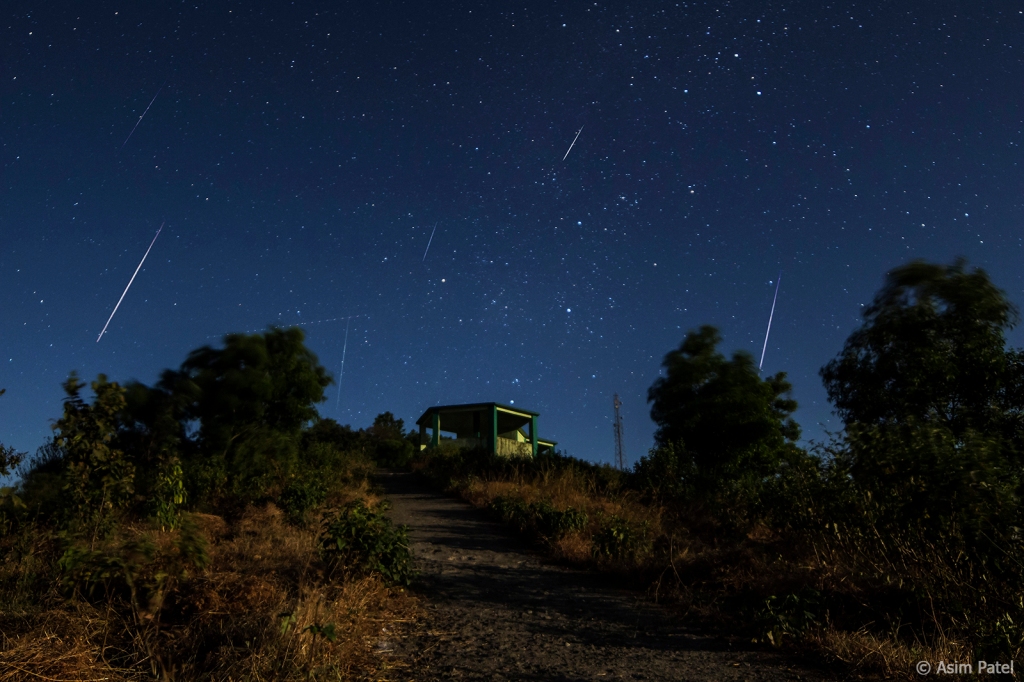
Meteor showers are generally produced when the Earth passes through the remnant tail of a comet, often long after it has visited our inner Solar System. July’s Perseids are a gift from Comet Swift Tuttle (last close approach in 1995), the Eta Aquariids in May and Orionids in October come from the path Halley’s Comet (1986), and each November we see the Leonids courtesy of comet Tempel-Tuttle (1998). Only two major meteor showers are the product of something other than a comet, the Geminids being the most active, and visible throughout mid-December.
Geminids, Asim Patel, courtesy Wikimedia Commons.
NASA’s Parker Solar Probe has been studying the sun since 2018 and holds the record of fastest human-made object, with a maximum speed of about 690,000 km/h or 430,000 mph. Its study of the sun has also provided valuable data on objects that orbit the sun, including the asteroid 3200 Phaeton. Classified as an Apollo asteroid for its Earth-crossing orbit, it is the largest and most studied asteroid passing closest to our Sun. The data from the Parker Solar Probe lends credence to the hypothesis that a much larger body was catastrophically torn apart by the Sun’s immense gravity, leaving behind 3200 Phaeton and at least two other large asteroids, and a debris field stretching for millions of miles through space.
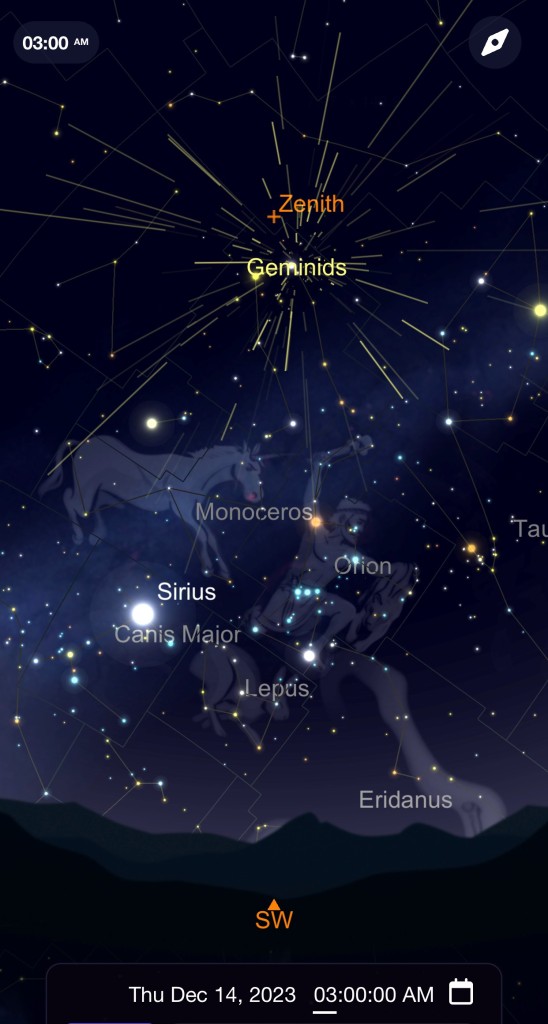
The tails of comets leave behind icy dust particles that may create a meteor shower on Earth. By comparison, the detritus remaining from the cataclysmic event that created 3200 Phaeton is more rocky and often larger in diameter, offering bright, multi-colored meteoroids for your viewing pleasure. Peaking on the early morning hours of December 13th through 15th, this rubble collides with our atmosphere at speeds of 35 km/s or 22 miles per second, which while seemingly fast, is slower than many other meteor showers, allowing for long, bright streaks across the sky. The fireballs will mostly appear to emanate from the Gemini constellation, with this point of origin called the radiant.
Geminids, 12/14/2023 at 3AM MST, SkySafari.
Step outside in the early hours of Thursday 14 December. Look to the South Southwest, find the belt of Orion, and continue up to the bright twins Castor and Pollux. Bring a blanket for the cool late fall morning, and you could enjoy more than 120 shooting stars per hour on this dark, moonless night.
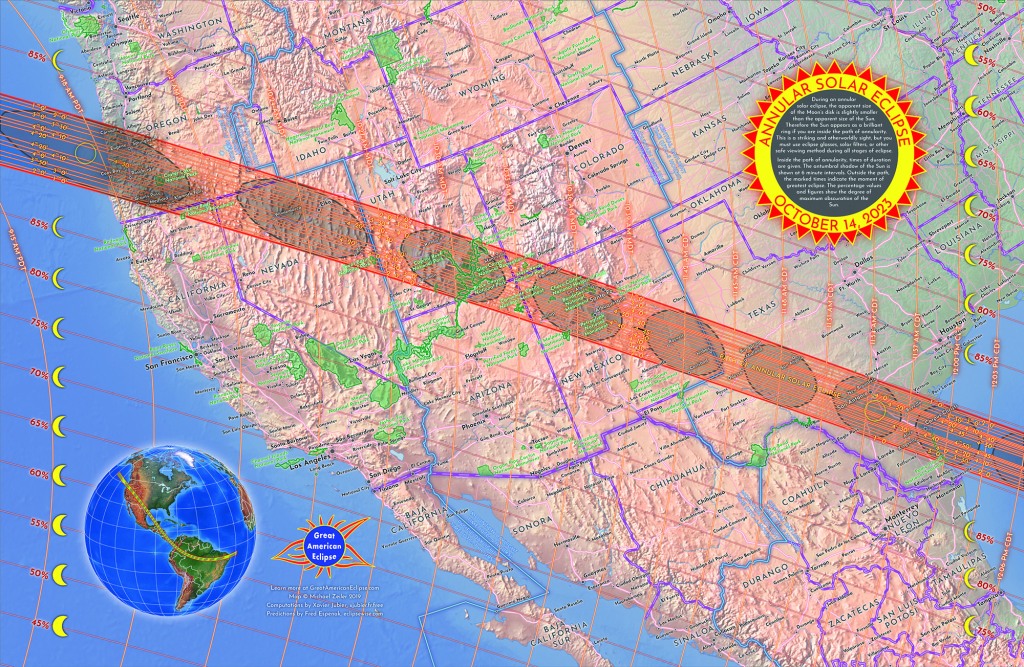
If you happen to be around the Four Corners area on October 14th, make sure to have your solar eclipse glasses with you. After that day, you will be able to tell your friends that you saw an eclipse from four different states! An annular solar eclipse will grace our skies that morning, with the full eclipse beginning around 9:30 MST and lasting for just under 5 minutes. You may encounter this path of totality along a swath of the United States covering from the coast of Oregon to South Texas on that day.
Path of Annular Eclipse, courtesy Great American Eclipse.
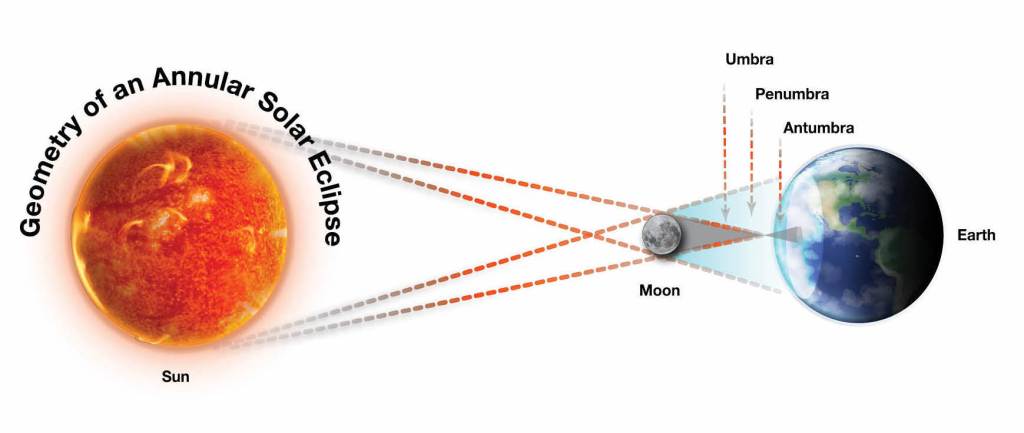
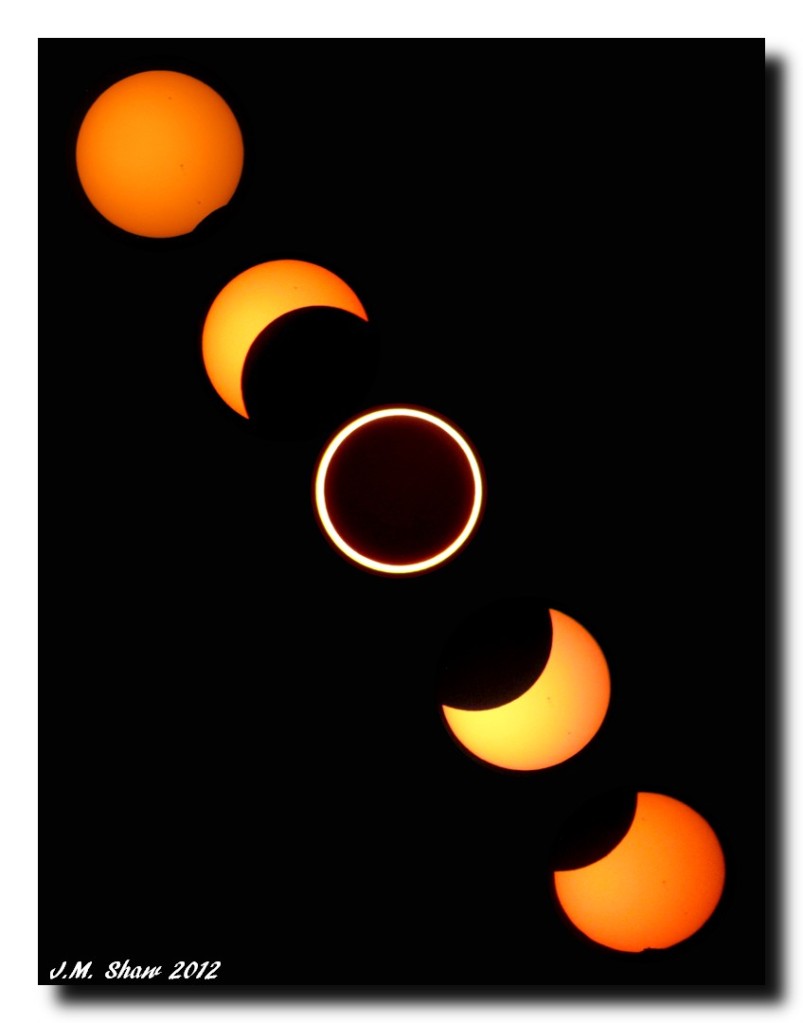
An annular eclipse is a type of solar eclipse, where the moon is directly between the Earth and Sun. When viewing a total solar eclipse, the moon will completely cover the disk of the sun, whereas an annular eclipse only covers the center of the Sun, leaving a slim ring of light visible around the Moon. This halo is the annulus, from the Latin meaning “little ring”, and mathematically is defined as the area between two concentric circles. This “little ring” is also where we get the word annual, for the circular nature of the yearly calendar.
Geometry of an Annular Solar Eclipse, courtesy of NASA.
The reason we have both total and annular eclipses is due to the non-circular nature of the universe. Seemingly a contradiction to all of this talk of rings and circles, objects in space are governed by the forces of gravity, and orbit in ellipses rather than true circles. At some points in the Moon’s orbit, it is closer to the Earth, at which time we experience Supermoons like we did in August. This closest part of the Moon’s – or any other object’s – orbit is known as perigee. At other times, the ovular orbit takes the orbiting body further from the primary body, and this more distant point is called apogee. Likewise, when the moon is at apogee during a solar eclipse, the apparent diameter of the Moon as viewed from Earth is not sufficient to fully cover the Sun, giving us a “ring of fire” eclipse that is quite the sight to behold.
Ring of Fire Eclipse, by Jerry Shaw.
Whether total or annular, a solar eclipse happens about twice per year on Earth, though with more than 70% of Earth’s surface covered by water, they are not always visible from terra firma. In addition, the rotation of the Earth means that these eclipses could happen on any continent, and so are unique events when able to be seen locally. The path of the annular eclipse is around 120 miles wide in that track across the Western United States, however a viewer hundreds of miles away can still experience a partial eclipse. Here in Central Yavapai County, we will see approximately 82% coverage of the Sun’s face over the course of the morning.
AND DON’T FORGET YOUR SOLAR GLASSES FOR SAFE VIEWING!
From double full super moons to ringed giants at opposition, August was full of local events in our Solar System, whereas September takes us back to some amazing deep sky objects. Many of the best clusters and nebulae lie along the galactic plane, easily identifiable in the sky as the Milky Way. While one can technically define the Milky Way as everything around us, the vast swath painted across the night sky represents the edge-on view of much of our galaxy, given Earth’s position somewhat centrally located on what we call the Orion Arm of our barred spiral galaxy. Being in the middle of all the action, looking toward this denser region of stars offers the casual viewer opportunities to pick out many more “faint fuzzies”.
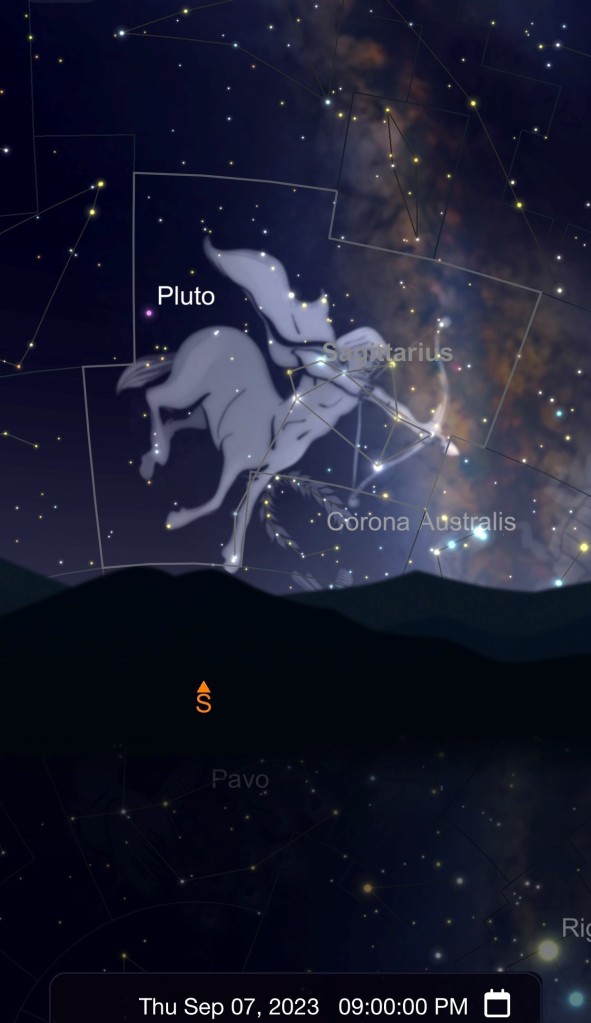
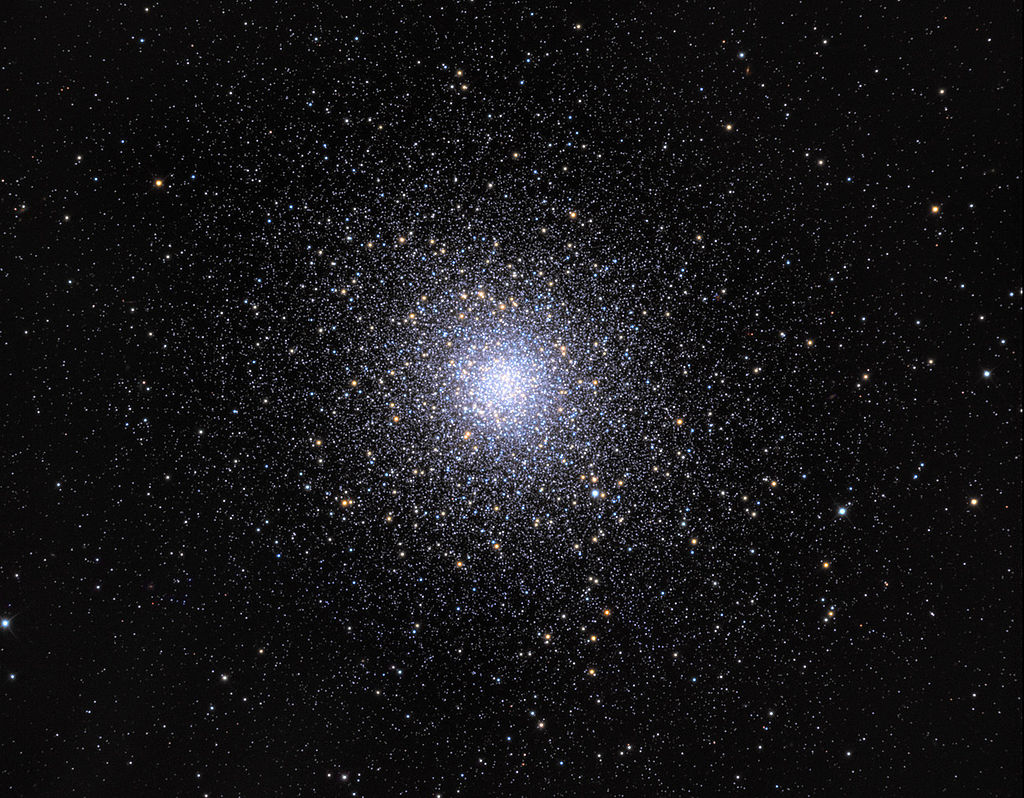
The constellation Sagittarius borders the Western edge of the Milky Way, pointing his bow and arrow into this hotbed of stellar activity. Hundreds of stars inhabit this constellation, with 17 making up the primary outline of the centaur archer. More easily identifiable are the 8 primary stars that make up the “Teapot” asterism, which defines the torso and bow of the Archer. Within or abutting the Teapot are five Globular clusters, catalogued by Charles Messier as M22, M28, M54, M69 and M70. The clusters of stars are only a few light years across yet are packed with thousands or even millions of stars orbiting the galactic center together. To the naked eye, these may seem like a single star, then binoculars will show the observer a fuzzy cotton-ball like image, and larger telescopes will begin to resolve many of the individual members of these heavenly neighborhoods. Use your binoculars or a wide-angle eyepiece on your telescope to scan the Teapot and see how many star clusters you can find.
Globular Cluster, Courtesy Mount Lemmon Steward Observatory.
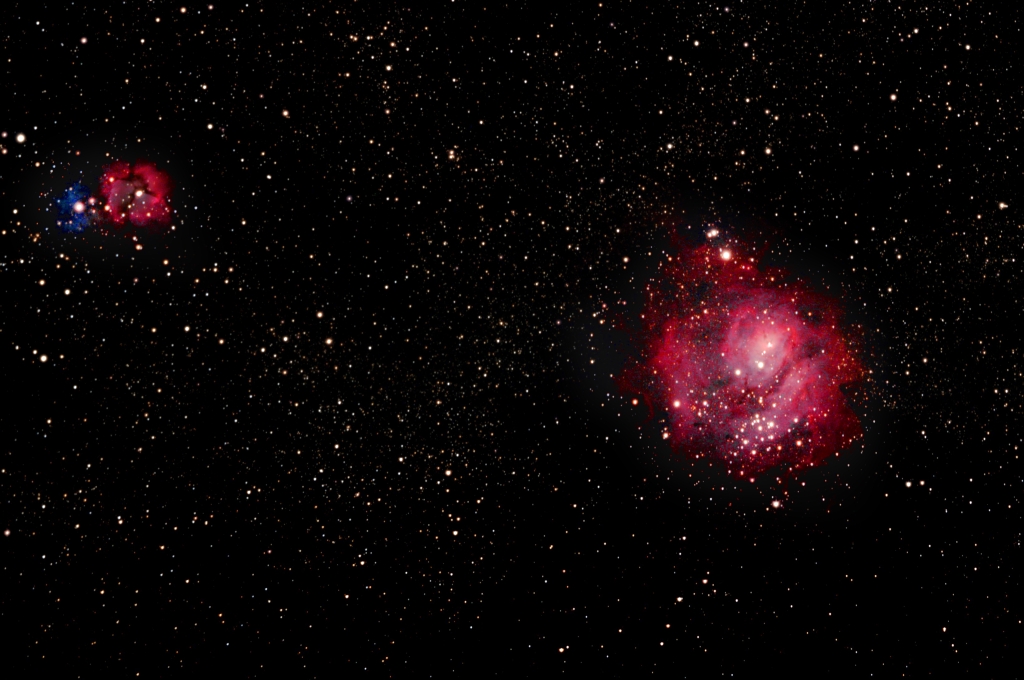
The stellar life cycle may begin or end with a large cloud of gas and dust, either coalescing over millions of years into stars and planets, or inversely created when a star runs out of fuel and collapses in on itself, exploding in one of the universe’s greatest displays of light and energy. These clouds are known as nebulae, Latin for “mist” or “fog”. As you peruse the Teapot and Milky Way, areas of light and dark gas will highlight against the dark backdrop of space. The Lagoon Nebula is visible to the naked eye in the darkest skies and is a perfect starting point for the amateur astronomer. As an emission nebula, it has a pinkish hue created by the ionized particles coming off nearby stars. Separately, the Trifid Nebula is a combination emission and reflection nebula, appearing both pink and blue as you scan the region. Also containing an open star cluster, the Trifid Nebula is a late summer favorite among many astronomers.
Trifid Nebula and Lagoon Nebula, Gary Jones, Wikimedia Commons.
So, remember to look to the South, for the teapot pouring out the milk, and you will be locked on to some of the greatest views in the Northern Hemisphere summer.
August hosts a plethora of lunar and planetary events, perfect for the Backyard Astronomer. Even the most basic binoculars or telescope will allow one to enjoy our celestial neighbors as they put on quite the display this month.
August 1st starts off the month with a Full Supermoon. The second Supermoon this year, this event occurs when the Moon appears slightly larger in the sky due to its proximity to Earth in its elliptical orbit. While there is no strict definition of a Supermoon, it is commonly accepted that the moon be within 90% of perigee, or the closest approach of its orbit to Earth. By contrast, the furthest part of an elliptical orbit is called the apogee, and the Moon’s distance from Earth can sway from about 405,500 km to as close as 363,400 km, or about 252,000 miles to 225,000 miles. This full moon was also known in the Great Lakes regions as the Sturgeon Moon, for its timing correlated with the preferred fishing season.
Supermoon Comparison, Courtesy NASA.
On August 10th, Mercury will be at greatest Eastern elongation from the Sun, meaning it is as high in the evening sky as we can see it, before it begins to move back around the Sun. “Eastern Elongation” may seem like a misnomer, referencing where the planets are in relation to each other, however you will look to the Western horizon just after sunset. This is the best day of the year to catch a glimpse of the elusive owl whom the Maya regarded as a messenger to the underworld.
In the early hours between August 12th-13th the Earth will pass through the tail of comet Swift-Tuttle. Having last visited the inner solar system in 1992, and not returning until 2126, the debris cloud of dust and ice particles affords the annual Perseids Meteor Shower, with excellent viewing this year as the moon will only be a crescent. Enjoy this show after midnight when you may catch upwards of 60 meteors per hour.
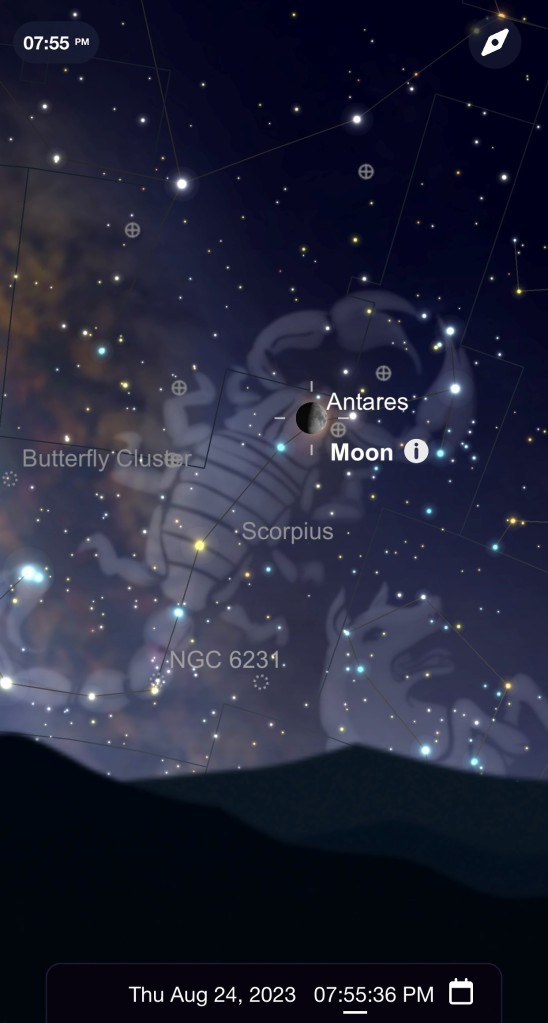
On August 24th, the bright red head of the Scorpius will be eclipsed by the moon. This rare event will see the occultation of Antares by the moon, disappearing behind the moon at 6:55 PM MST and reappearing an hour later at 7:55PM.
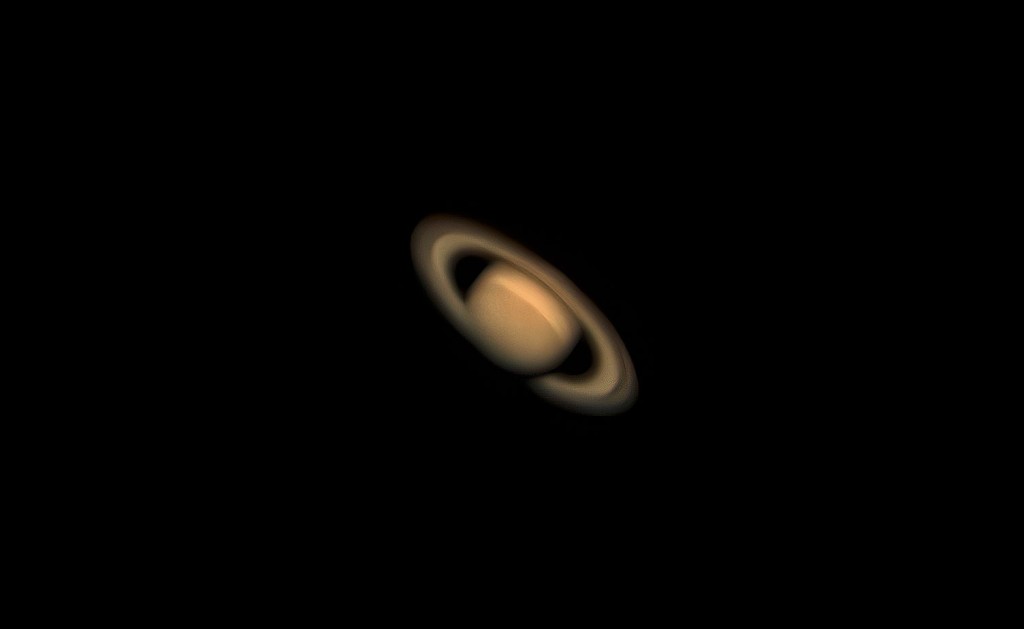
Saturn puts on a show on August 27th, at what we call Opposition. Saturn will be at its closets to Earth on this night, and fully illuminated by the Sun directly opposite it. Moving through the constellation Aquarius in the Southern sky, a medium sized telescope will allow you to see the rings and maybe even its moon Titan.
Saturn by Joel Cohen.
Wrapping up the month of August on the evening of the 31st is the second Supermoon of the month. When two full moons occur in the same calendar month, we call the second one a Blue Moon. This Moon won’t really appear blue but is a relatively rare event to have both full moons in a single month be Supermoons.
The Greeks coined the term planetes – meaning “wanderer” – to describe the objects they saw in the sky that regularly moved against the background of the other, fixed stars. Over time, this included many bodies that wander across the night sky, including the moon, Mercury, Venus, Mars, Jupiter, and Saturn, as well as smaller bodies like Sedna, Eris, Ceres, and Pluto. The strict definition of a planet has caused heated debates between individual astronomers, professional observatories, and universities, which have pockmarked history like the craters of our Moon. The International Astronomical Union, or IAU was founded in 1919 as a consortium of astronomers from all over the world, with the mission of cooperative astronomical “research, communication, education and development”. As such, the IAU has become the definitive organization for the uniform classification and naming of our continued discoveries across space.
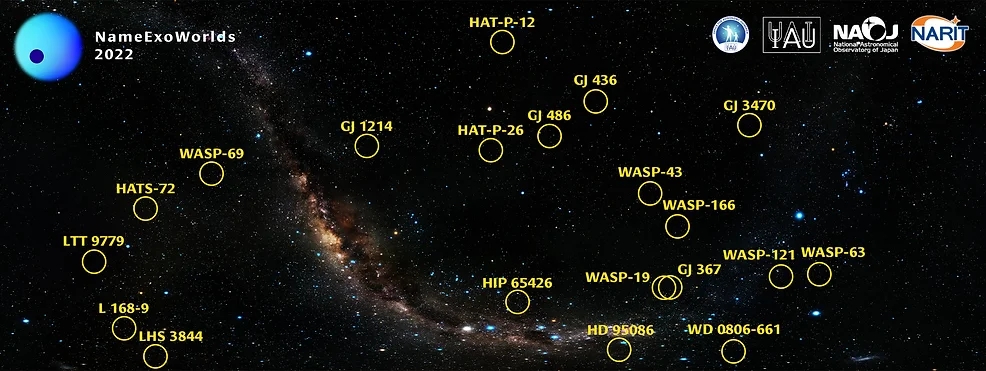
Since the first telescopes appeared around 1608, we have been able to observe much more than the easily visible stars that have graced our skies and mythologies for thousands of years. Commonly known stars such as Polaris, Betelgeuse, Rigel, and Vega were soon joined by many hundreds of others, which were often assigned designations, usually relative to the name of the discoverer, and the chronology of which it was discovered. For example, German astronomer Wilhelm Gliese (pronounced GLEE-zə) published a 1957 catalogue of 915 stars that were within 20 light years of Earth, essentially our closest stellar neighbors. The majority of these continue to carry designations like Gliese 436, being the 436th star listed in the catalogue. Not nearly as fun to say as Betelgeuse, the IAU has developed periodic naming competitions for some of the more interesting and commonly studied of these many thousands of additional stars sans moniker. Astronomers, educators, students, and laypeople alike contribute to these competitions, with the winning epithets from around the world are now represented in the heavens.
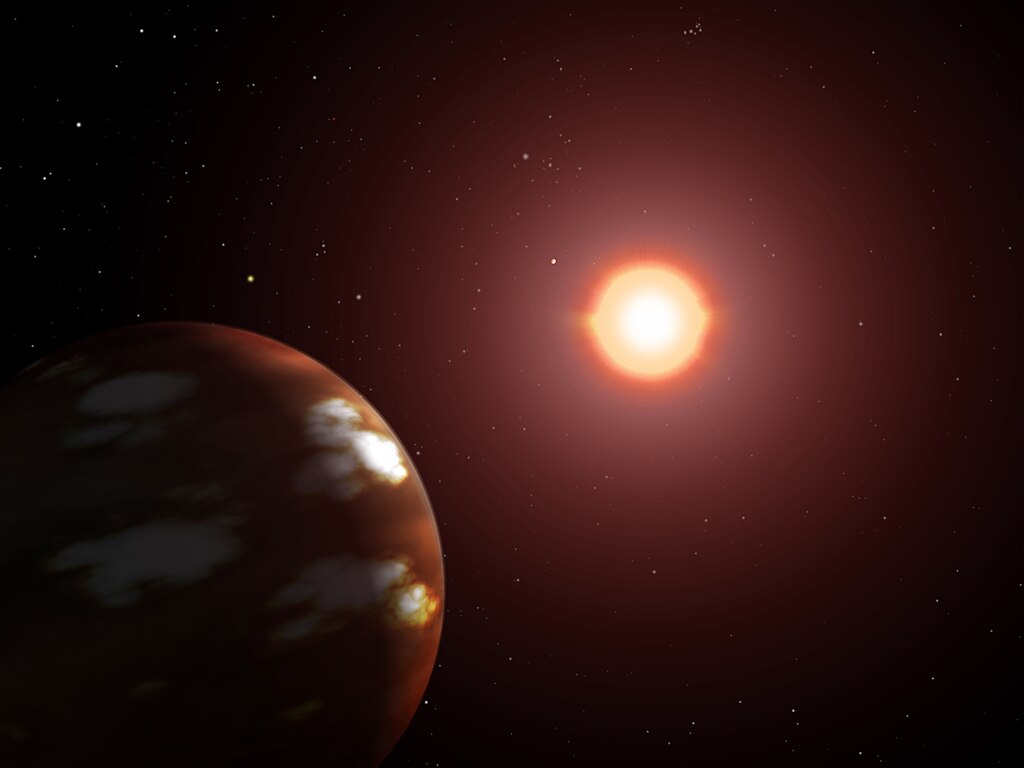
In 1992, the first exoplanet was confirmed. Exo being the Greek for “outside”, the IAU has defined an exoplanet similar to that of a planet, being a body which regularly orbits its host star, with a gravitational pull great enough to have cleared its orbit of other smaller bodies, and with the caveat of existing outside of our own solar system. Finding these exoplanets is difficult, and only a handful have been directly imaged. Most are discovered through various methods including how their gravity tugs on a star as it orbits and making the host star “wobble”, or by measuring the dip in light observed when the exoplanet passes in front of its star as measured from our view. Since that first discovery in 1992 by researchers at Puerto Rico’s now defunct Arecibo Observatory, we have added more than 5000 confirmed exoplanets to the list of rocky, liquid, or gas bodies orbiting other stars. Commonly, they follow the naming designation of the host star itself, such as the hot-Neptune icy body Gliese 436b orbiting its red dwarf star approximately 32 light years distant.
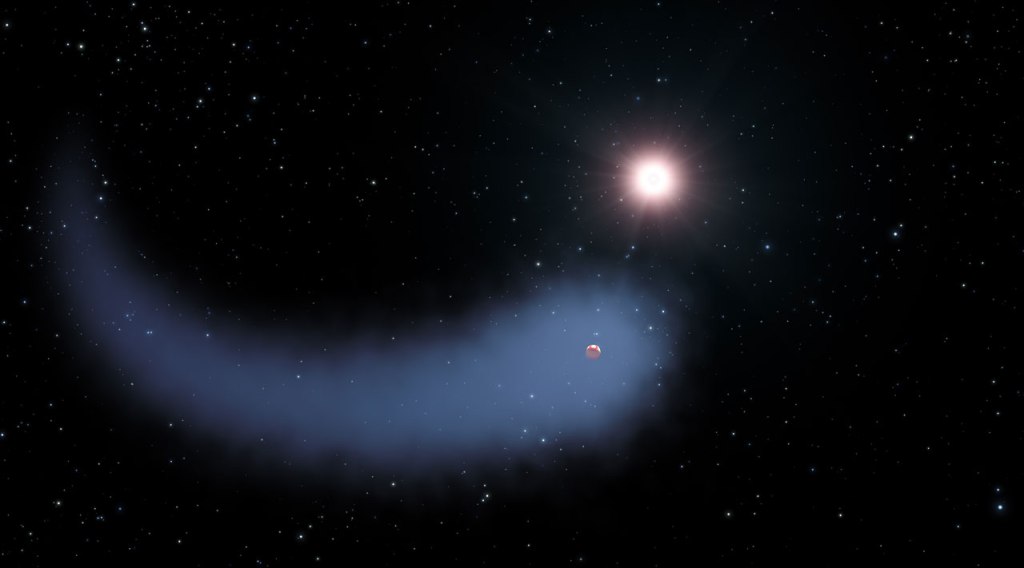
This artist’s concept shows the enormous comet-like cloud of hydrogen bleeding off of the warm, Neptune-sized planet Gliese 436b just 30 light-years from Earth. Also depicted is the parent star, which is a faint red dwarf named Gliese 436. The hydrogen is evaporating from the planet due to extreme radiation from the star. A phenomenon this large has never before been seen around any exoplanet.
To learn more about these exoplanets astronomers have created ground-based observatories such as the Very Large Telescope in Chile’s Atacama desert, and space-based equipment like the James Webb Space Telescope orbiting with the Earth at 4 times the distance of the moon. The sensitivity of these telescopes, and ability to observe outside the visible light spectrum of optical telescopes, has provided information that allows us to measure the volume, mass, and atmospheric compositions of some of these exoplanets. For example, Gliese 436b was chosen as one of the first exoplanets to be studied by the JWST, after the smaller Spitzer Space Telescope previously suggested a composition like that of a giant ice world, albeit with extremely high pressures and temperatures in excess of 800F. The heat, pressure, and proximity to the radiation of its star at just 2.6 million miles suggested that a giant cloud of gas observed around the exoplanet was actually a comet-like tail stretching 9 million miles.
Credit to @Trolligi and @Planetkid32 for Celestia footage of Noquisi and Awohali
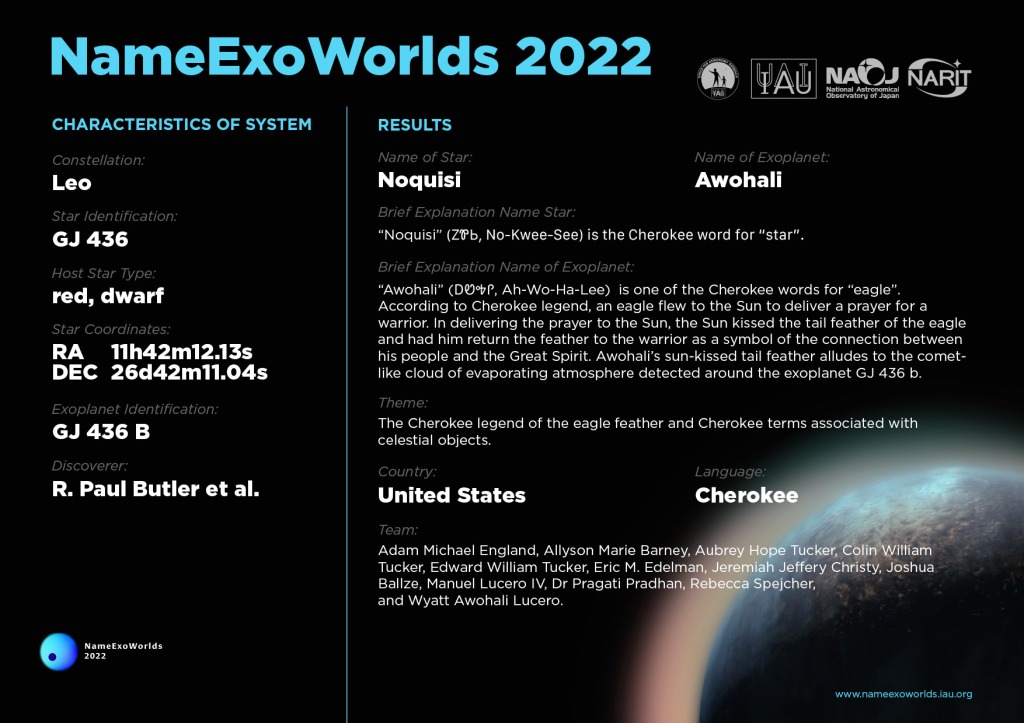
An exotic exoplanet, 21 times the mass of Earth, soaring around its star every 62 hours, with a surface of solid ice that exists at temperatures hotter than a household oven – and carrying the monotonous designation Gliese 436b. Something had to be done, and to this end, the IAU introduced NameExoWorld2022, an international competition to propose names for the more fascinating exoplanets that the James Webb Space Telescope will be dedicating time to observing. The theme for the NameExoWorlds2022 competition was “indigenous languages”, and so I assembled a team including representatives from Prescott’s Museum of Indigenous People, Embry Riddle Aeronautical University, The Northern Arizona Astronomical Consortium, and students from ERAU, Bradshaw Mountain High School, Northpoint Expeditionary Academy, and Liberty Traditional School. Together, we came up with submission for Gliese 436b and its host star Gliese 436, and have spent the last 8 months promoting this through in-person outreach events around the Quad City area, articles, videos, and podcasts available online.
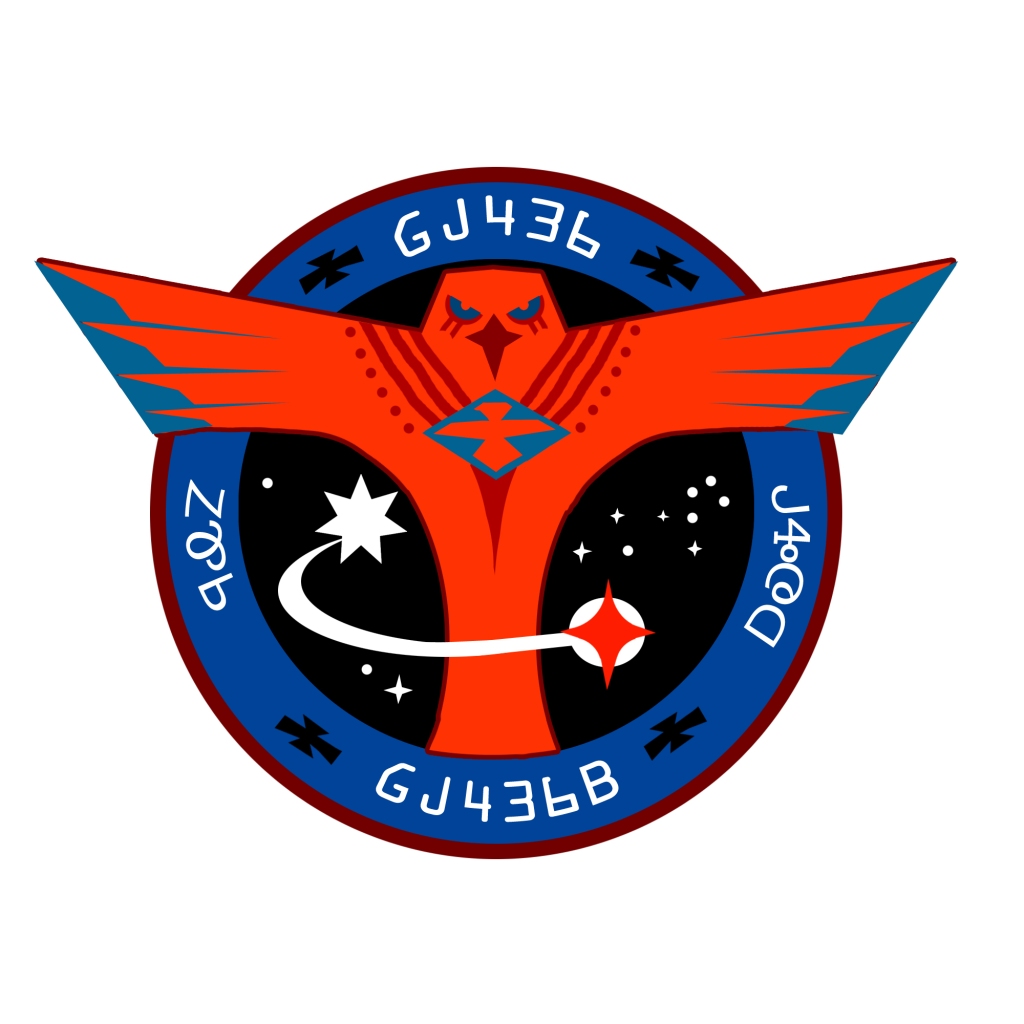
On Wednesday, June 7th, the IAU announced that Gliese 436/b will now formally carry the approved names Noquisi and Awohali for the star and exoplanet, coming from the Cherokee language meaning “Star” and “Eagle” respectively. These names represent so much more than just two words picked at random from an indigenous language. They represent an oral history handed down for hundreds of generations telling of a connection between humanity, nature, and the stars, as well as the first time that a star or exoplanet have officially carried a name in the indigenous language of a North American people. As told by Manuel Lucero IV, Director of Prescott’s Museum of Indigenous People, and a member of the Cherokee Nation, the oral history of Awohali goes:
Long ago when animals chose to speak with us, there was a warrior who had a prayer for his people that he wanted to deliver to the Great Spirit. This warrior climbed a mountain as high as he could go, and he came across Yona, the Bear. Yona said, “Two-legged, what are you doing here? You don’t belong here!” The warrior said, “I want to deliver this prayer to the Great Spirit.” Yona was very taken aback by this story and says, “I will take that prayer for you.” He took the prayer and climbed as high up the mountain as he could. When he reached the top of the mountain and there were no more trees except for one, he saw Awohali the Eagle nested up at the top of it. Awohali looked down and said, “Yona, what are you doing here? You don’t belong here.” Yona told Awohali about the prayer, and equally touched, offers take the prayer. Awohali in Cherokee means “He who flies the highest,” and Awohali flew as high as he could, higher than he ever had before, all the way to the Sun – our star Noquisi. The Sun looked at the eagle and said, “Awohali, what are you doing here? You don’t belong here.” Awohali told the Sun about the prayer, who replied, “I speak with the Great Spirit all the time, give me the prayer and I will deliver it. But first, give me one of your tail feathers.” Awohali reached back and plucked one, handing it to the Sun, who kissed it. This is why the golden eagle tail feather has a black mark on the tip. The Sun told Awohali, “Give this feather to the people so they will know they have a direct connection to the Great Spirit.” For this reason, the eagle feather is coveted by most native people.
We are honored to share this story with you, as a small piece of the valued history of one of our country’s many diverse cultures, and as the members of the Prescott Area team who worked so diligently to share it with the world, for now and for generations to come. I urge you to take an afternoon and visit the Museum of Indigenous People at 147 N. Arizona Avenue to learn more about the Noquisi/Awohali system, the NameExoWorlds2022 competition, and indigenous astronomy at the Ani Noquisi exhibit running now through December 2023, and follow the Jim and Linda Lee Planetarium at Embry-Riddle for more upcoming shows on this and other astronomical wonders. Additionally, a video of the project is available at https://youtu.be/nl893hO6v5w
Members of Team Ani Noquisi:
-Manuel Lucero – Director, Museum of Indigenous People; Representative of the Cherokee Nation
-Joshua Ballze – Trustee, Museum of Indigenous People; Jurassic Paleoart Expo; Representative of the Hia-Ced O’odham Nation
-Dr. Pragati Pradhan – Assistant Professor of Physics and Astronomy, Embry Riddle Aeronautical University; Association for Women in Science
-Eric Edelman – Director, Jim and Linda Lee Planetarium, Embry Riddle Aeronautical University; AAS Astronomy Ambassador, Equity, Diversity, and Inclusion Committee of the International Planetarium Society
-Adam M. England, E.A, “The Backyard Astronomer” – Founding secretary, Northern Arizona Astronomical Consortium; Former Vice-President, Prescott Astronomy Club; Astronomical League member
-Rebecca Spejcher – Undergraduate Student of Astronomy, ERAU; Society of Physics Students
-Colin Tucker -Student, Bradshaw Mountain High School
-Wyatt Lucero – Student, Northpoint Expeditionary Learning Academy
-Allyson Barney – Student, Liberty Traditional School
-Jeremiah Christy – Student, Liberty Traditional School
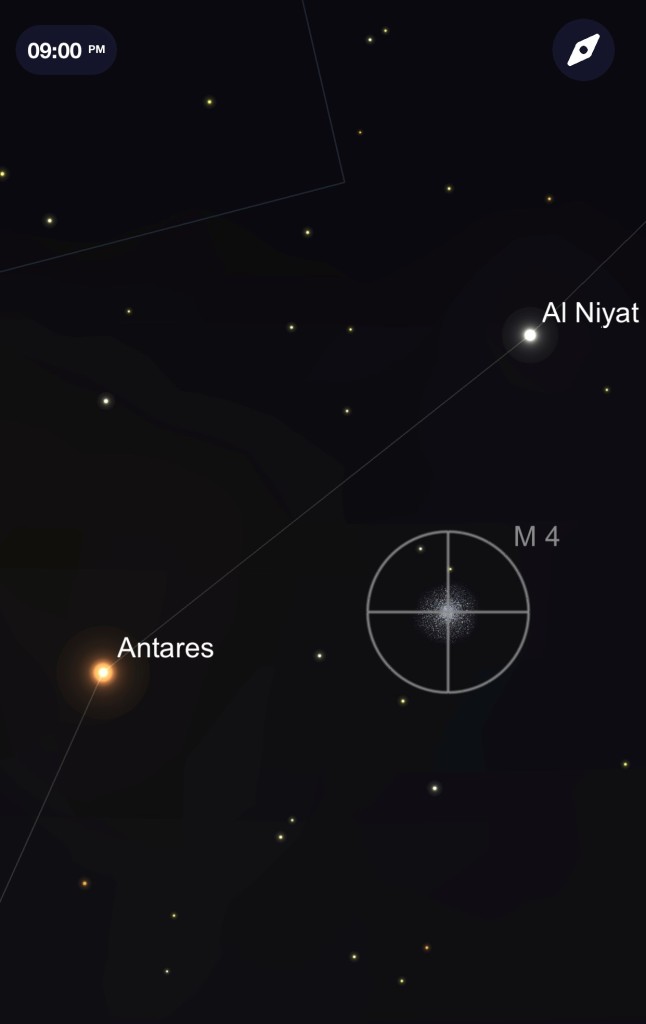
One of my personal favorite constellations is Scorpius. It is very easy to identify in the summer months when it rises in the Southeast and sways above the Bradshaw Mountains like the traditional scorpion promenade à deux pairing dance. The red supergiant Antares defines the head of the Scorpion and is often confused with Mars for its brightness and somewhat ochre coloration. Just one degree westward of Antares is the globular cluster Messier 4 (M4), the first cluster to have individual stars resolved by astronomers in the mid 1700s. Today, Backyard astronomers can easily locate this cluster with a decent pair of binoculars or a small telescope.
Antares and Messier 4 – SkySafari
While the head of the scorpion is dominated by Antares and the five stars making up its head and claws, the tail of the scorpion rises above the mountain tops a litter later in the evening and is defined by its large hook at the tip. The Hawaiian culture saw these stars as the fishhook of the demigod Maui, calling it Ka Makau Nui o Māui or “The Big Fishhook of Maui”.
Scorpius – Till Credner, Wikimedia Commons
Here in Northern Arizona, we certainly have scorpions and will use a fishhook for landing a trout, however the Navajo culture some something different in these stars. The last four stars in the tail are strikingly similar to the tracks left by a running rabbit, and as such, was known as Gah Haat’e’ii – Rabbit Tracks. It was the return of the rabbit tracks each year that signified to Navajo hunters that hunting season was over. During the time this constellation is visible in the night sky is when deer, elk, and other large game have given birth to your young, and these newborns are still reliant on their mothers for sustenance. When Rabbit Tracks move to the East and is no longer upright in the sky, the young are then old enough to care for themselves, and the hunting season returns.
Gah Haat-e’ii – Rabbit Tracks – Judy Volker, judy-volker.com
Due to its placement along the main swath of the Milky Way, Scorpius contains many other deep sky objects, including double stars, nebulae, and both open and globular clusters. Enjoy the beautiful summer nights of Northern Arizona and get your telescope out to look at this amazing patch of sky.
Spring also brings with it the pollinators that make our world possible, and the Beehive Cluster shines prominent in the sky this month. You may be able to spot these industrious little lights “buzzing” around Mars on the night of June 2nd, when the Red Planet will be centrally located among this open cluster. Mars is easy to spot, being one of the most crimson objects in the night sky and should help you locate the beehive cluster above the Southwestern horizon just after dusk. On many nights, and from dark skies, it is easy to locate with the naked eye, as astronomers and observers have done for millennia. A handful of stars have always been visible to the eye; however, Galileo turned his telescope to the cluster in 1609 as one of his first observations and was able to discern 40 individual stars. Modern observations have catalogued over 1000 stars that are gravitationally linked in this area of space with a radius of about 12 light years, with around 30% of the stars being Sun-like.
Just as our bees are busy spreading life around our planet, the stars in the Beehive Cluster too are busy forming new planets of their own. In 2012 researchers using the Kepler Space Telescope announced that two planets had been discovered orbiting two separate stars in the cluster. Known as “Hot Jupiters” these planets are some of the largest gas giants, though they orbit much closer to their host star, making them – you guessed it – much hotter. While this is not in itself a unique discovery in this age of planets, what is unique is that both of the stars they orbit are similar in size and brightness to our own star. From our limited observations since the first exoplanet discovery in 1992 we have found 9432 exoplanets, with less than 5% being rocky, earth like bodies, and K type “orange dwarf” stars being the most common type of star to host a planet. By comparison, our Sun is a G type yellow dwarf, being slightly larger and hotter.
M44 by astrophotographer Drew Evans.
If you missed the conjunction of Mars and the Beehive Cluster on June 2nd, you could witness an earth-like planet join the cluster on the nights of June 12th and 13th. Earth’s celestial twin, Venus, will be making a close approach to the cluster as it traverses the ecliptic. Though separated by millions of miles of empty space, both of these wanderers appear to move along the same cosmic road, as determined by our solar system’s formation out of a disk of gas and dust, and few planets have strayed more than a few degrees from this original stellar plane.
Spring has sprung in Northern Arizona, and with it comes the return of budding flora and emerging fauna. In like fashion, the sky also graces us with clusters in bloom, and the slithering serpents that herald their homecoming.
Messier 5 through the eyes of the Hubble Space Telescope.
The constellation Serpens is often depicted as two halves of a snake, as held by Asclepius, the Greek god of medicine. The snake was observed to shed its skin, an act seen by the ancients as a sort of rebirth and resurrection, and the return of the constellation Serpens brings the rebirth of the plant and animal life that laid dormant throughout the winter. The serpent begins to rise in the Eastern skies during the month of May and brings with it a host of deep sky objects for your viewing pleasure.
M5 as seen from the 32″ scope on Arizona’s Mount Lemmon (Schulman).
Messier 5 (M5) is a globular cluster near the head of the Serpent, with more than 100,000 stars densely packed into a ball of space about 165 light years in diameter. Despite having so many individual stars, its distance from Earth at around 25,000 light years makes it appear to the naked eye as a single, faint star. Through your binoculars you will be able to discern that it is not a single object, however larger telescopes can resolve many of the brighter individuals, which includes one hundred five variable stars, 2 millisecond pulsars, and a dwarf nova.
Messier 5 through the eyes of the Hubble Space Telescope.
The entirety of M5 is speeding away from our solar system at more than 50km/s, so by the time you finish reading this article, it will have moved a full Earth diameter further away from your backyard telescope. The most daring Backyard Astronomers can also hunt galaxies off the head of The Serpent. Hoag’s Object is an extremely rare ring galaxy, and Seyfert’s Sextet is a group of six galaxies which are gravitationally bound like a globular cluster, albeit over a much grander scale.
Hoag’s Object taken by astronomer Konig Von Murmeltiere.
For early-bird astronomers, Jupiter and the Moon will be dancing together on the morning of May 17th. Jupiter will be hidden behind the Moon as it rises from the Eastern Horizon, in what is known as a Lunar Occultation. Jupiter will re-emerge from behind Luna at 5:17 AM MST, with sunrise just a few minutes later at 5:26 AM, potentially obscuring the view from all but the most dedicated observers.