Category: Solar System

  • June 2025 – Solstice Mesa

    Solstice Mesa, Prescott, AZ, aligned with Granite Moutain. Image by Edward Tucker.

    The celebration of solstices and equinoxes are documented in almost every culture worldwide.  Varying types of events have become regional staples, especially in the Northern Hemisphere, where the date around June 20-21st each year represents the longest days and most sunlight, before the Sun begins its semi-annual trek back to the South.  In Sweden, one may encounter a Midsummer celebration with revelers dancing around the maypole, adorned in festive attire, while neighboring Norway celebrates with massive bonfires.  As Christianity spread across Europe, many of these ancient rituals merged with the traditional birthday of Saint John the Baptist on June 24th, for deeply religious symbolism.  In Barcelona, communities commemorate the holy day with feasts and bonfires fires lit from the Canigó Flame, burning continuously since 1955.  Comparatively, Alaskans celebrate the long summer sun in many ways, including a midnight baseball game in Fairbanks – with no artificial lighting – and indigenous games and a “polar bear swim” in Nome.

    Norwegian Midsummer Bonfire, Nina Aldin Thune, courtesy Wikimedia Commons.

    Possibly the most well-known solstice events occur at ancient megaliths.  The 5,000 year old Ħaġar Qim site in Malta was built so that the solstice aligned a hole in the wall to create a crescent shaped light that morphs into an ellipse and the disappears as if sinking into the ground.  The most famous of these is Stonehenge, where thousands will gather this year to witness the Sun rise behind the Heel Stone.

    Stonehenge Heel Stone, Summer solstice, Andrew Dunn, courtesy Wikimedia Commons.

    It could lead one to believe in ancient alien conspiracy theories, that so many cultures, separated by thousands of miles and thousands of years, all did a pretty good job of coordinating with the modern calendar.  Archaeoastronomers, however, know better.  From the solar alignment of the Temple of Kukulcan at Chichen Itza, to the layout of the entire Angkor Wat complex in Cambodia, humans have observed the sun, measured its movements, and calculated its future positions for thousands of years.

    Solstice Mesa in Prescott, AZ is situated as that the setting sun is in alignment with the saddle in Granite Mountain at the Summer Solstice and with Thumb Butte to the South at the Winter Solstice. Image by Adam England.

    Venturing across the Central Highlands of Northern Arizona, one can also find such monuments left in the strata of history. The indigenous inhabitants of these lands as well as passing travelers left their marks on the landscape, as evidenced by ruins and petroglyphs found throughout the area.  One such location is Solstice Mesa, nestled in a protected park in Prescott Lakes at the end of Tawny Drive.  Rock art throughout this short hike tells the story of thousands of years of regional inhabitation, as well as the record of the changing of the seasons.  This monolithic ephemeris aligns with a crag in Granite Mountain at the Summer Solstice, and again with Thumb Butte at the Winter Solstice.  Such an alignment cannot be mere coincidence, and silently speaks to the advanced astronomical understanding of the early Yavapai and other peoples who have called this land home.
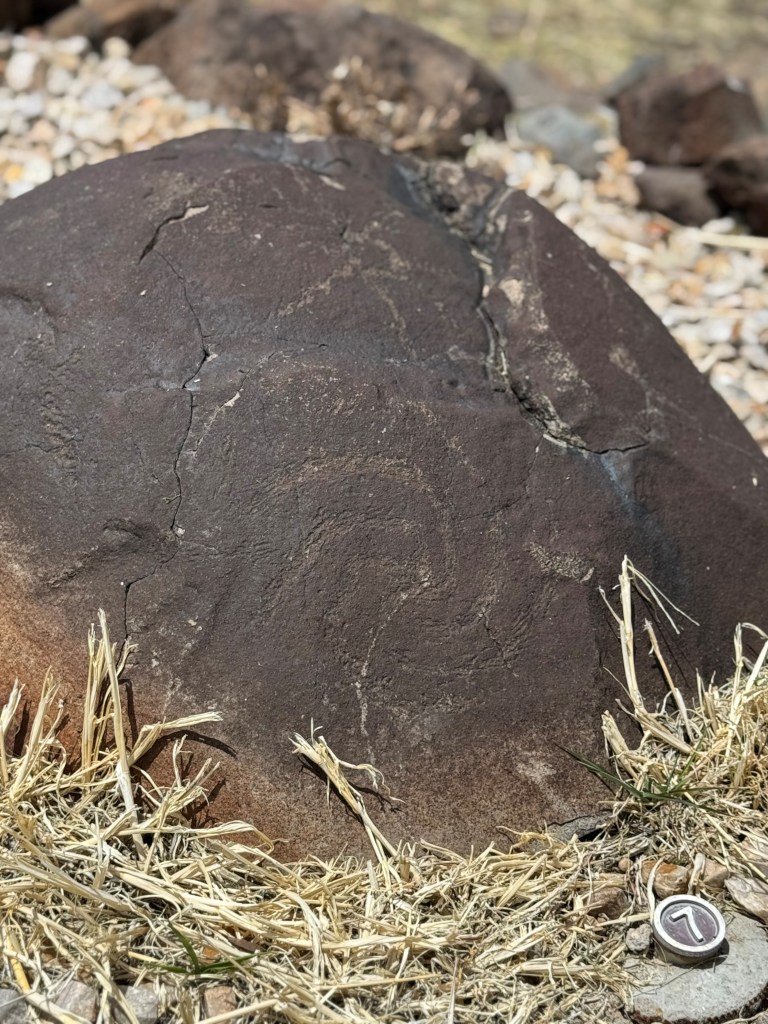
    A swirling petroglyph on Solstice Mesa – possibly an ideation of a galaxy, such as Andromeda? Image by Adam England.

    Should you visit, please use the opportunity for discovery and enlightenment to respect this sacred place.  To learn even more about the indigenous cultures of Northern Arizona, visit the Museum of Indigenous People at 147 N Arizona Ave in Prescott.
  • May 2025 – Life In The Cosmos

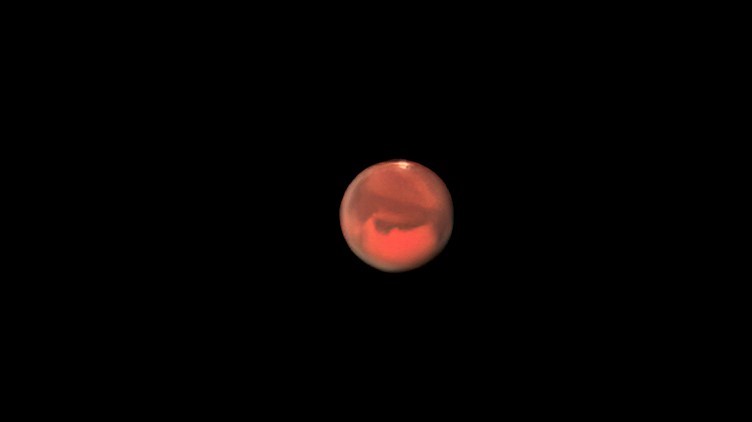
    Mars 10-02-2020, courtesy Prescott Astronomy Club member Joel Cohen.

    Humans have likely always looked at the sky and wondered if we are alone in the universe.  From the classical Roman god messenger Mercury to the angelic hosts of the Abrahamic religions, ancient belief systems often referred to Gods and other visitors as omnipotent beings capable of traversing Heaven and Earth.  As technology improved and enhanced humanity’s understanding of the universe, the habitability of neighboring planets became a legitimate scientific endeavor.  Natural geographic features of Mars were (incorrectly) interpreted as intentionally engineered, and the idea of intelligent Martians and Vesuvians populated the themes of science fiction.  Our fleet of robotic investigators throughout the Solar System can now confirm that no advanced species constructed canals on Mars, and that intelligent life – as we know it – could not survive on these inhospitable worlds.   This insight has led us to look deeper into the history of our own planet to discover what the origins of life may be.

    Martian canals, Percival Lowell, courtesy Wikimedia Commons.

    Taking it back a few hundred million years, the “Cambrian explosion” was a time in Earth’s history when life grew from single celled organisms to multi-cellular, complex life.  Fossil records show this began in the oceans, with large populations of phytoplankton gobbling up the abundant carbon and using sunlight as energy to convert up to half of the oxygen in our atmosphere.  One byproduct of this process is the compound Dimethyl Sulfide, which is only known to be naturally produced through this process.

    Astrobiologists use many different factors in the search for extraterrestrial life.  Earth-like conditions for habitability have led us to define the Goldilocks Zone where a planet may orbit its host star in a way that it would neither be too hot nor too cold, but “just right” for liquid water to exist.  A breathable atmosphere like ours would optimally be composed of about 3:1 nitrogen to oxygen, with trace amounts of other elements and compounds such as carbon dioxide, methane, and – you guessed it – dimethyl sulfide.

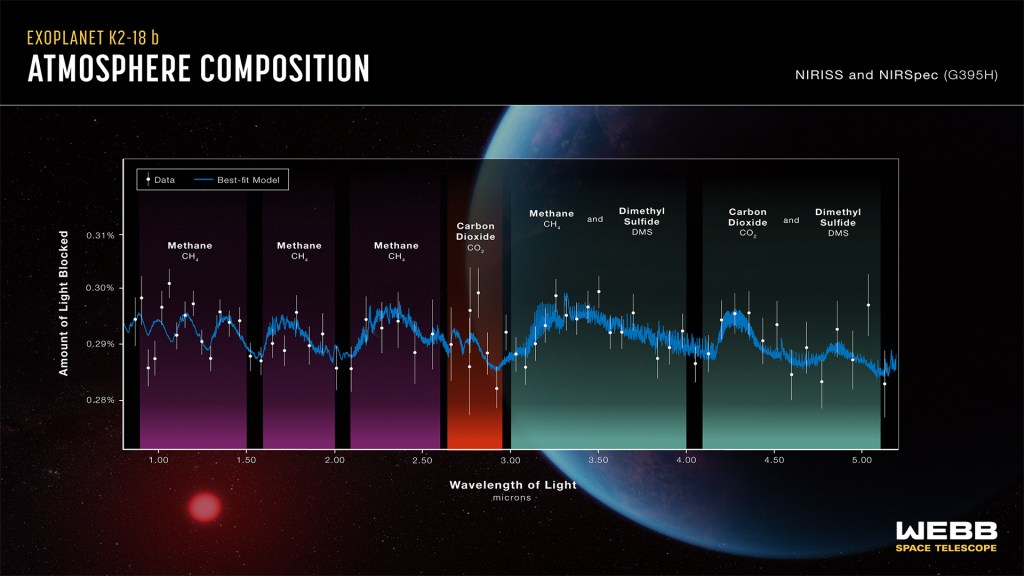
    K2-18b JWST spectra, courtesy NASA.

    The James Webb Space Telescope was constructed with extremely sensitive instruments that can measure the atmosphere of distant worlds by studying the light that has passed through it.  At 124 light years distant in the constellation Leo, the exoplanet K2-18b just happens to be in this Goldilocks Zone around a red dwarf star and about 8 times the mass of Earth. Following up on observations made by the Kepler and Hubble telescopes, JWST data indicates the atmosphere is likely made up of hydrogen, carbons, methane, and dimethyl sulfide.  If this is the case, it is possible that a form of early photosynthesis is active in the oceans of this alien world.

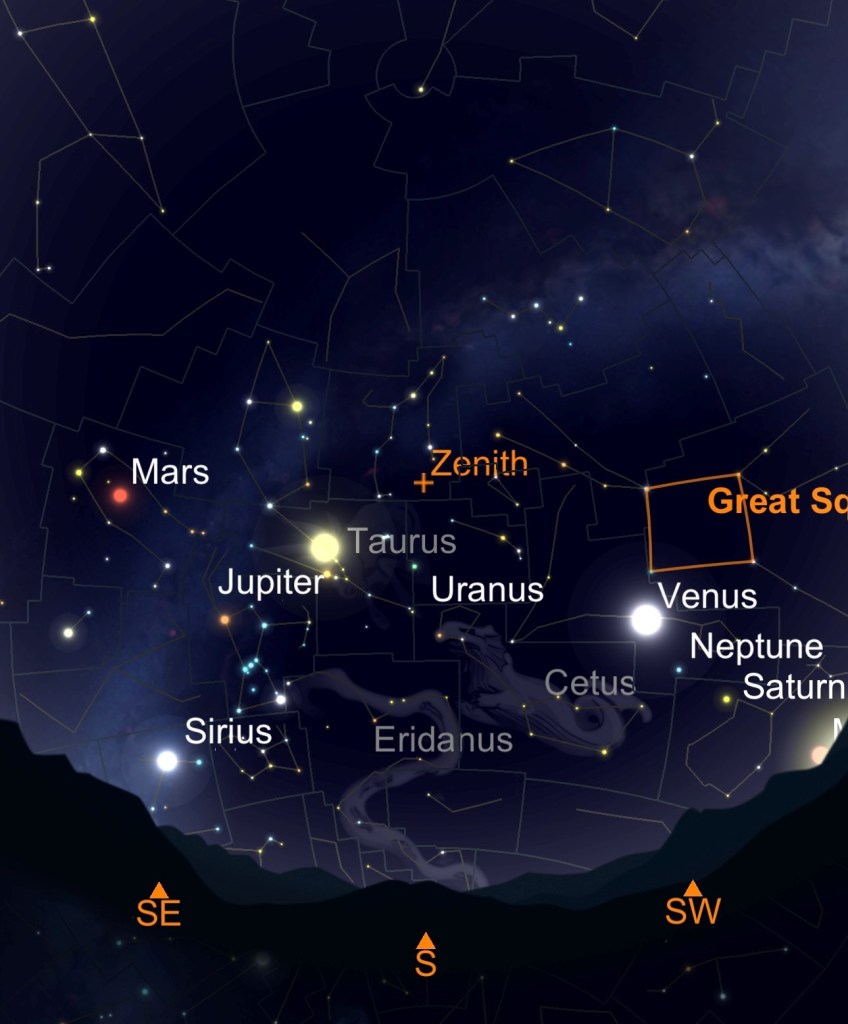
    Leo and Mars, May 2025, SkySafari

    As the constellation Leo moves to the southwest throughout the Spring, the planet Mars will enter the constellation later in the month of May.  While observing the Martian “canals” from your own backyard, your field of view may well include distant worlds teeming with the earliest forms of microbial life.

  • April 2025 – Clear Skies and Comet Tails

    Astronomers love to get lucky.  It’s a true art of patience, “waiting for the stars to align”, both metaphorically and physically speaking.  Despite Arizona’s more than 300 days of Sun each year, a storm may roll over and obscure our view, as we experienced with the lunar eclipse in March, and also with the Solar Eclipse in April 2024.  Maybe T Corona Borealis – The Blaze Star – will burst as a nova when we have an excellent view of the Northern Crown this year; or maybe Earth will be halfway around the Sun, and the stars gracing our night sky will be from the opposing hemisphere of our Milky Way galaxy; or perhaps you’ve been looking forward to a planetary conjunction to image two planets in one frame, and the full Moon decides to cover it up, and shine blindingly across your star party.

    Sometimes, however, astronomers do get lucky.  Statistically speaking, April tends to afford Arizona astronomers clear skies, and the deep chill of winter nights soon give way to more agreeable observing temperatures.  Seems like we’re starting to get lucky.

    Image courtesy Wikimedia Commons: First place in the 2021 IAU OAE Astrophotography Contest, category Meteor showers: Geminid Meteor Shower from China, by Dai Jianfeng, China.

    Then there’s that blasted moon.  Many beginning astronomers may hone their skills on the lunar craters, but soon find the bright glow of neighboring Luna a hinderance to celestial events and deep sky observing.  For this reason, the Prescott Astronomy Club will host public Starry Nights Star Parties on or near the new moon, affording the darkest skies possible. Visit www.prescottastronomyclub.org to find the next public event you can attend.

    While weather is unpredictable, and the moon is like clockwork, these are both short term considerations.  Periodically, the universe sends us longer duration events, such as comets.  A comet may take hundreds or even thousands of years to come near Earth on its elliptical path around the Sun, then disappearing again into the vast outer reaches of our Solar System.  Even after no being longer visible to our eyes or our telescopes, these comets leave a trace of their journey floating in space.  Having been blasted by the solar wind, the comet’s tail will begin to disintegrate and vaporize, and the tiny particulates reminiscent of snow and sand and dust will linger, until acted upon by another celestial body.  If that body happens to be the atmosphere of the Earth, then we might just get a show.

    Screenshot

    The Lyrids meteor shower peaks this year around the night of April 21st-22nd.  Usually producing around 20 meteors per hour, these shooting stars will burn in our upper atmosphere and produce bright trails across the night sky.  Luckily, the waning moon will be below the horizon for most of that night, rising in the East at the 4 o’clock hour.  The Lyrids are named from where they appear from in the sky, near the constellation Lyra, the Lyre.  A small and simple constellation, it is easy to locate, as anchored by the bright star Vega.  Look to the East in the hours after midnight, and pan upwards to the Zenith.  The brightest star you find will be Vega, and, weather permitting, you may enjoy one of the best meteor showers of the year.

  • The Backyard Astronomer – March 2025 – An “Edgy” Perspective

    By Adam England, The Backyard Astronomer

    Stuck on Earth, we essentially get one viewpoint of the cosmos.  From a nearly fixed location in the universe, it doesn’t seem like other objects move very much, apart from the “wanderers”, as coined by the Greeks with the term “planētēs,” or planets.  Due to the tilt of the Earth’s axis at 23.5 degrees, and as our planet orbits the Sun, we do have the opportunity to view different parts of the night sky at different times of the year.  This gives us various constellations, that while they no longer match up to the ancient months of astrological charts, do progress through our skies over the course of one orbit, or year.  But, as we know, Earth is not the only orbiting body running laps around the Sun.  And, as it turns out, Earth isn’t the only planet that leans to the side either.

    Artist rendering of a solar system forming.

    The early Solar System was complete chaos.  Over nearly 500 million years, a giant cloud of gas and dust coalesced around the Sun, and gravity pulled debris together into gassy and rocky clumps – both large and small.  Run-ins between these bodies were common, and one such collision knocked the early Earth sideways, giving us the 23.5 degree tilt, and therefore seasons.  While we can’t rewind and watch a replay of these planetary fouls, the tell-tale signs of such impacts are scattered across the Solar System.

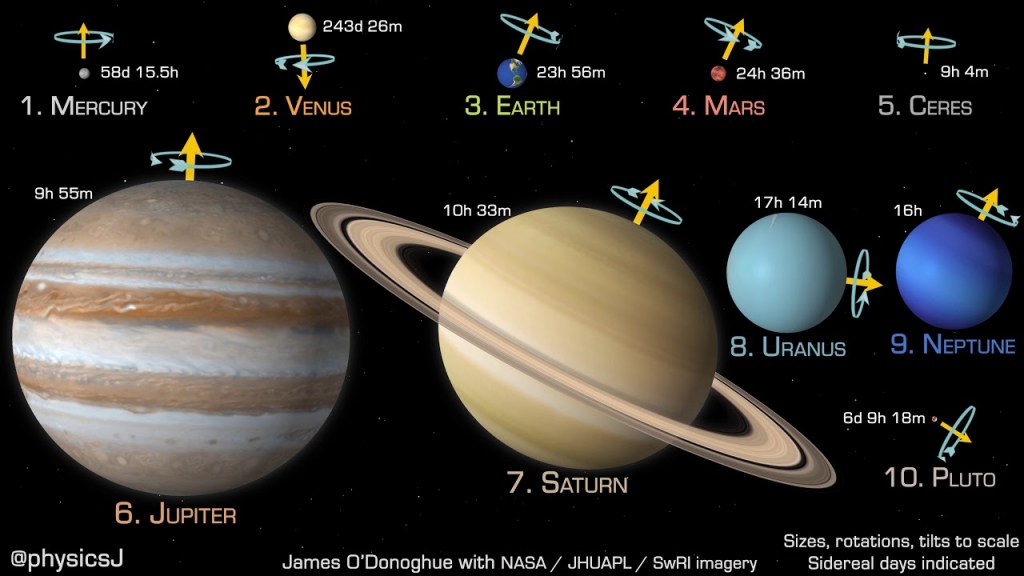
    James O’Donoghue, courtesy NASA.

    Ironically, Mars isn’t much different than Earth, with a tilt of 23.98 degrees.  Jupiter can clearly take a punch, because it barely leans at 3 degrees.  Saturn sits at 26.73 degrees off kilter, and Uranus is completely sideways, rolling down its orbital plane at 98 degrees.  Venus took a knockout blow at some point, as it spins on its axis at 177 degrees, or almost completely upside down, and backwards of everything else in our stellar neighborhood.  The larger planets must have protected their little brother from these celestial scuffles, as Mercury is the only known body in our Solar System with no tilt at all.

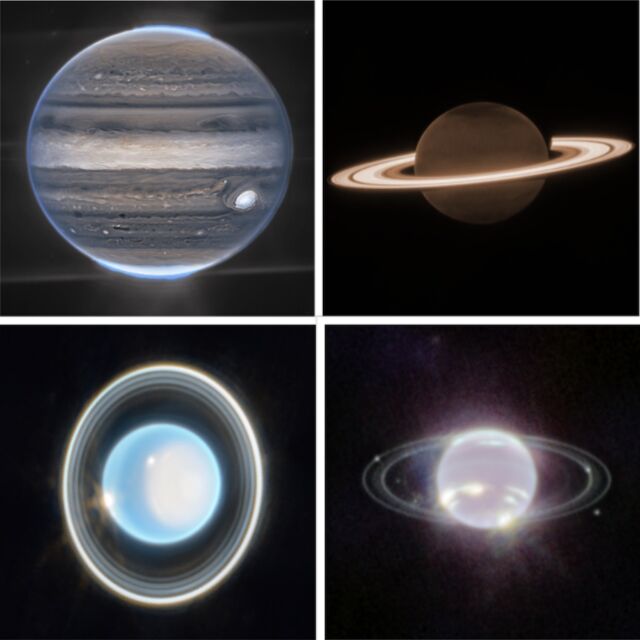
    Gas Giant with Rings, JWST.

    These cosmic accidents left debris fields in their wake, proof of which are the rings that grace the four gas giants of the Outer Solar System.  Galileo was extremely perplexed by this unique shape he gazed at through his early telescope, and while he likely never fully understood the oblong shape he saw, those who followed have certainly been entranced by Saturn’s rings.  Like countless astronomers before, seeing the rings of Saturn through a backyard telescope is what truly solidified this author’s passion for space. 

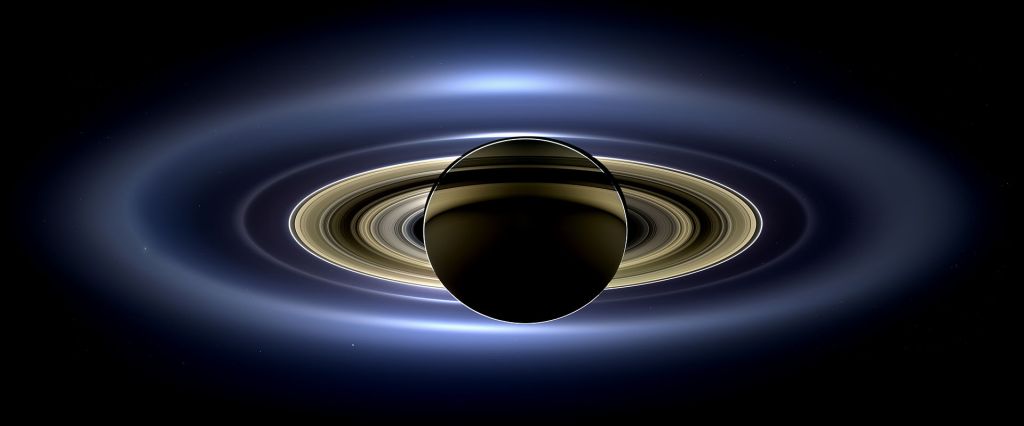
    Saturn, by Cassini.

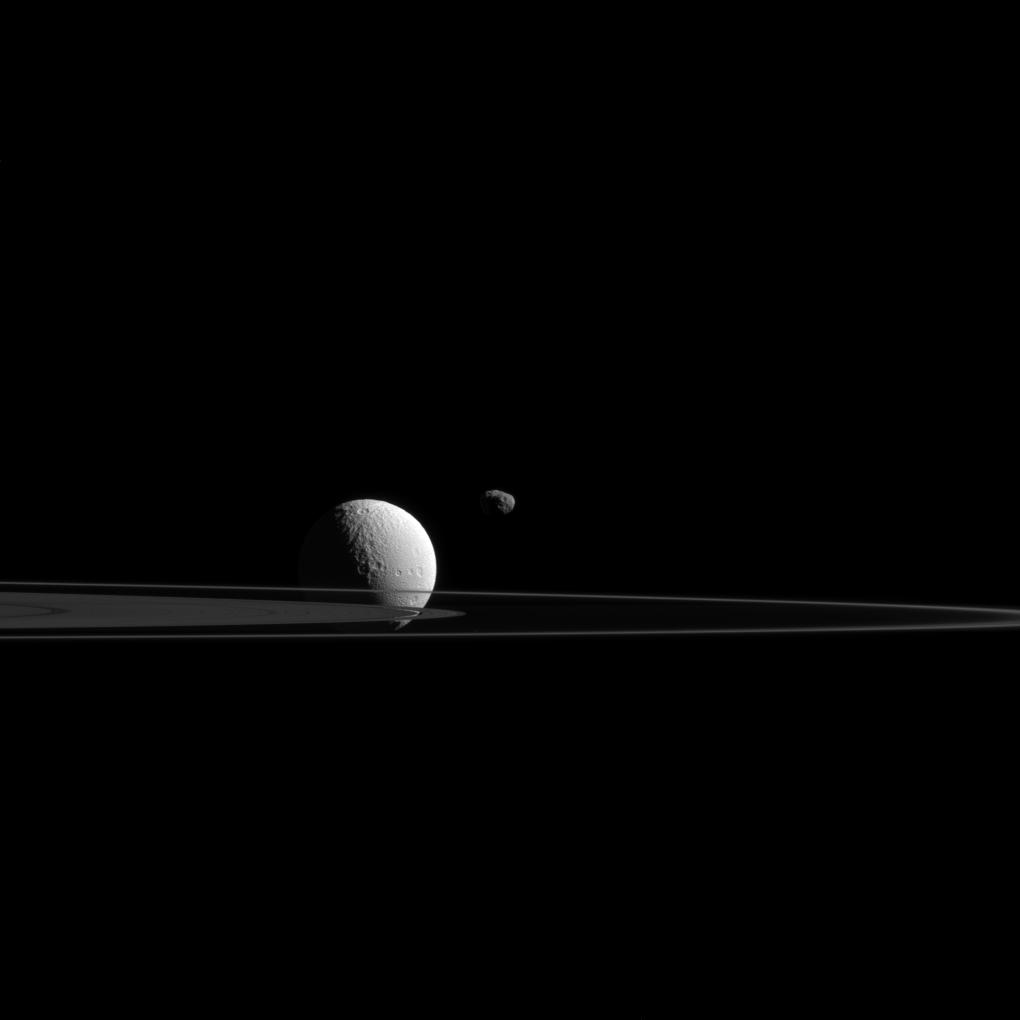
    Over 400 years of study have documented the changes in Saturn’s rings, from both far away and up close, and across the entire spectrum of visible and non-visible light.  The Cassini probe orbited Saturn from 2004 to 2017, and gave us an understanding of the rings’ structure as billions of small pieces of snowy dust, ranging in size from a grain of sand to a small house.  The overall depth of the rings averages less than 1 kilometer in thickness.  Amazingly, at nearly 1 billion miles distant, we can still see these rings from our vantage point on Earth. 

    Sometimes.

    Saturn’s rings and moons, Cassini.

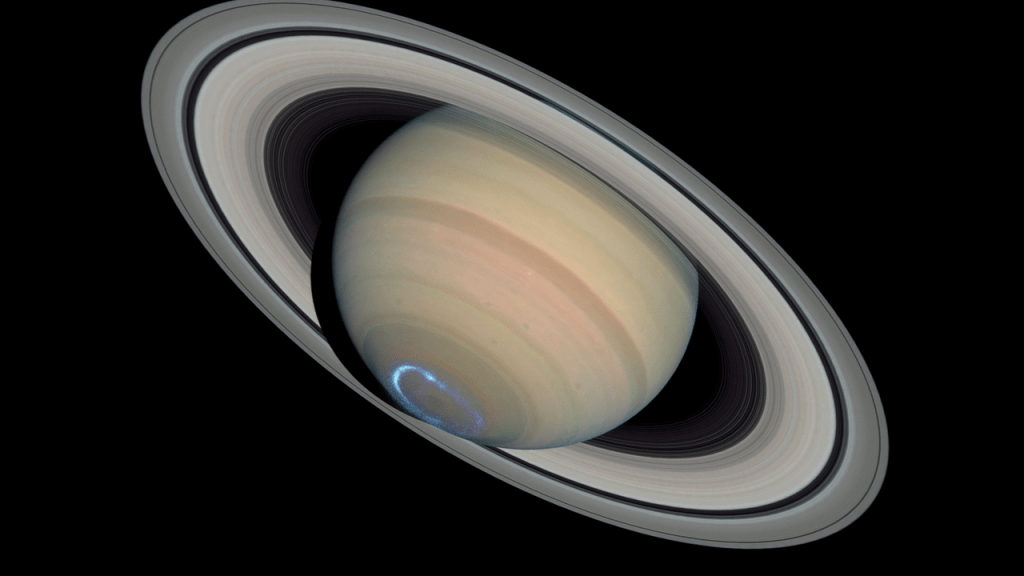
    Because Saturn is tilted at its respective 26.73 degrees, the rings can be viewed at different angles depending on how they and Earth’s orbits align.  About every 14 years, we see the rings as completely edge-on, and they essentially disappear.  During the month of March, the rings will be at this edge-on angle relative to Earth, and seem invisible except to the largest of telescopes. Sadly, Saturn is extremely close to the Sun this month, and not visible to most amateur astronomers.  However, as Saturn emerges from behind the Sun in the early spring mornings later this year, the rings will again begin to tilt toward our view, and offer backyard astronomers the world over one of the greatest sights in the heavens.

    Saturn, Hubble Space Telescope.

    Adam England is the owner of a local financial services firm and moonlights as an amateur astronomer, writer, and interplanetary conquest consultant.  Follow him on Instagram @TheBackyardAstronomerAZ and at http://www.ManzanitaInsuranceAndAccounting.com

  • February 2025 – Planetary Alignments

    “The planets are aligned for the first and last time in 396 billion years!”

    Well, not quite.

    Headlines like the above have become common click-bait in the last few weeks, as most of our solar system’s planets have been visible in the night skies throughout this Winter.  Enjoying this sight from our terrestrial vantage point, it’s easy to see how one might assume the planets are neatly ordered in a rare fashion.  However, orbital mechanics can be a little difficult to grasp from such a perspective.


    So let’s step out of the box, er rather, step off the sphere that is our Earth.

    To start off, a true alignment in space, where multiple bodies are in a nearly straight line with each other,  is known as a syzygy – which just so happens to be one of my absolute favorite words in the English language.  But I digress.

    Looking down on our solar system, of course the Sun is the gravity monster at the center which holds everything together, and all the other stuff is spinning around it.  The rocky planets all complete an orbit relatively quick, from Mercury at 88 days to Mars at 687 days, and Earth somewhere in the middle at 365 days, 6 hours, and 9 minutes, give or take.

    The Gas Giants are another story.  One Jovian (Jupiter) year is equivalent to 12 Earth years, Saturn needs 29.4 years to run a whole lap, Uranus jumps up to 84 years to round off its circuit, and Neptune takes a whopping 165 Earth years to complete one orbit of our star.  Neptune was only discovered in 1846, so it just barely celebrated its first discovery anniversary in 2011.  Happy belated birthday, Neptune.

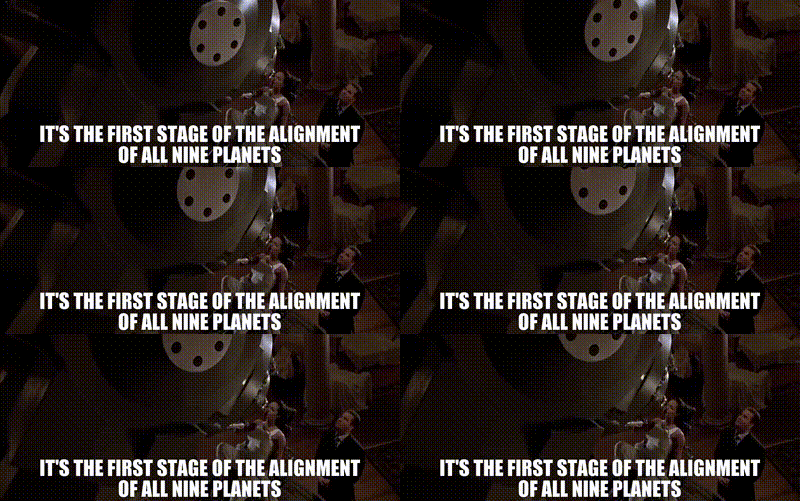
    Since these eight planets are moving at various speeds and across such vast distances in space, it’s not everyday that they will all be in a perfect line – or syzygy.  On average, Mercury, Venus and Earth will line up about every 40 years, but the time increases exponentially for each planet we add to the equation beyond Earth.  In the 2001 Angelina Jolie video game adaptation of “Lara Croft: Tomb Raider” the plot centers around a planetary syzygy that will imbibe the Illuminati with omnipotence via an ancient artifact.    Tony Flanders of Sky and Telescope Magazine did some math, and calculated approximately once in 396 billion years for all eight planets to be within a 3.6° arc of a true syzygy.  For comparison, our Solar System is only 4.6 billion years old.  Let’s take it a little further.  If the planets were within 1° of a perfect alignment, to of course aid the Illuminati in such a valiant endeavor, Tony determined we will be waiting about 13.4 TRILLION years.  That is 1,000 times longer than our entire universe has even existed. 

    So, no, the planets are not aligned in syzygy.  Odds are, they will probably never line up in such a fashion during our Sun’s expected life of about 10 billion years.  They are, however, putting on a fabulous procession across our winter night sky, which you can enjoy just by stepping outside right after sunset, and following the ecliptic across the Southern sky.

    My deepest condolences to Lara Croft, the Illuminati, and click-bait article writers everywhere. 

    Adam England is the owner of a local financial services firm and moonlights as an amateur astronomer, writer, and interplanetary conquest consultant.  Follow him on Instagram @TheBackyardAstronomerAZ and at http://www.Manzanita-Insurance.com

  • November 2024 – The Great Square of Pegasus

    The ancients clearly had two things going for them: wonderfully dark skies and fantastic imaginations.  It can often be difficult for the modern backyard astronomer to pick out constellations and imagine a Great Bear, a Hunter, or a horse with wings, just by connecting the twinkling dots in the sky.  Light pollution certainly has an impact on our ability to decipher some of these celestial images, with brighter lights preventing us from seeing many of the dimmer stars in the sky.  Some online tools can help one find relatively dark areas for astronomical viewing, such as lightpollutionmap.info, where one can see the major metropolitan areas of the Southwestern United States pockmarked against the more desolate (and DARK!) regions that may be just a short drive away.  Even with our good fortune to live in a fairly dark area, some of those constellations can still be a challenge.

    For this astronomer, Pegasus is one of these constellations.  Usually depicted upside down between the neighboring Aquarius to the south and Andromeda to the North, and bordered by the two fish of Pisces to the East, I still have a difficult time coming to the same conclusion of a winged horse when I look to the South during the Fall.  Alternatively, I can quickly pick out the four bright stars that form a near perfect square – the asterism oft referred to as the Great Square of Pegasus.  Roughly outlining the body and wings of a sensational stallion, two white and one each red and blue stars denote the corners of this heavenly box, residing just above the ecliptic.  You can follow the stars off the southern and western corners to envisage the head and front legs of this airborne equine.  As you explore around the Great Square, there are a may dark sky objects you can find.

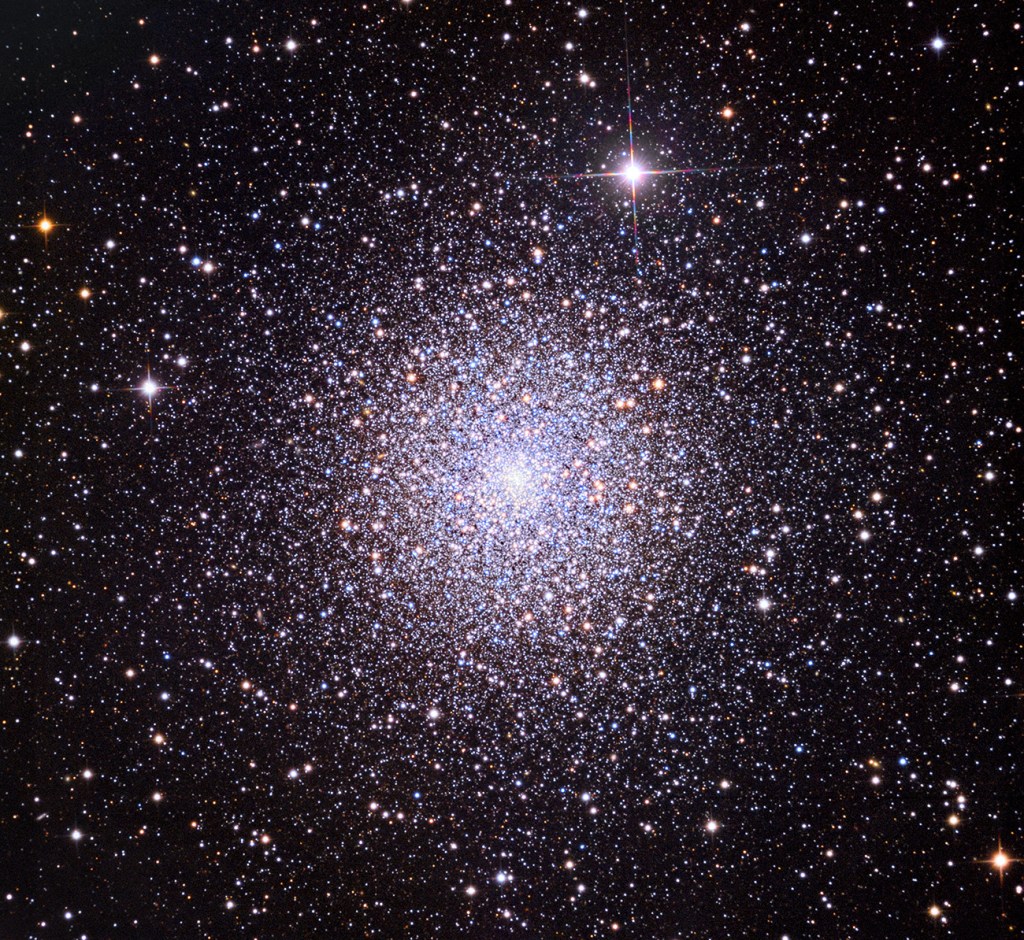
    M15, Courtesy Adam Block, Mount Lemmon.

    Moving to the Southwest of the Great Square is the red star Enif, marking the horse’s muzzle.  Just to the west of this star is M15, a prime target for fans of globular clusters.  Do you prefer galaxies?  Look to the North of the bright white star Alpheratz, the top corner of the square, and you can find M31, the Andromeda Galaxy, the closest galaxy to our own Milky Way.  You can also use the square to guide you to other objects, such as the Triangulum Galaxy.  Draw a line between the top two stars in the sky, look approximately the same distance east, and you will find one of the only deep sky objects which – with dark skies and good vision – humans have been able to see with the naked eye for thousands of years, even if they did not yet know what it was.

    M33, courtesy Joel Cohen, Prescott Valley, AZ
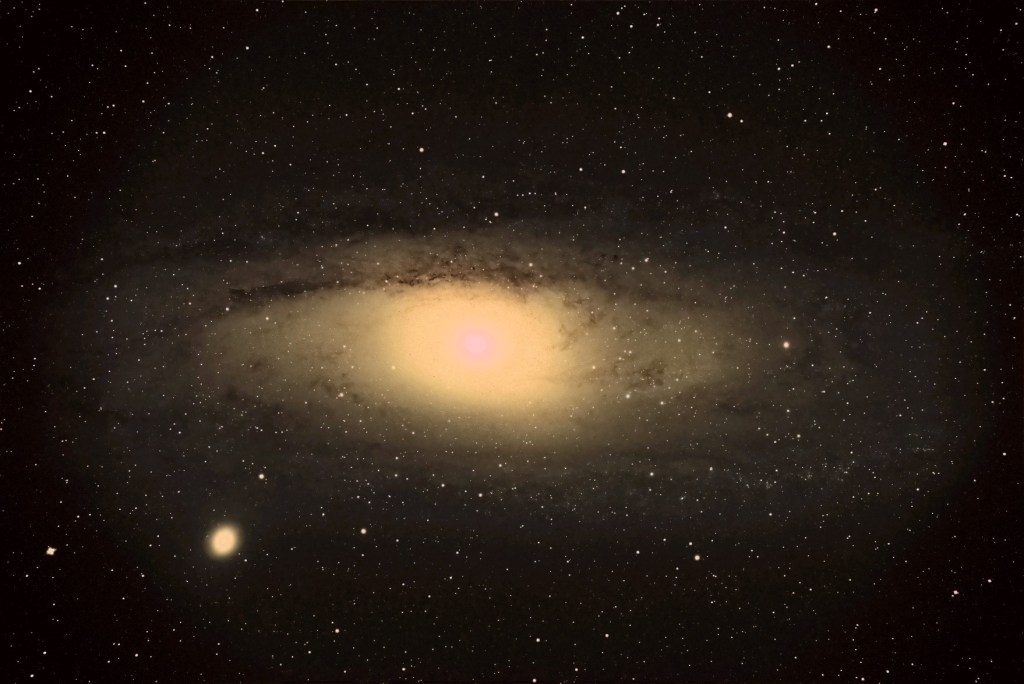
    Andromeda Galaxy, courtesy Joel Cohen, Prescott Valley, AZ.
  • October 2024 – Wandering Stars, The Oort Cloud and Comets

    In space, everything is in motion.  From a spacecraft orbiting the Earth, to moons dancing around planets, or star systems on an epic voyage across our galaxy, nothing ever truly “stops” moving.  We find patterns in these movements, such as the ecliptic, or great highway on which the Sun moves across the sky, and the planets take turns traversing our nights.  From these patterns, astronomers can work forwards to predict when the next eclipse will occur, or work backwards to understand how our solar system formed.  However, we often find objects that move in odd ways, such as a comet that orbits opposite of the standard movement of planets and most asteroids, known as a retrograde orbit.  These objects are indicative of something strange that is either happening or previously happened in the distant reaches of our Sun’s sphere of influence. 

    Our Solar System, Wikimedia Commons.

    The Oort Cloud is a vast sphere of cold, dark objects that are loosely held in a shell by the Sun’s gravity.  Stretching from about 2,000 to 200,000 AU – an AU or Astronomical Unit being the average distance of the Earth to Sun, or about 93 million miles – the Oort Cloud is where most of our long period comets come from, taking hundreds or even thousands of years to complete an orbit.  This is far past the orbits of Neptune and Pluto, and this distant region is where science fiction and science fact have attempted to explain strange orbits with concepts like a Planet X.  Recently, AI models have suggested that in the past billion or so years, it’s likely that a wandering star careened through the outer edges of our solar system, leaving gravitational chaos in its wake.  The lasting effects of such a close stellar encounter could explain the movements of many objects in the other solar system, including retrograde comets.

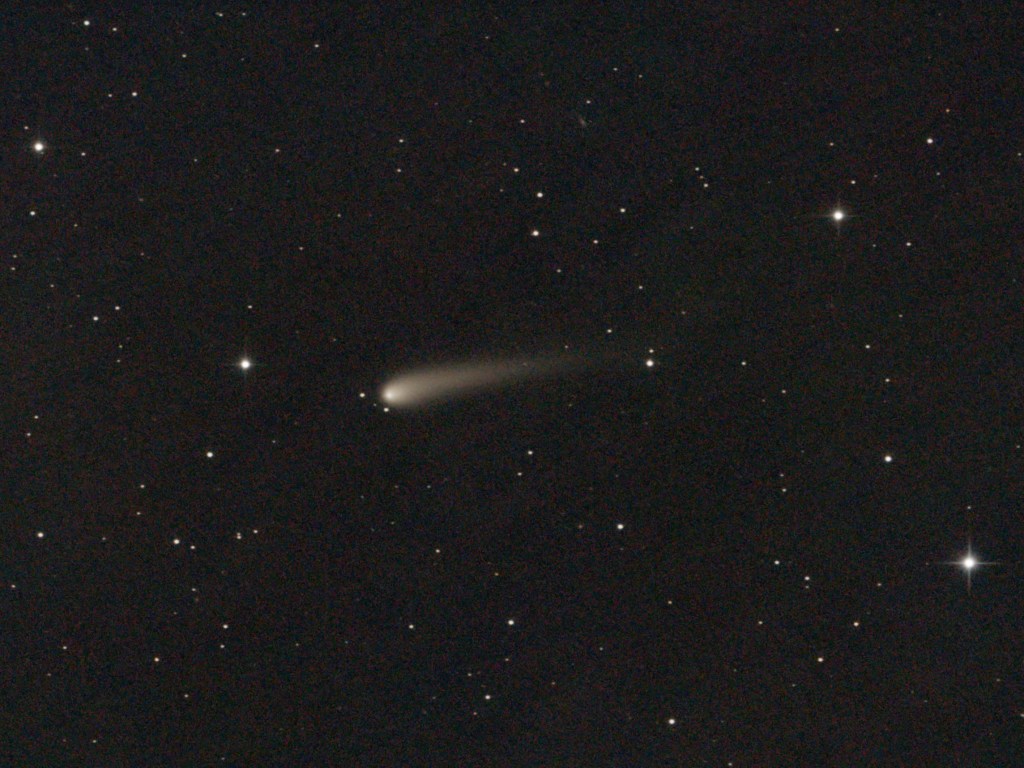
    Comet C/2023 A3 photographed by C Messier 6/10/2024, Wikimedia Commons.

    One such comet was discovered in early 2023 by multiple observatories around the world, designated C/2023 A3 (Tsuchinshan–ATLAS).  This comet has a retrograde orbit, and by tracking its movements towards the inner solar system, it has been suggested that its orbital period may be millions of years, having come from the furthest reaches of the Oort Cloud, and likely sent on its current path by the gravitational push and pull of one such passing star.  Likewise, its outbound trajectory appears such that it may be ejected from our solar system after its swing around the Sun, destined to traverse the cold depths of the Milky Way Galaxy for millions or billions of years.

    Comet C/2023 A3 on October 15th, SkySafari.

    Mid to late October will offer backyard astronomers throughout the Northern Hemisphere great opportunities to see this once-in-a-lifetime comet.  Though difficult to project, it is shaping up to be one of the brightest comets in decades, with current estimates that it could reach magnitude 0 brightness around mid-October.  Around October 15th, look to the Southwest just after sunset.  Venus will be low on the horizon, with the red star Antares to its left, and comet C/2023 A3 just above and to the right.  You should be able to see the comet naked eye, but even a good pair of binoculars or small telescope should give you a great view of the tail stretching across the constellation Serpens and pointing directly away from the point where the Sun just set.  It will begin to dim over the coming weeks as it moves higher in the sky and away from the Sun, as it continues back to the dim and frigid fringes of our solar system.

  • September 2024 – The History of Saturn

    Ringed Planets – James Webb Space Telescope, Courtesy NASA.

    September gives us prime viewing of two of our Solar System’s four ringed planets.  Yes, you read that correctly; our Solar System has four planets with rings.  You’re certainly familiar with Saturn, which we have known for its rings for nearly 400 years.  However, as our telescopic technology has progressed, we have found that all four of the gas giants have rings.  Both Saturn and Neptune will be at opposition this month, and though Neptune may appear as only a small blue dot through even the largest backyard telescopes, viewing a fully illuminated Saturn at its annual closest approach to Earth is always a treat for both new and experienced astronomers.

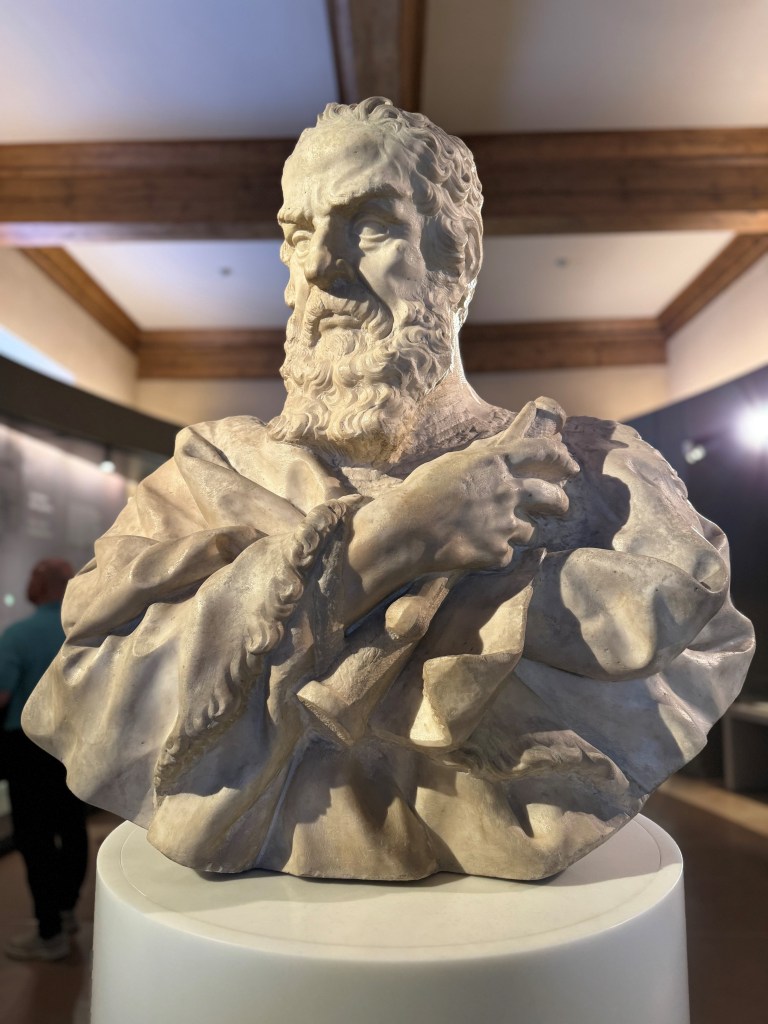
    Bust of Galileo, Museo Galileo, Florence, Italy. Photograph by Adam England.

    Florence, Italy, 1609.  Galileo Galilei had completed his first telescope, with a magnification of about 3x, and began scanning the sky.  Of course, he observed the Moon, Jupiter, and the phases of Venus, reinforcing Copernicus’ heliocentric model of the Solar System.

    Galileo’s telescopes, Museo Galileo, Florence, Italy. Photograph by Adam England.

    He then turned his attention to more distant objects, and sketched Saturn with what he believed to be two moons on either side of the planet.  The next time he looked, these satellites seemed to have disappeared, but then reappeared again in 1616.  Quite confused, it is believed he died without knowing that what he saw are the now famed rings, which, due to the respective tilts of Earth and Saturn, and the harmonics of our respective orbits, are viewed completely edge on and seem to disappear every 13-15 years.

    Galileo sketch of Saturn, Wikimedia Commons.

    His outspoken views of the Solar System (and Earth’s place within it) were not taken well by The Church, earning him a date with the inquisition, and he ultimately spent the last nine years of his life under house arrest at his villa (numbered 42, anybody?) overlooking the Tuscan countryside. 

    Your author at Villa Galileo, 42 Via del Pian dei Giullari, Florence, italy.

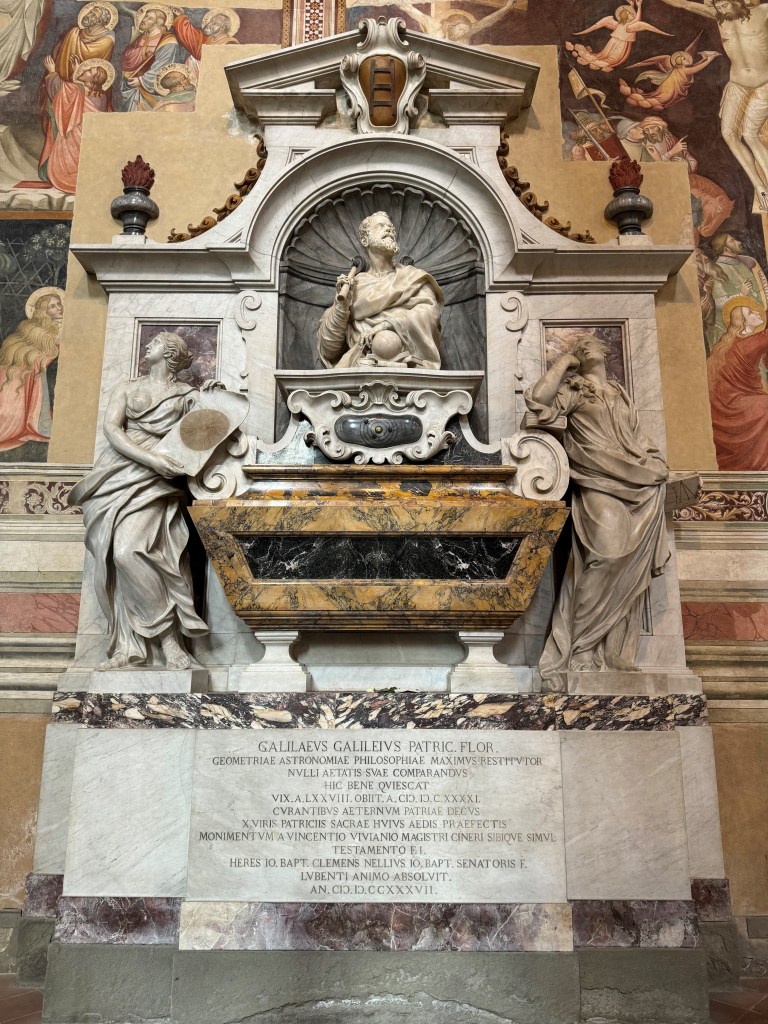
    Galileo died in 1642 and was ultimately interred in the Florentine Basilica of Santa Croce, adjacent Renaissance virtuosos such as Da Vinci, Michelangelo, Alberti, Ghiberti, and Machiavelli.

    Galileo’s Tomb, Basilica di Santa Croce, Florence, Italy. Photograph by Adam England.

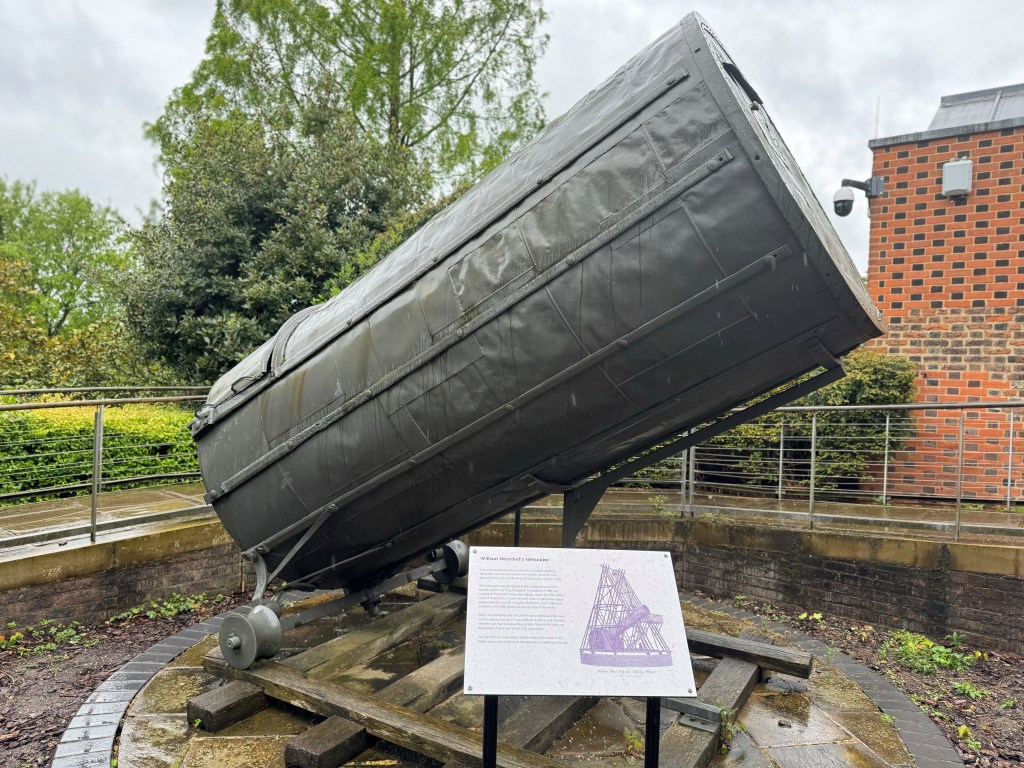
    By the late 1700s, English Astronomer William Herschel had become fascinated with Saturn and its rings. He constructed a 40-foot telescope in 1789, the largest in the world for more than 50 years, and immediately began to observe the Saturnian system, keeping an astronomical journal of the positions of both the rings and multiple moons.  Dutch astronomer Christiaan Huygens had discovered Titan in 1655, and Italian Giovanni Cassini charted four more moons between 1671 and 1684.  Over a century later, and with the benefit of his mammoth telescope, Herschel stumbled across two more, bringing the number of known satellites to seven.  (We now count 146 moons orbiting this ringed giant.) 

    Remaining section of Herschel’s 40ft scope, Greenwich Observatory, London, England. Photograph by Adam England.

    William’s son, John Herschel, built upon his father’s work, founded the Royal Astronomical Society in 1820, contributed advancements to the fields of botany and photography, and later suggested the moons of Saturn carry the names of the Giants in Greek mythology.  Both father and son are memorialized in Westminster Abby’s  Scientists’ Corner, in the company of Charles Darwin, Isaac Newton, and Stephen Hawking.

    William Herschel memorial at Westminster Abbey, London, England. Photograph by Adam England.
    John Herschel memorial at Westminster Abbey, London, England. Photograph by Adam England.

    You also can observe these same rings and moons of Saturn throughout the month of September.  A good pair of binoculars should define the elongated rings.  2-inch telescopes begin to see Saturn’s largest moon, Titan, and a 4-inch scope should define Iapetus, Rhea, Dione, and Tethys.  Apertures of 8 inches or larger will allow views of Enceladus, Mimas, Hyperion, and other moons, as well as divisions within the rings, and weather bands on the planet itself.  Whatever equipment you have, when you look at Saturn, you are following in the footsteps of generations of great astronomers.

    Saturn as imaged by Hubble. Courtesy NASA.
  • August 2024 – The Sky Is Falling!

    Recently there have been a string of stories in the news regarding objects falling from space.  Both the universe and humanity have contributed to these episodes, such as a recent fireball that burned bright over New York City, or the Florida family who in April received quite the surprise when a piece of refuse from the International Space Station crashed through the roof of their home.  So, what is going on?  Are we now living in the space-junk-pocalypse?

    Tunguska Event, courtesy of Wikimedia Commons.

    To put it simply – no, objects falling from the heavens is not a new phenomenon.  Over 3600 years ago in the Dead Sea valley, evidence points to the destruction of a city from a fireball bursting in the air and causing the deaths of around 8,000 inhabitants.  Russia has been hit twice in the last century or so, with the 1908 Tunguska event leveling 80 million trees across 830 square miles of unpopulated Siberia, and again in 2013 when the city of Chelyabinsk experienced a massive shockwave from an approximately 59ft wide space rock that caused millions of dollars in damage to more than 7200 buildings.

    Smaller and more isolated events can still cause harm.  In 1888 a town in Iraq experienced a bolide that exploded and rained down stones on the villagers, killing one and paralyzing another.  Closer to home, Alabama resident Ann Hodges was resting on her couch in 1954 when a grapefruit sized rock smashed through her roof, bounced off her radio and smacked her on the side of her torso.

    Ann Hodges meteorite, courtesy of University of Alabama.

    Since the dawn of the Space Age with the launch of Sputnik I on 4 October 1957, we humans have continued to send terrestrial materials into orbit around Earth.  As satellites age and die, or fail prematurely, orbital decay drags these inert bodies from the sky, and the intense heat of atmospheric friction often disintegrates most if not all of the object.  What remains has a high probability of falling in the ocean, or some inhospitable corner of the Earth, but the law of averages tells us that the more stuff we put up there, the more we will see some coming back down.

    On 9 May 2024, a farmer in Saskatchewan was prepping his fields for seed when he found an object the size of a truck hood sticking out of the ground.  This was the second time in 2 years that a piece of a SpaceX rocket had survived reentry, against expectations, but that doesn’t make them the only culprit.  In 2000, worldwide orbital launches tallied at 85.  The year 2023 saw 223 launches, and 2024 is set to blow that record out of the sky – pun intended. 

    Saskatchewan farmer and space junk, courtesy Gillian Massie, X/Twitter.

    As more players have entered the growing space economy, the United Nations Office of Space Affairs has formulated ground rules for both governmental and commercial entities and the liabilities they incur.  115 countries are party to the Outer Space Treaty, which says the launching state (government) is ultimately responsible for anything that originates from their sovereignty, which is often passed on to private space companies through insurance policies.  Likewise, most standard home insurance policies do cover falling debris also.

    So, rest assured, Chicken Little – you have a far better chance at winning the lottery or being eaten by a shark than that of being hit by space junk.  But it does happen!

  • June 2024 – Planets on Parade

    Around 4.5 billion years ago, our solar system was nothing more than a large cloud of gas and dust, not much different than the Orion Nebula (Messier 42) that we enjoy looking at with our backyard telescopes every winter.  Composed of mostly hydrogen, the cloud coalesced over millions and billions of years until a catalyst – most likely the shockwave from a nearby star exploding as a supernova – jolted the cloud into a spin and collapsing in on itself.  The dense center of the nebula became our sun, the cloud flattened into a disk, and clumps of gas further out spun up into the gas giants that dominate our outer solar system.  Scattered between these gas giants were pockets of primordial dust, left over from the very first stars and planets that populated our universe.  This dust collided and stuck together as it began to form larger and larger rocky bodies, eventually the size of small planets called planetesimals.  Dozens or possibly hundreds of these baby planets collided over hundreds of millions of years, forming the rocky planets of our solar system today, and scattering debris across the cosmos as asteroids and comets and moons.

    From that initial shock that jolted our solar system into motion, everything continued to spin.  Throughout eons of chaos and disorder, the rotation of the planets and moons and asteroids and comets and even the sun itself persisted.  The flattened disk that was the nursery for the birth of planets maintained a consistent path through space, which today we call the ecliptic.  As viewed from Earth, the ecliptic is the superhighway on which the sun and planets travel across our sky.  Despite the violent early days of the solar system and the catastrophic collisions of protoplanets, none of the eight major planets ever strayed more than a few degrees from this original orbit.  As such, we can look out and quickly identify the planets wandering against the backdrop of static stars.  For this reason, the word planet comes from the Greek planetes meaning “wanderer”.

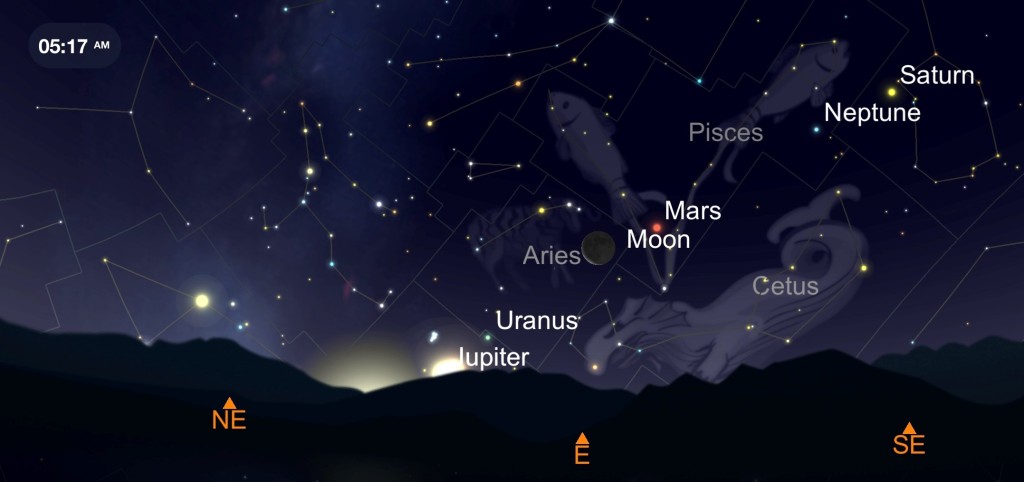
    Early in the morning of June 3rd these wanderers will come together for a relatively rare celestial alignment.  In the hour prior to the sun rise at 5:17AM, look to the East to see up to 6 planets followed closely by the Sun.  Starting to the Southeast, Saturn will shine brightly.  As you move down to the East you will pass Neptune under the belly of Pisces, Mars glowing red near the crescent moon, followed by Uranus then Jupiter peeking over the horizon.  Venus may be visible in the best observing situations, however Mercury will certainly be obscured by the rising Sun.