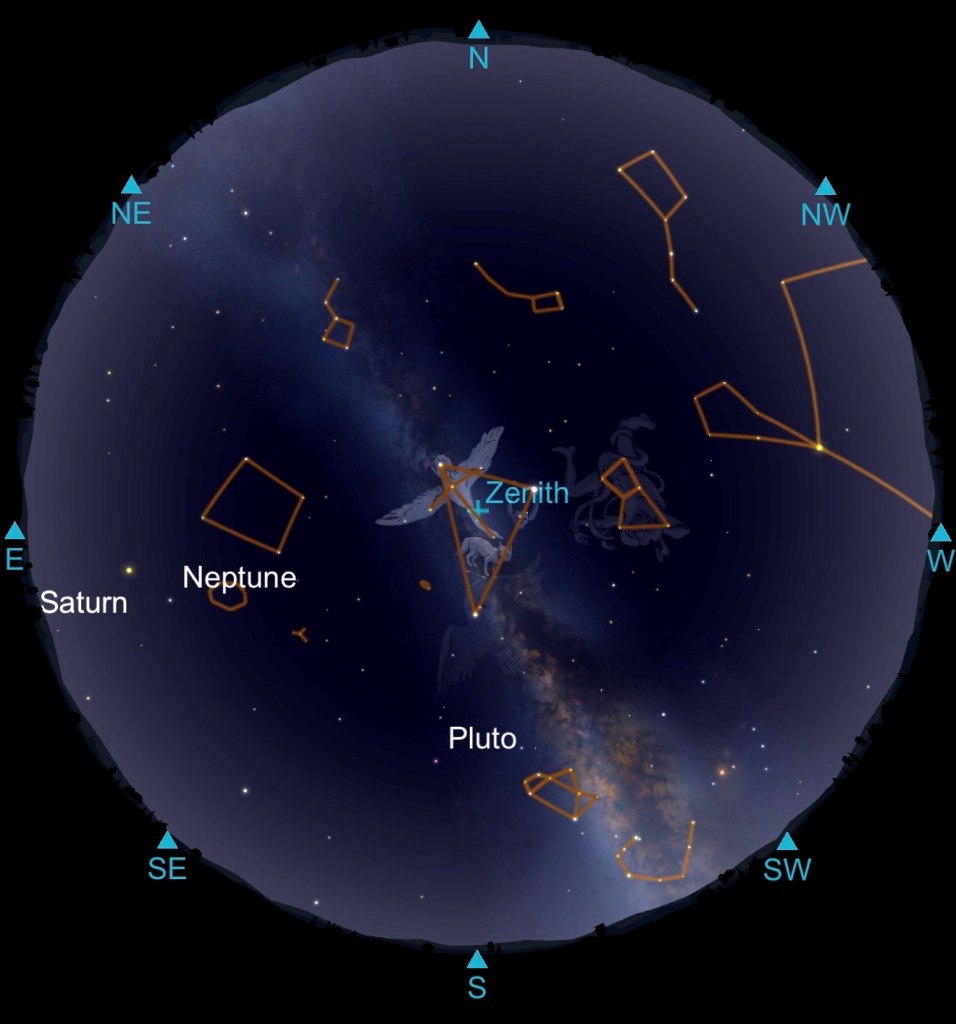
How many can you find?
October 10 brings us a New Moon, giving us one of the darkest evenings of the month. In central Yavapai County, sunset will be around 6:00 PM. Get outside shortly afterward, turn off the porch lights, and give your eyes time to adjust. Over the next few hours, more and more of the night sky will reveal itself.
A comfortable chair will make the evening more enjoyable, and a pair of binoculars or a small telescope will open up even more to see. A good free sky app, such as SkySafari, can also make finding some of these objects much easier.
☐ The Summer Triangle
As twilight fades, look overhead for three bright stars forming a huge triangle: Vega, Deneb and Altair. That’s the Summer Triangle. Despite its name, it remains easy to spot in October and makes a great first landmark.
☐ The Great Square of Pegasus
Look toward the east for four bright stars forming a large square. The Great Square of Pegasus is another easy pattern to recognize once the sky gets dark. Learn these big, simple shapes and the night sky starts to feel a lot less intimidating.
☐ The Teapot of Sagittarius
Now look toward the southwest for the Teapot. It really does look like one, with a handle on one side and a spout on the other.
The Teapot, Summer Triangle, and Great Square of Pegasus are asterisms, recognizable patterns of stars that aren’t an official constellation by themselves. Asterisms are useful because they give us landmarks in the sky. Once you learn a few, you can use them to find other objects with your eyes, binoculars or a telescope.
☐ The Milky Way
Look toward the Teapot’s spout and you’ll find the Milky Way stretching across the sky. That hazy band isn’t a cloud. You’re looking through the disk of our own galaxy, seeing the combined light of countless stars.
The Teapot points toward the crowded center of the Milky Way, which is why this part of the sky can be so spectacular under a dark sky. Follow that river of starlight across the sky and you’ll eventually encounter another familiar pattern.
☐ The Big Dipper
The Big Dipper is one of the easiest asterisms to recognize. On this October evening, it will be in the northern sky, looking almost as if it is swinging toward the Milky Way, ready to scoop some of it back up.
☐ The Andromeda Galaxy
Now that its getting a little darker, go back to the Great Square of Pegasus. Find the star at its northeastern corner, then follow the line of stars extending northeast from it. These stars lead you into Andromeda. Under a dark sky, look just beyond them for a faint, elongated smudge of light.
That’s the Andromeda Galaxy, our nearest large galactic neighbor, about 2.5 million light-years away. If you can see it with your naked eyes, you’re looking at an entire galaxy without a telescope.
☐ Saturn
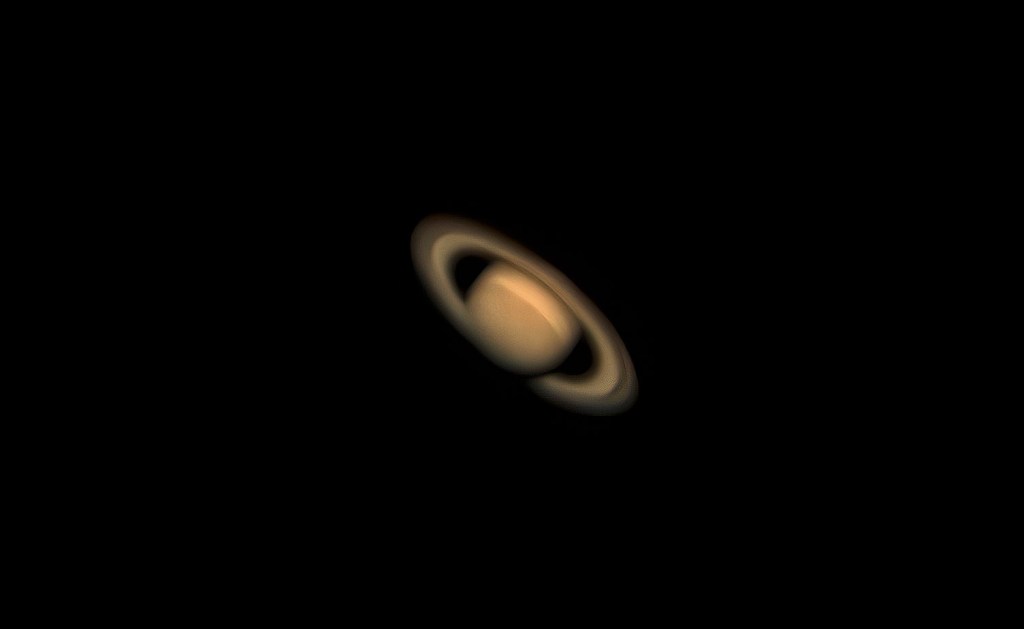
Now look toward the southeast for Saturn. It will be one of the brightest objects in the sky tonight. Saturn is at opposition this month, when Earth passes between it and the Sun, making Saturn especially bright and well placed for observing.
With binoculars or a small telescope, you can clearly see Saturn’s rings.
☐ Titan
Have a 4-inch or larger telescope? Take the challenge a step further and see if you can spot Titan, Saturn’s largest moon. Look for a tiny point of light near Saturn and its rings. Titan is constantly moving around Saturn, so its position will change as it orbits the planet.
☐ Neptune
Did you find Titan? Are you up for an even fainter object? Let’s see if you can spot Neptune!
Neptune is much fainter than Saturn, but on this night it will be only about 10 degrees away (about the width of your closed fist held at arm’s length), making Saturn a useful starting point for finding it. Through a telescope, Neptune appears as a tiny blue-green disk. The color is subtle, but if you can make it out, you’ve found a world nearly 2.7 billion miles from Earth.
☐ The Pleiades
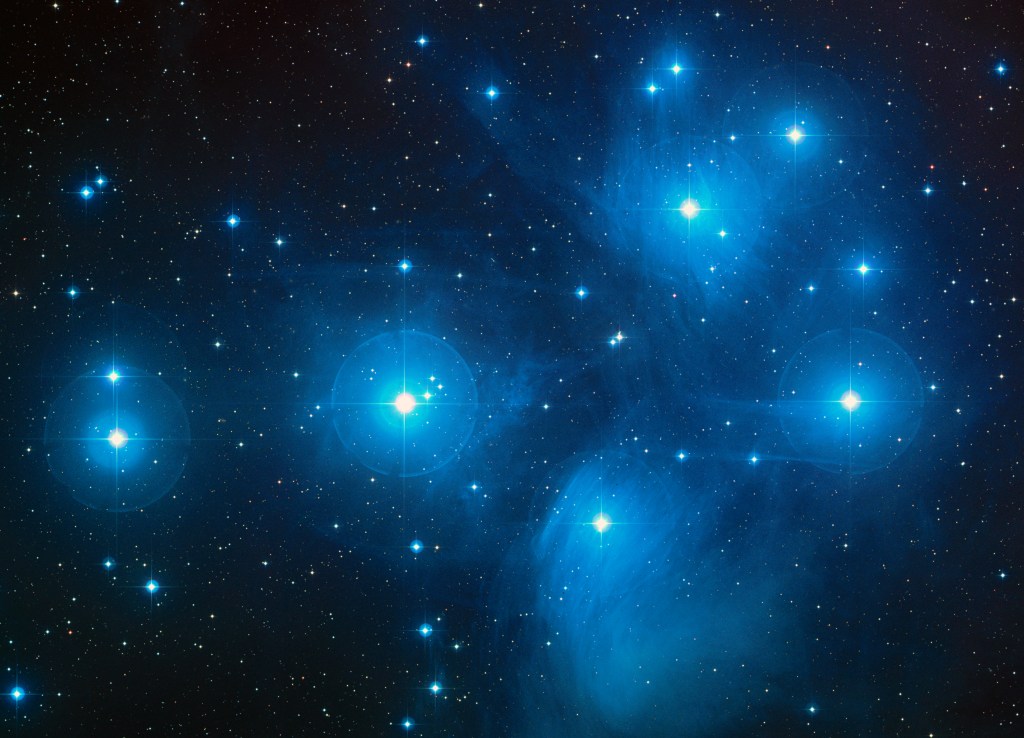
By around 10 PM, turn your attention toward the east and look for the Pleiades. To the naked eye, this young star cluster looks like a tiny handful of stars. Through binoculars, the view changes completely, revealing many more stars packed together.
How many did you find?
You don’t need an expensive telescope or an astronomy degree to explore the night sky. Start with the patterns you can recognize, use them as landmarks, and let your eyes do the rest.
Clear skies and happy viewing.
10 October 2026 night sky – Courtesy SkySafari.
Saturn – Courtesy PAC member Joel Cohen, Prescott Valley, 09/2020.
The Pleiades – Courtesy NASA, Wikimedia Commons.
Adam England is the owner of a local financial services firm and moonlights as an amateur astronomer, writer, and interplanetary conquest consultant. Follow him on Instagram @TheBackyardAstronomerAZ and at http://www.ManzanitaInsuranceAndAccounting.com

