Category: Astronomy History & Science

  • NASA DART Mission – Armageddon Version 2.0

    When Billy Bob Thorton’s character approaches Bruce Willis, Ben Affleck and Steve Buscemi to save the world from impending doom in 1998’s blockbuster film “Armageddon” they only had 18 days to prevent an asteroid the size of Texas from annihilating life on Earth. In the years since, real NASA scientists have spent countless hours observing NEO’s – Near Earth Object’s – and painstakingly tracking their past and future orbits to find which will be the next major asteroid to cross path’s with Earth. And while we are yet to find one that with certainty will be the next major Chelyabinsk or Tunguska Event, that hasn’t stopped researchers from thinking about ways to prevent such a collision from happening.

    Since 2018, a joint planetary defense operation between NASA, Johns Hopkins Applied Physics Laboratory, and the space agencies of Europe, Italy, and Japan have come together to design the DART Mission. The “Double Asteroid Redirection Test” is scheduled to launch from Vandenburg Air Force Base in California at 11:20 PM MST Tuesday 23 November aboard a SpaceX Falcon 9 rocket for its one-way trip to the binary asteroid Didymos. While Didymos is not a threat to Earth, it was chosen as the perfect testing ground for a potential new technology that could be used for future asteroid redirect missions.

    On 2 October 2022 the DART spacecraft will collide with the smaller of the two asteroids in the Didymos binary system. Unlike most spacecraft full of scientific experiments, the primary craft is essentially a 500kg (1,100 lb) inert mass with little more than a guidance system and antenna powered by a small solar array. A few days prior to impact a small CubeSat designed by the Italian Space Agency will seaparte form the main spacecraft and trail behind to image the impact and relay both narrow and wide field images back to Earth.

    The plan is such that the impact will have a very small effect on the asteroid at the moment of collision, just a half a millimeter per second. That is enough change however that as Didymos continues its trek around the sun, Earth based telescope will be able to see how its orbit changes. This information will help us plan future missions to move asteroids of varying sizes out of orbits that may be deemed hazardous to Earth or other potential risks. A follow up mission is scheduled to revisit Didymos 5 years after the impactor to study its geology and the longer term affects of the initial mission.

    Here’s to hoping it works and we don’t have to sacrifice Ben Affleck again.
  • Miss Mitchell’s Comet

    What’s Up? by Adam England

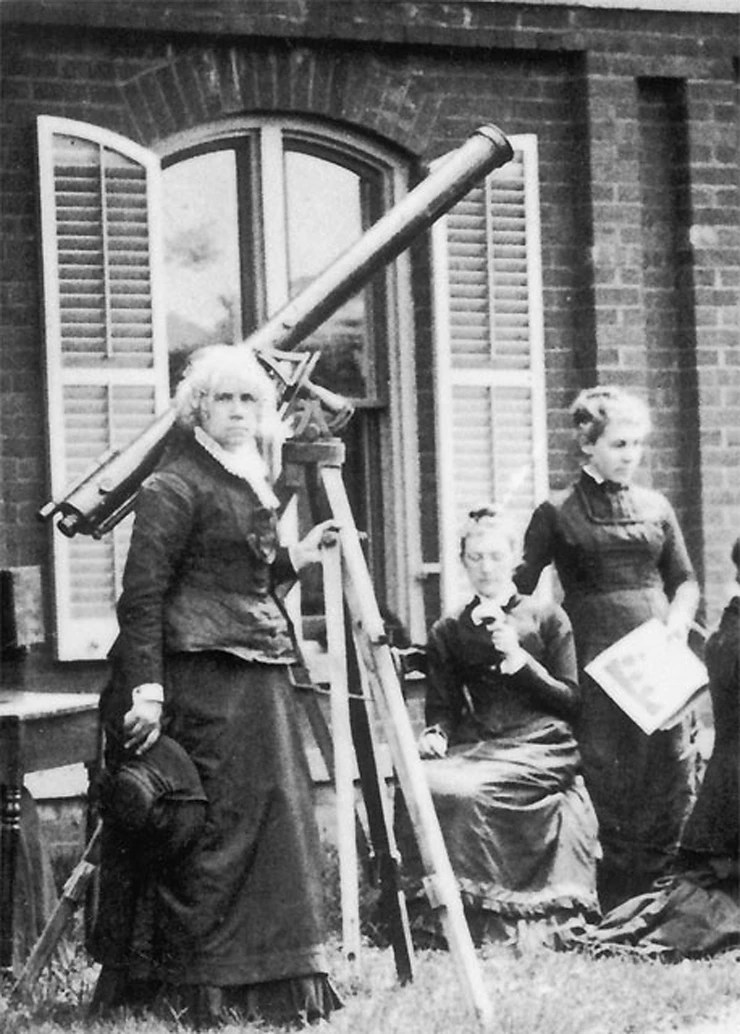
    Born August 1, 1818 to a Quaker family in the island town of Nantucket, Massachusetts, Maria Mitchell was the third of ten children raised by a schoolteacher father and librarian mother.

    The culture of fishing and whaling was such that the women were often left alone for months and raised to be just as educated as the men, something quite rare for the time. Her mother’s profession afforded her a nearly limitless supply of reading material, and her father took every opportunity to teach his children the science of astronomy. ​ By age 12 she was a teaching assistant to her father, and together they accurately calculated the exact moment of the 1831 eclipse. Before age 20 she opened her own school, allowing nonwhite children to learn side-by-side with their peers.

    On the night of October 1, 1847, at exactly 10:50pm, she discovered a telescopic comet, invisible to the naked eye. After a brief dispute with an Italian astronomer, it was learned that Mitchell’s discovery came two days before the other astronomer’s reported finding, and she received the Cometary Prize Medal from Denmark’s King Frederick VI, inscribed with words from Virgil’s Georgics: Non Frustra Signorum Obitus Speculamur et Ortus (“not in vain do we watch the setting and the rising of the stars”). The discovery of “Miss Mitchell’s Comet” made her only the third woman to win credit for a cometary discovery.

    She became a superstar back home in Nantucket, rubbing elbows with Ralph Waldo Emerson, Herman Melville, Frederick Douglass and Sojourner Truth. The US government took notice, and she took a position tracking the movements of the planets to aid in navigation.

    Still never having attended formal college herself, she was appointed professor of astronomy at Vassar College in 1865, a post she held for over 20 years. This made her the first woman to work as both a professional astronomer and a professor of astronomy.

    She began recording sunspots in 1868, and in 1873 began photographing them daily with her students, developing many theories about the sun, planets, nebulae and double stars that still hold today. Despite this, she was paid less than much younger male professors, so she fought for equal pay, and got it.

    She retired in 1888, a year before she died of brain disease at age 70.

    You may not get to see Miss Mitchell’s Comet in your lifetime, but if you ever find yourself on New York’s Metro North commuter line, you just might get to ride the train named the Maria Mitchell Comet.

    To learn more about the sky, telescopes, orsocialize with other amateur astronomers, visit us at prescottastronomyclub.org or Facebook @PrescottAstronomyClub to find the next star party, Star Talk, or event.

    ​Adam England is a local insurance broker who moonlights as an amateur astronomer, writer, and interplanetary conquest consultant. Follow his rants and exploits on Twitter @AZSalesman or at Facebook.com/AdamEfromAZ.