
By Adam England, The Backyard Astronomer
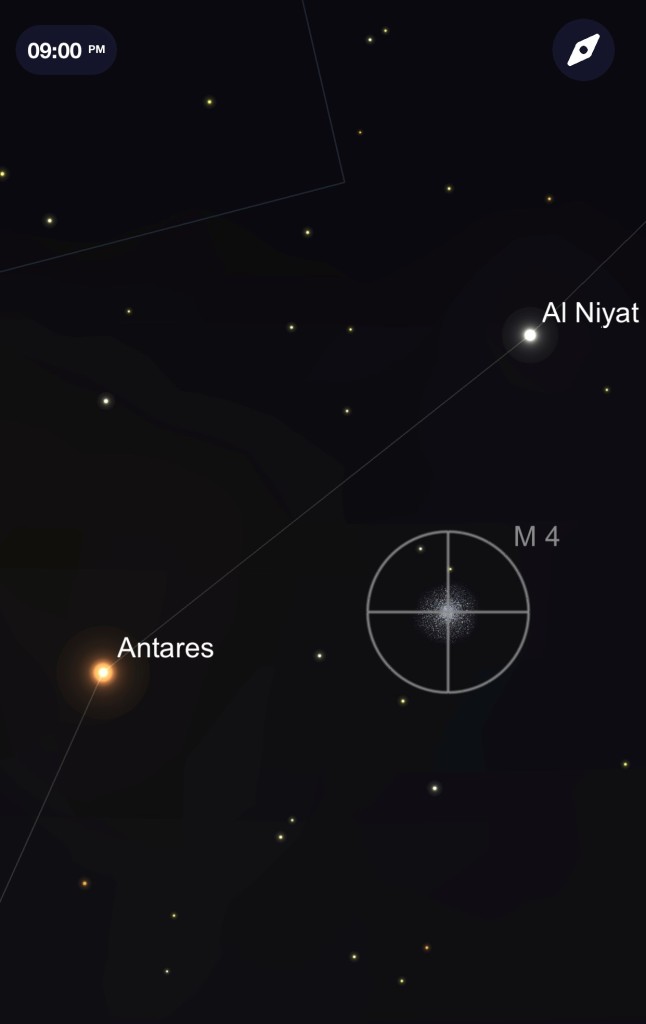
One of my personal favorite constellations is Scorpius. It is very easy to identify in the summer months when it rises in the Southeast and sways above the Bradshaw Mountains like the traditional scorpion promenade à deux pairing dance. The red supergiant Antares defines the head of the Scorpion and is often confused with Mars for its brightness and somewhat ochre coloration. Just one degree westward of Antares is the globular cluster Messier 4 (M4), the first cluster to have individual stars resolved by astronomers in the mid 1700s. Today, Backyard astronomers can easily locate this cluster with a decent pair of binoculars or a small telescope.
While the head of the scorpion is dominated by Antares and the five stars making up its head and claws, the tail of the scorpion rises above the mountain tops a litter later in the evening and is defined by its large hook at the tip. The Hawaiian culture saw these stars as the fishhook of the demigod Maui, calling it Ka Makau Nui o Māui or “The Big Fishhook of Maui”.

Here in Northern Arizona, we certainly have scorpions and will use a fishhook for landing a trout, however the Navajo culture some something different in these stars. The last four stars in the tail are strikingly similar to the tracks left by a running rabbit, and as such, was known as Gah Haat’e’ii – Rabbit Tracks. It was the return of the rabbit tracks each year that signified to Navajo hunters that hunting season was over. During the time this constellation is visible in the night sky is when deer, elk, and other large game have given birth to your young, and these newborns are still reliant on their mothers for sustenance. When Rabbit Tracks move to the East and is no longer upright in the sky, the young are then old enough to care for themselves, and the hunting season returns.

Due to its placement along the main swath of the Milky Way, Scorpius contains many other deep sky objects, including double stars, nebulae, and both open and globular clusters. Enjoy the beautiful summer nights of Northern Arizona and get your telescope out to look at this amazing patch of sky.
 The Backyard Astronomer