

The Red Planet shines bright this month, transiting between the horns of Taurus, the bull, and up towards Gemini, the twins, at just over one AU from Earth. One Astronomical Unit is the average distance from the Earth to the Sun, or about 93 million miles/150 million kilometers.
The horns of Taurus are peaked by the bright stars Zeta Tauri and Elnath. At apparent magnitudes 3.0 and 1.67, respectively, they should be quite easy to find by looking to the Southwestern sky after sunset. Zeta Tauri is a binary star system, with the brighter Zeta Tauri A 11 times more massive than our sun, and separated from its partner Zeta Tauri B by only 1.17 AU. Being nearly as close to each other as we are to the Sun or Mars right now, we cannot see them as separate objects with backyard telescopes, though scientists have been able to measure the Doppler shift – or change in the frequency of their light spectrum – calculating an orbital period of just 133 days.
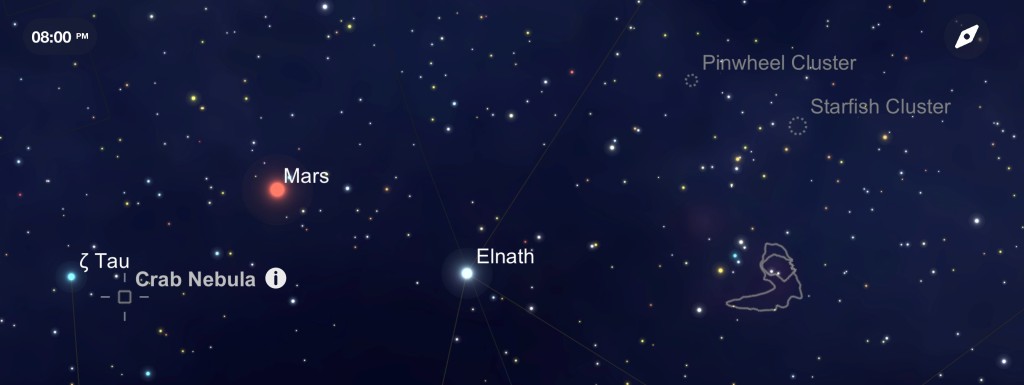
About 1 degree west of Zeta Tauri is the popular Crab Nebula. You can approximate 1 degree in the sky by the width of your finger at arm’s length. The Crab Nebula bears the designation M1 or Messier 1, as it was the first object recorded by Charles Messier in 1758 during his attempts to locate the predicted return of a comet, as previously calculated by its modern namesake, Edmund Halley. This same nebula was independently discovered by multiple astronomers over the 18th century, and has since become one of the most studied and beloved objects in the night sky. Modern observations by the Hubble Space Telescope, Chandra X Ray Observatory, and the Spitzer Infrared Telescope have continued to provide extraordinary detail into this magnitude 8.4 remnant of an ancient supernova which was recorded by Chinese astronomers in 1054.
Defining the bull’s other horn, Elnath come from the Arabic meaning “the butting one”. Relatively close at 130 ly distant, this giant star is 5 times the mass of our Sun, while putting out approximately 700 times more light.

While the Pleiades is the most familiar open cluster in the constellation Taurus, it is host to many other star clusters and nebulae. The Hyades cluster is nearer the bright star Aldebaran in the face of the bull, with approximately 100 total stars filling a spherical void in space with the same age and chemical composition.
Moving counterclockwise from the West around Elnath, backyard astronomers can find the Flaming Star Nebula (magnitude 6.0), Messier 38 or the Starfish Cluster (magnitude 7.4), and Messier 36 or the Pinwheel Cluster (magnitude 6.3).
 The Backyard Astronomer