
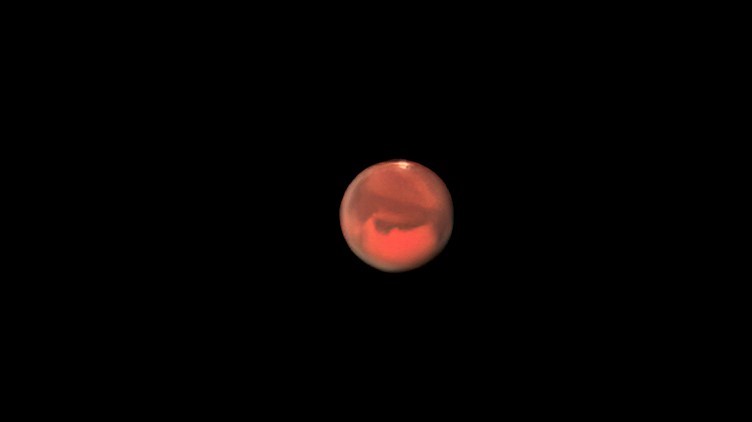
Humans have likely always looked at the sky and wondered if we are alone in the universe. From the classical Roman god messenger Mercury to the angelic hosts of the Abrahamic religions, ancient belief systems often referred to Gods and other visitors as omnipotent beings capable of traversing Heaven and Earth. As technology improved and enhanced humanity’s understanding of the universe, the habitability of neighboring planets became a legitimate scientific endeavor. Natural geographic features of Mars were (incorrectly) interpreted as intentionally engineered, and the idea of intelligent Martians and Vesuvians populated the themes of science fiction. Our fleet of robotic investigators throughout the Solar System can now confirm that no advanced species constructed canals on Mars, and that intelligent life – as we know it – could not survive on these inhospitable worlds. This insight has led us to look deeper into the history of our own planet to discover what the origins of life may be.

Taking it back a few hundred million years, the “Cambrian explosion” was a time in Earth’s history when life grew from single celled organisms to multi-cellular, complex life. Fossil records show this began in the oceans, with large populations of phytoplankton gobbling up the abundant carbon and using sunlight as energy to convert up to half of the oxygen in our atmosphere. One byproduct of this process is the compound Dimethyl Sulfide, which is only known to be naturally produced through this process.
Astrobiologists use many different factors in the search for extraterrestrial life. Earth-like conditions for habitability have led us to define the Goldilocks Zone where a planet may orbit its host star in a way that it would neither be too hot nor too cold, but “just right” for liquid water to exist. A breathable atmosphere like ours would optimally be composed of about 3:1 nitrogen to oxygen, with trace amounts of other elements and compounds such as carbon dioxide, methane, and – you guessed it – dimethyl sulfide.
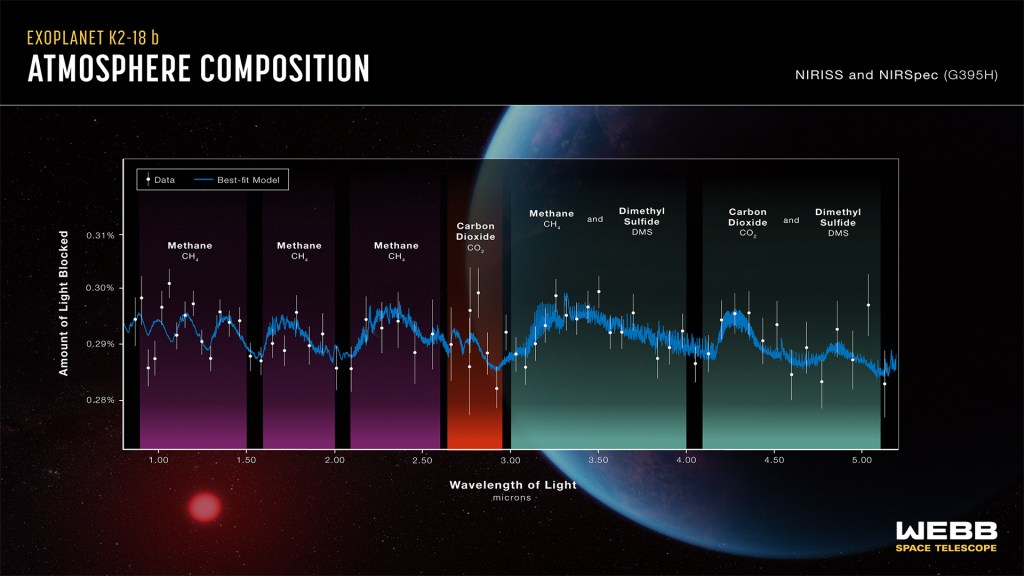
The James Webb Space Telescope was constructed with extremely sensitive instruments that can measure the atmosphere of distant worlds by studying the light that has passed through it. At 124 light years distant in the constellation Leo, the exoplanet K2-18b just happens to be in this Goldilocks Zone around a red dwarf star and about 8 times the mass of Earth. Following up on observations made by the Kepler and Hubble telescopes, JWST data indicates the atmosphere is likely made up of hydrogen, carbons, methane, and dimethyl sulfide. If this is the case, it is possible that a form of early photosynthesis is active in the oceans of this alien world.

As the constellation Leo moves to the southwest throughout the Spring, the planet Mars will enter the constellation later in the month of May. While observing the Martian “canals” from your own backyard, your field of view may well include distant worlds teeming with the earliest forms of microbial life.
 The Backyard Astronomer