
In space, everything is in motion. From a spacecraft orbiting the Earth, to moons dancing around planets, or star systems on an epic voyage across our galaxy, nothing ever truly “stops” moving. We find patterns in these movements, such as the ecliptic, or great highway on which the Sun moves across the sky, and the planets take turns traversing our nights. From these patterns, astronomers can work forwards to predict when the next eclipse will occur, or work backwards to understand how our solar system formed. However, we often find objects that move in odd ways, such as a comet that orbits opposite of the standard movement of planets and most asteroids, known as a retrograde orbit. These objects are indicative of something strange that is either happening or previously happened in the distant reaches of our Sun’s sphere of influence.

The Oort Cloud is a vast sphere of cold, dark objects that are loosely held in a shell by the Sun’s gravity. Stretching from about 2,000 to 200,000 AU – an AU or Astronomical Unit being the average distance of the Earth to Sun, or about 93 million miles – the Oort Cloud is where most of our long period comets come from, taking hundreds or even thousands of years to complete an orbit. This is far past the orbits of Neptune and Pluto, and this distant region is where science fiction and science fact have attempted to explain strange orbits with concepts like a Planet X. Recently, AI models have suggested that in the past billion or so years, it’s likely that a wandering star careened through the outer edges of our solar system, leaving gravitational chaos in its wake. The lasting effects of such a close stellar encounter could explain the movements of many objects in the other solar system, including retrograde comets.
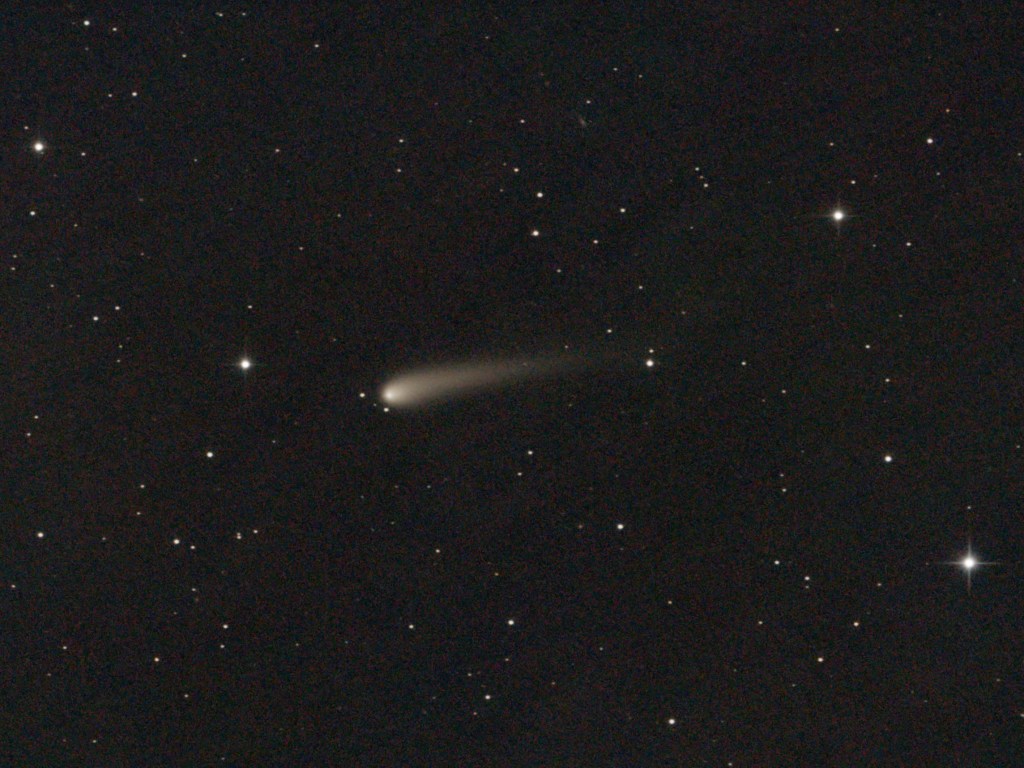
One such comet was discovered in early 2023 by multiple observatories around the world, designated C/2023 A3 (Tsuchinshan–ATLAS). This comet has a retrograde orbit, and by tracking its movements towards the inner solar system, it has been suggested that its orbital period may be millions of years, having come from the furthest reaches of the Oort Cloud, and likely sent on its current path by the gravitational push and pull of one such passing star. Likewise, its outbound trajectory appears such that it may be ejected from our solar system after its swing around the Sun, destined to traverse the cold depths of the Milky Way Galaxy for millions or billions of years.

Mid to late October will offer backyard astronomers throughout the Northern Hemisphere great opportunities to see this once-in-a-lifetime comet. Though difficult to project, it is shaping up to be one of the brightest comets in decades, with current estimates that it could reach magnitude 0 brightness around mid-October. Around October 15th, look to the Southwest just after sunset. Venus will be low on the horizon, with the red star Antares to its left, and comet C/2023 A3 just above and to the right. You should be able to see the comet naked eye, but even a good pair of binoculars or small telescope should give you a great view of the tail stretching across the constellation Serpens and pointing directly away from the point where the Sun just set. It will begin to dim over the coming weeks as it moves higher in the sky and away from the Sun, as it continues back to the dim and frigid fringes of our solar system.
 The Backyard Astronomer