
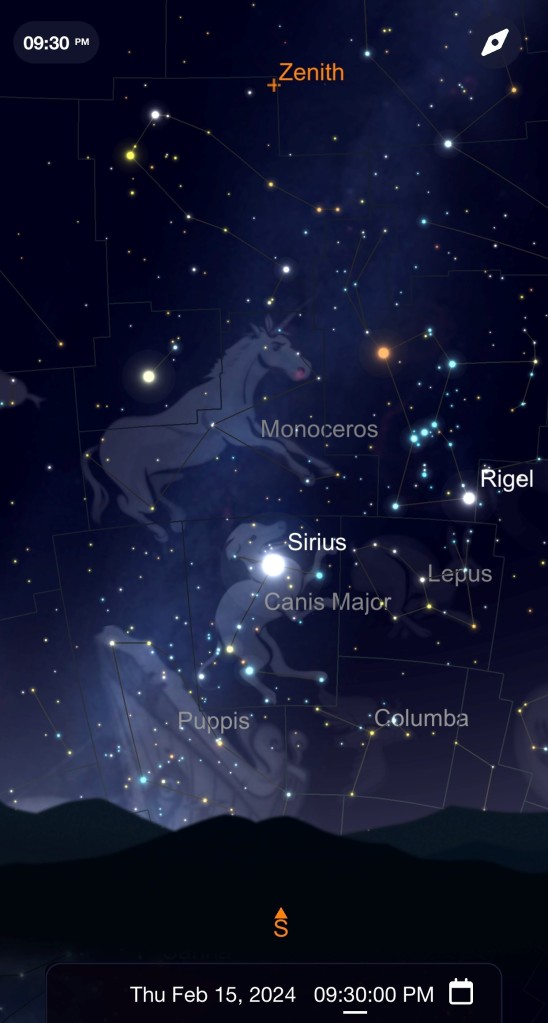
A lesser-known and relatively modern constellation occupies the void between Orion, Canis Major, Hydra and Gemini, though the stars are difficult to see with the naked eye due to modern light pollution. Monoceros – mono meaning “one” and ceros meaning “horn” – the Unicorn is a simple 7-point constellation, though only two of the stars are usually discernible without the aid of binoculars or a telescope. Coined by Dutch cartographer Petrus Plancius in the 17th century, Monoceros contains many intriguing objects for the amateur observer.
The nose of the unicorn is quite easy to locate. Start with the bright orange shoulder of Orion, the easily identifiable star Betelgeuse and the dimmer blue star Meissa that marks the Hunter’s head. Draw a line from Meissa to Betelgeuse, continuing nearly that same distance again to the Southeast of Betelgeuse to find the binary system ε Monocerotis, denoting the nose of the unicorn. Just a slight look continuing to the east will place the Rosette Nebula in your view.
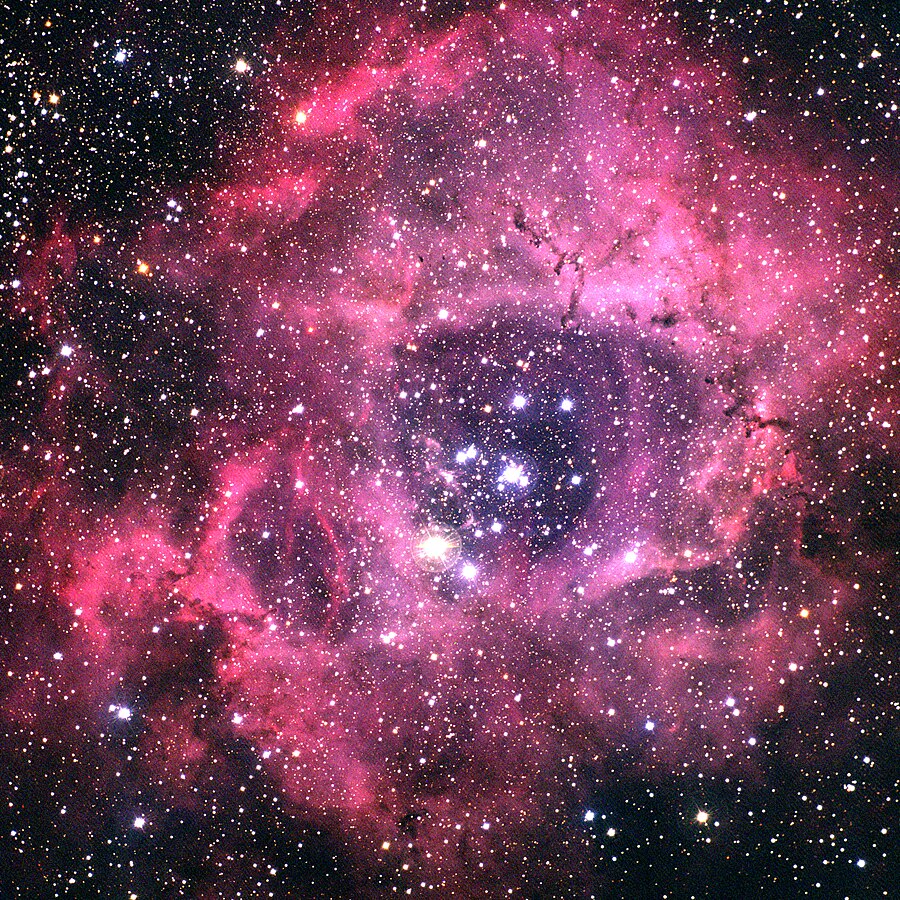
About 5,200 lightyears distant, the Rosette Nebula takes its name from the stylized floral design, often seen as a textile rose awarded for competitions. English astronomer John Flamsteed first noted the nebula in 1690, noting its circular shape and dark center, reminiscent of a rose. Approximately 130 lightyears across, this emission nebula is a star nursery, estimated at a mass of more than 10,000 solar masses, or the equivalent of 10,000 of our suns. The intense radiation of the juvenile stars in this densely packed space excites the molecules in the clouds of gas and dust around them, off putting more and more radiation in a chain of events that continuously sends ever increasing quantities of ultraviolet and x-ray radiation in all directions. For us, this equates to a beautiful nebula, perfect for our viewing pleasure. At apparent magnitude of 9.0, even small telescopes can resolve this stellar breeding ground.
Enjoy the Rosette Nebula, Monoceros, and the Orion constellation in the Southern sky in the early hours of the evening throughout the month of February. Wishing you clear skies!
 The Backyard Astronomer