
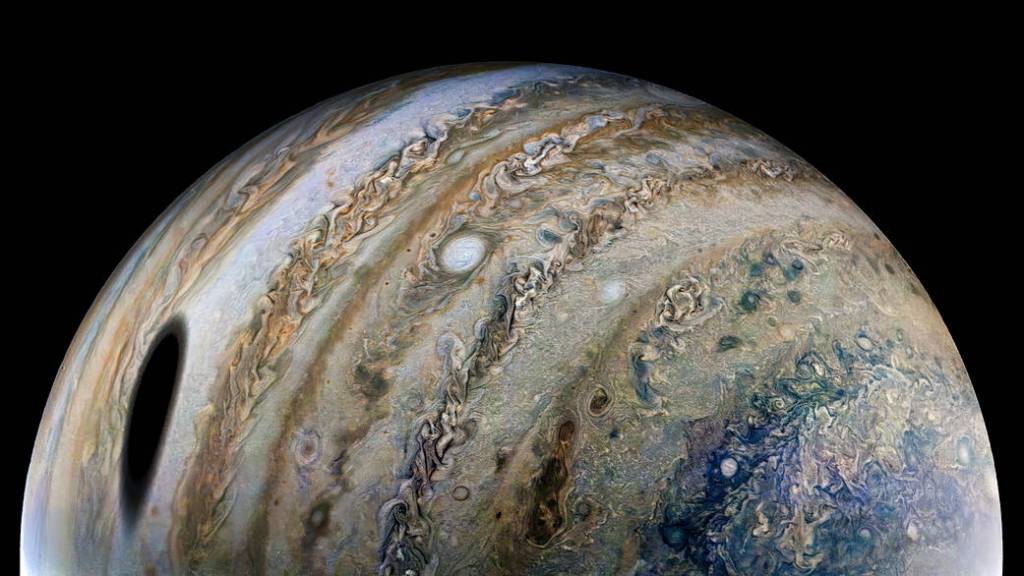
Two months in a row we are fortunate to have the largest of our Solar System’s Gas Giants put on a stunning display. While in August Saturn was at opposition, Jupiter will also be at its nearest and brightest to Earth on the night of September 26th. Unlike the Saturnian opposition, however, when the Moon lit up the sky on August 14th at 93% fullness, on that Monday night in September, backyard astronomers the world over will appreciate the darkness afforded by a New Moon.
Jupiter was the name given this planet by the ancient Romans in honor of their chief God. This naming pattern follows the Grecian title of Zeus, the Babylonian designation of Marduk, the Sanskrit honorific of Brihaspati, the Hebrew epithet of Tsedek, and Nordic mythology of Thor, from which we still refer to a particular day of the week as “Thor’s-day” (Thursday). Mùxīng as it is known in Chinese is so important in their mythology that the entirety of the zodiac revolves around the approximately 12-year cycle of Jupiter making a complete orbit of the Sun.

If one was able to take all of the “stuff” in the Solar System – excluding the Sun – and push it together into a giant ball, Jupiter would still be more than twice as large as everything else combined. Even the smallest of telescopes and binoculars can pick out the 4 Galilean moons orbiting the planet, though with larger scopes one can begin to resolve many more, with 79 known moons orbiting this giant. On clear nights, you may also start to notice colored bands across the surface of the planet. These are clouds of gas, like jet streams on Earth, with different currents moving in different directions and in colors ranging from white to orange and brown.

The Juno spacecraft arrived in Jovian orbit in 2016 and has been studying the planet in detail ever since. While your backyard observations will be in the visible light spectrum, Juno is able to study Jupiter’s gravitational field and magnetic field through microwave, infrared and ultraviolet astronomy. In addition, the new James Webb Space Telescope has already gazed at Jupiter in the infrared, allowing scientists to merge data across light spectrum to understand more of how this giant planet formed and continues to evolve as the defender of our inner solar system today.
 The Backyard Astronomer