
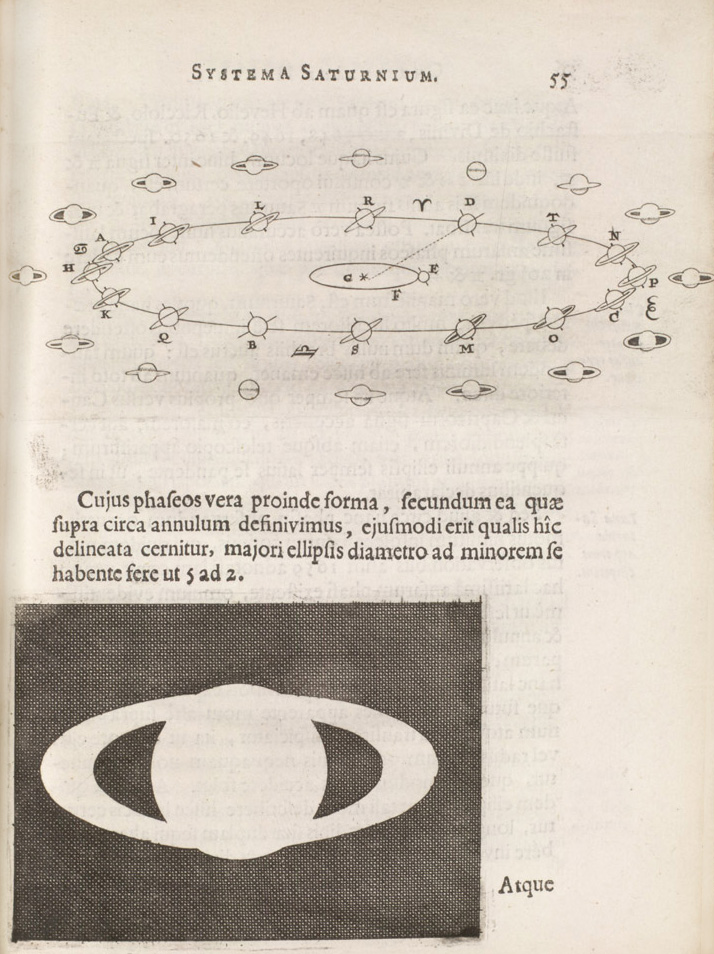
The planet Saturn has intrigued astronomers – both professional and amateur – since Galileo first sketched what he thought were two odd-shaped moons on either side of the planet. His final telescope at magnification 30x was still not quite able to resolve the rings that we love so much to gaze at. Dutch mathematician Christiaan Huygens explained the rings of Saturn by 1659 and identified its moon Titan with a slightly larger telescope at 43x magnification. Both major accomplishments for their time, we now benefit from even the most basic telescopes and binoculars able to show us the beautiful rings of Saturn and its moon Titan nearly any time of year.

Saturn is the second largest of our solar system’s gas giants behind Jupiter, with a volume 763 times that of Earth. Despite its massive size, the average density is less than that of water, and as such is only 95 times more massive than the Earth.
In August, the planets align to give the best view of the year of this exceptional viewing opportunity. Saturn reaches opposition on August 14th, meaning it is the closest to Earth, and also its brightest due to the Earthward facing side fully illuminated by the Sun. It will be one of the brightest objects in the sky this month, moving Westward along the ecliptic, the path that all planets take across the Southern sky. You can find it near the tail of the constellation Capricornus that night.

At opposition, Saturn will be approximately 816 million miles away, a distance that takes light 73 minutes to traverse. So, when you are gazing at the Ringed Planet, you are actually seeing light that left the Sun, travelled 1 hour 21 minutes to Saturn, and then back 1 hour 13 minutes to your eyepiece in Northern Arizona. Those same particles of light may have taken upwards of a million years to escape the 430,000 miles of the Sun’s dense plasma, but we will discuss that in more detail another day. If your telescope mirror is at least 2” or larger, you should also be able to see Titan off to the side, with the rings nearly making a line pointing to this moon that is larger than the planet Mercury. Titan’s dense methane atmosphere often makes it appear slightly orange.
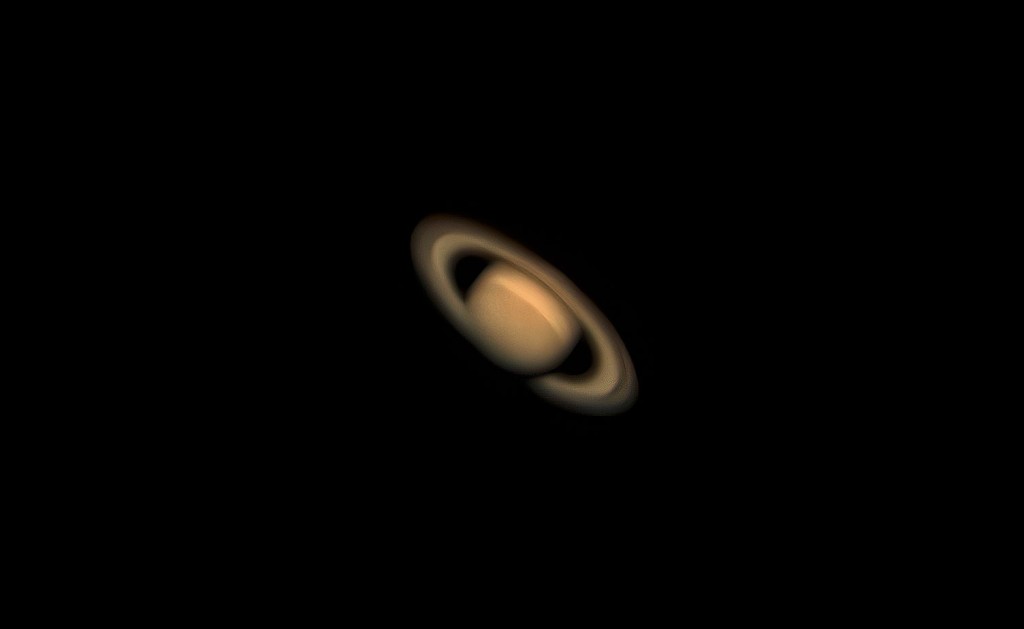
The new James Webb Space Telescope will be photographing the planets outward from the orbit of Mars over the next few months and years and is sure to amaze. In the meantime, if you are able to get a picture of Saturn through your telescope, share it with us on social media!
 The Backyard Astronomer