
The early solar system was a violent place. We know this courtesy of modern telescopes and models generated by today’s supercomputers, allowing us to peer at clouds of gas around distant stars, and observe their planets forming, and hypothesize how our solar system would have formed under similar conditions. Like the rings around Saturn, a young star usually forms in a cloud of tenuous gas, slowly pushing inward and becoming more and more dense, with the star at the center hosting the majority of the mass – and therefore gravity – and the outer rings coalescing into planets, moons, asteroids and comets. Over time, these objects run into each other, as we observed with objects hitting Jupiter over the past few decades, and large craters on the surface of Earth and elsewhere about the solar system preserved as monuments to these cataclysmic events.

It is believed the Sun absorbed enough material to initiate nuclear fusion around 4.6 billion years ago. Over the next 100 million years, the disk of gas around it formed all the planets we now know, as well as many others that are long since forgotten. Theia was one of these protoplanets, about the size of Mars, having formed much further out in the solar system with the comets, and containing much more water ice than the inner planets. Its orbit was erratic, or possibly disturbed by the passing of a wayward star, and after countless close encounters, Earth and Theia collided in what must have been an awesome event. The violent impact knocked Earth sideways, merged the heavy planetary cores into a much larger core and mantle, ejected debris for hundreds of thousands of miles into a new orbit around the Earth, and everything began a slow process of cooling to form continents and oceans, and even our moon.

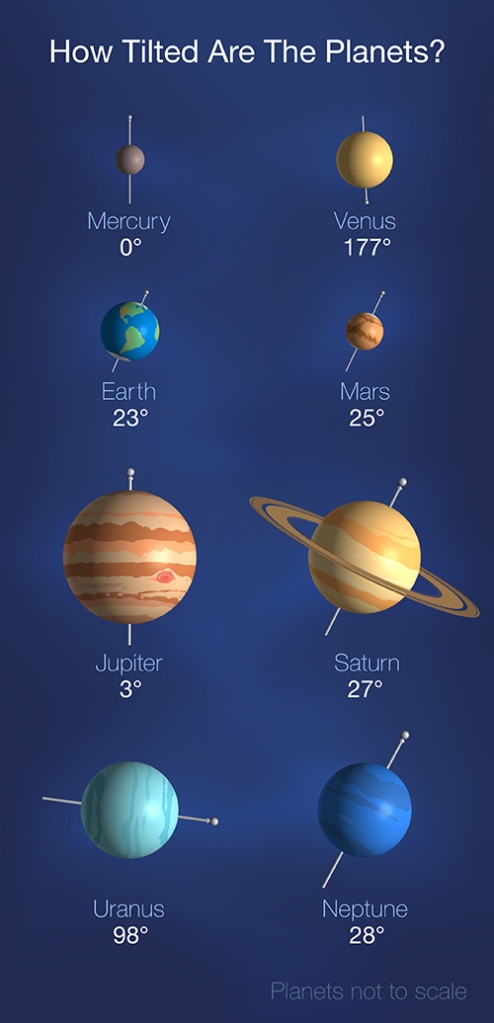
Many other bodies experienced this same type of event, as we can see the tilt and rotation of every planet in our solar system slightly different from the others. Jupiter being the largest was able to better withstand impacts than the smaller, rocky planets, and only has a tilt of 3°, while Venus was somehow knocked completely upside down to a 177° tilt and rotating in the opposite direction of the other planets. Uranus lies at a 98° tilt relative to the sun and essentially orbits on its side, while Earth, Mars, Saturn, and Neptune all have relatively stable seasons due to their axial tilt – Earth at 23.5°, Mars at 25°, Saturn at 27°, and Neptune at 30°.
The 23.5° tilt of Earth’s axis through the poles allows different parts of the Earth to lean toward or away from the Sun at different times of the year. As we orbit the Sun, the northern Hemisphere gets closer and more direct sunlight, culminating on June 21st this year, which we celebrate as the Summer Solstice. The sun will appear to stand still in the sky for three days as it reaches its northernmost view of Earth, and then will begin to move southward again for the next 6 months. This change in the seasons affects all of Earth’s weather patterns and the evolutionary habits of plants and animals alike.
And it’s all thanks to Theia.
 The Backyard Astronomer