
We live on Earth, which orbits the sun every 365.256 days as part of our Solar System. Our Solar system is one of hundreds of millions of stars and similar systems that orbits the center of our Milky Way galaxy about every 225 million years. We are familiar with the cloudy or “milky” swath above our heads that is visible on moonless nights throughout much of the year. With advancements in radio astronomy in recent decades, we have been able to peer deeper into the sky and analyze the structure of our galaxy to learn we are on the outskirts of an arm in a giant spiral galaxy, held together by the gravitational pull of dark matter and a massive black hole in the center which we call Sagittarius A* – pronounced “Sagittarius A Star”.
For hundreds of years, we had to guess what the structure of our galaxy was, as we are inside of it and cannot see it from an outside perspective. Our best approximation came from looking at our neighboring galaxies, some of which are visible to the naked eye. Our nearest partner in space is the Andromeda galaxy. Although it hangs out about 2.5 million light years distant, it is large enough and bright enough to have been documented over a thousand years ago – long before the advent of the telescope. In the tenth century Persian astronomer Abd al-Rahman al-Sufi described Andromeda as a “nebulous smear”, with later astronomers using rudimentary telescopes to define the blurry spot in the sky as an “island universe”. With a diameter more than 6 times that of the full moon, Andromeda is one of the largest objects that astronomers can see with either the naked eye or simple ground-based equipment, and many astronomers have spent their lives dedicated to researching it. However, it was not until Edwin Hubble studied Andromeda in 1925 that we truly understood it was a separate galaxy at such as distance from our own. This realization expanded our understanding of the universe from essentially believing in one galaxy to now knowing there are upwards of two trillion separate galaxies in the observable universe.
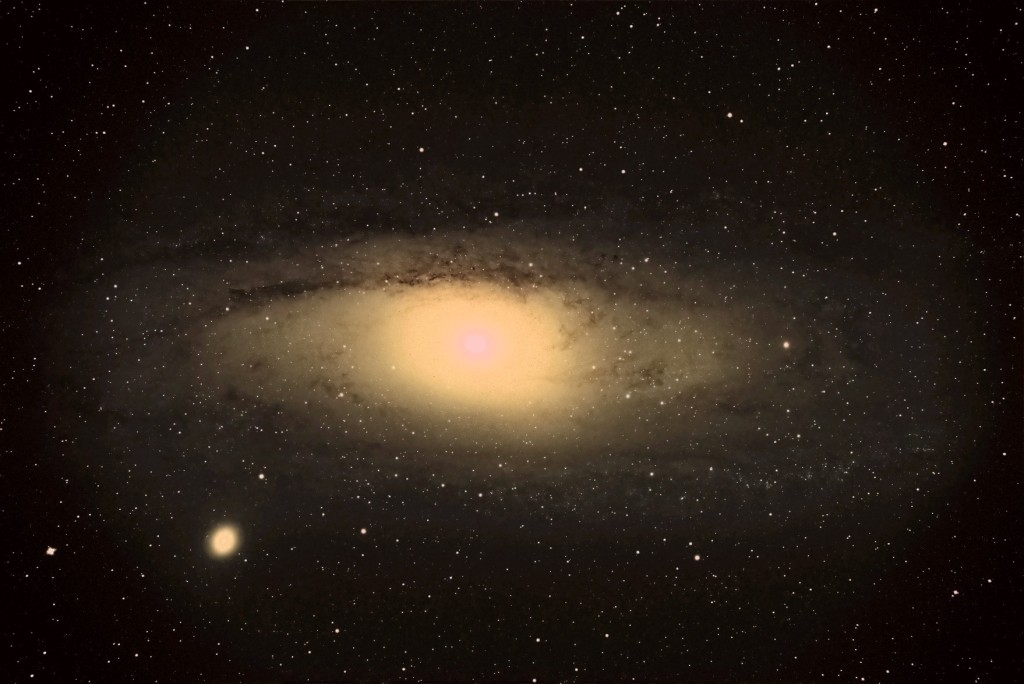
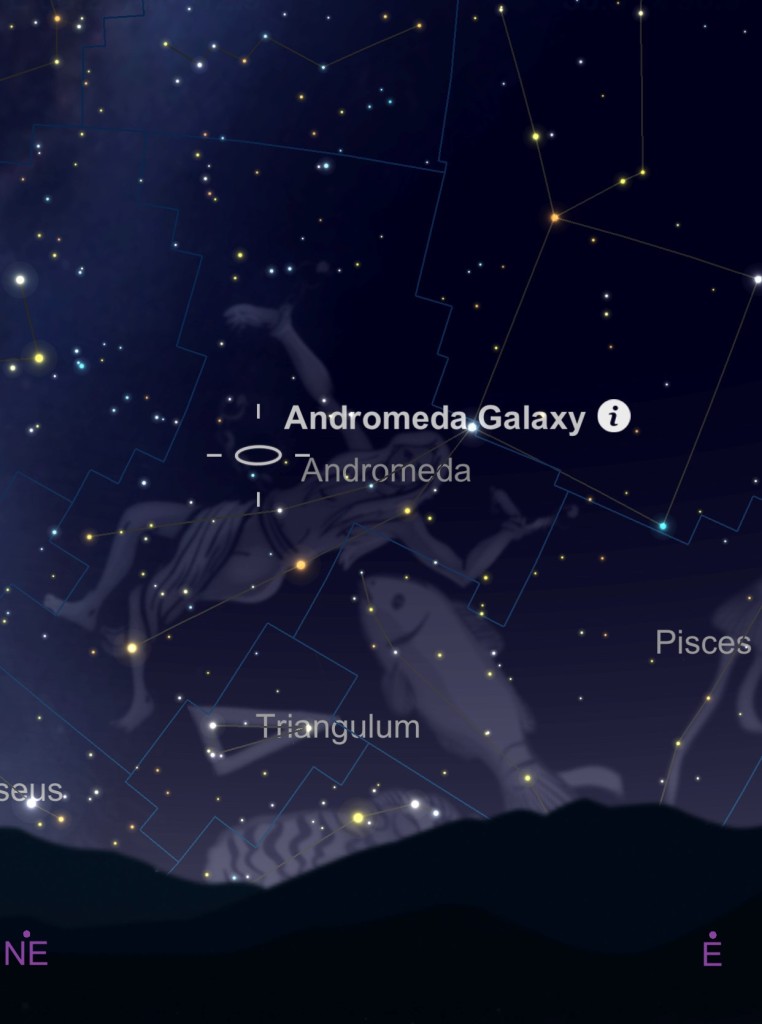
October is arguably the best month to view Andromeda in the evening sky, reaching the zenith (directly above you) around midnight. October 6th is the new moon, and about an hour after sunset that evening Andromeda will be approximately 30° above the Northeast horizon. You can find it by looking for the Great Square of Pegasus – an easily identifiable asterism – with the bright double star Alpheratz forming the northern corner. Two streams of stars seem to pour left from this point, and about 12° from Alpheratz (slightly more than the size of your fist held at arm’s length) and just above the top line of stars will have you looking at a cloudy patch of sky. Bust out the binoculars and you will see this is Andromeda, and then with the telescope you will begin to resolve the bright galactic center and swirls of stars around it. You will see Andromeda just slightly off from edge on, so it should look like a long oval getting brighter and denser towards the center.
 The Backyard Astronomer